search the site


Crew Welfare Week 2026: Strategic welfare is key to a resilient shipping industry
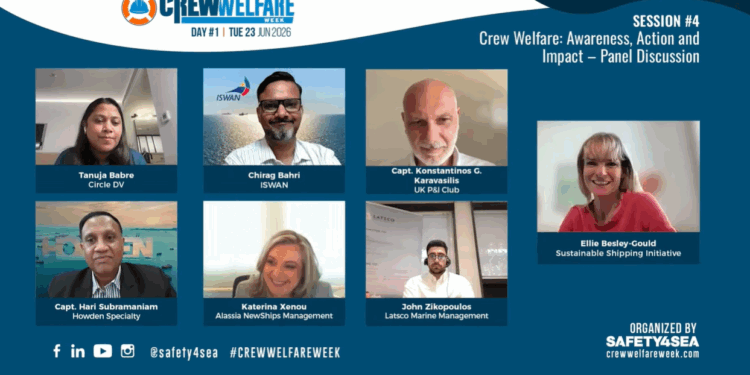
The maritime industry must move beyond reactive, tick-box approaches and embed crew welfare into commercial decisions, leadership practices and everyday life onboard, experts highlighted during a panel discussion at the 2026 Crew Welfare Week.
Moderated by Ellie Besley-Gordon, CEO of the Sustainable Shipping Initiative (SSI), the discussion explored how shipping can translate growing awareness of seafarer wellbeing into measurable action and long-term impact. Speakers agreed that Maritime Labour Convention (MLC) compliance should represent the minimum standard rather than the industry’s ultimate ambition.
The panel featured Tanuja Babre, Head of Swastha, Circle DV; Chirag Bahri, Operations Manager, ISWAN; Capt. Konstantinos G. Karavasilis, Regional Director, Loss Prevention, UK P&I Club; Capt. Hari Subramaniam, Chief Commercial Officer – Marine, Cargo & Logistics, Howden Specialty; Katerina Xenou, Crew Manager, Alassia NewShips Management Inc.; and John Zikopoulos, Senior Fleet Crew Operator, Latsco Marine Management Inc.
10 actions identified by the panel to strengthen crew welfare
#1 Go beyond compliance: MLC requirements should be treated as the minimum foundation, not the industry’s welfare target.
#2 Recognise commercial value: Better welfare can support retention, operational performance, safety and lower claims, making it a value driver rather than a cost centre.
#3 Bring welfare into the boardroom: Shared KPIs should allow charterers, insurers, financiers and operators to consider welfare performance within commercial decisions.
#4 Protect confidentiality: Seafarers must understand why data are collected and trust that personal information or reports of distress will not harm their employment.
#5 Avoid surveillance and added workload: Data collection, training and welfare documentation should not become another administrative burden onboard.
#6 Strengthen human-centred leadership: Masters should be equipped to lead as modern CEOs, supported by communication, empathy and other soft skills.
#7 Provide meaningful connectivity: Fast and reliable internet is essential for maintaining relationships with family, although online access should not replace social interaction onboard.
#8 Address fatigue and isolation: Compressed port calls, limited shore leave, long contracts and expanding requirements continue to affect wellbeing.
#9 Give seafarers a voice: Crews should be properly informed and involved, wherever possible, in decisions concerning voyages through geopolitical risk areas.
#10 Translate awareness into action: Policies must produce visible improvements in everyday seafarer life rather than remain campaigns, documents or tick-box exercises
Welfare is a professional requirement
Opening the discussion, the speakers agreed that crew welfare should not be reduced to individual initiatives, occasional campaigns or regulatory documentation. Instead, it should be understood as a fundamental condition for safe and effective work.
Zikopoulos described welfare as encompassing the mental and physical health required for seafarers to perform effectively, alongside safe working conditions, adequate rest, professional development and access to medical and psychological support.
Welfare is not always something that is governed by the existing regulations. This is something you have to do as a company that goes beyond,
…he said.
Babre similarly argued that wellbeing should be treated as a professional asset rather than a “good to have”.
“If I have good wellbeing, then I will be able to do my job well,” she explained, adding that psychological safety becomes possible when people experience respect, dignity and the freedom to be honest and vulnerable.
From an insurance perspective, Capt. Karavasilis linked welfare directly with safety. Seafarers who feel appreciated and supported are better placed to perform their duties safely, he said, while noting that conditions have improved considerably since his own time at sea.
However, progress remains incomplete. Xenou stressed that procedures and welfare manuals must translate into human relationships and daily practice.
It is not only about procedures and documentation; it is about human relationships,
…she said.
MLC compliance must be the floor
A central theme was the need to stop treating minimum compliance as an aspirational welfare standard.
Although the MLC has significantly improved living and working conditions at sea, Zikopoulos described it as “the bare minimum”. Meeting regulatory requirements does not automatically mean that those onboard are rested, supported or satisfied with their working environment.
This distinction becomes particularly important as fatigue, reduced manning, compressed port schedules and growing administrative requirements place increasing pressure on crews.
Although regulatory requirements are met, seafarers continue to be tired all the time,
…Zikopoulos warned.
The panel argued that welfare must also become visible within commercial decision-making. Operational efficiency, vessel performance and retention are all influenced by the condition and motivation of those onboard, yet welfare is still often viewed as a cost centre.
“The greatest opportunity lies in aligning commercial decision-making with welfare outcomes,” Zikopoulos said. “The industry should increasingly view welfare as a value driver.”
Xenou called for recognised and widely accepted welfare indicators that could become part of commercial discussions. Charterers should examine crew welfare performance when assessing vessels and operators, she suggested, bringing the issue into boardroom conversations where budgets and resources are determined.
“The market does not reward operators who invest beyond compliance,” she noted. “We have to set some KPIs and indicators that are well known and accepted in the industry, and these should be part of the commercial deal.”
Capt. Subramaniam highlighted that established vetting and management assessment systems are already helping certain chartering sectors benchmark operators. Better welfare performance can strengthen rankings and create a clearer commercial incentive for companies that may otherwise struggle to recognize its value.
Isolation and fatigue remain persistent
Despite improved technology and greater awareness, the panel identified fatigue, isolation, restricted shore leave and silence around mental health as continuing concerns.
Bahri reported that cases reaching ISWAN’s confidential helpline have become increasingly complex. Seafarers are seeking emotional and mental health support, while cases involving suicidal thoughts, bullying and harassment have also been reported, including incidents affecting women working in merchant shipping and yachting.
Babre highlighted the paradox created by modern communications. Seafarers may be more connected than ever, but this does not necessarily make them feel less alone.
You are more connected than you have ever been before, but we also hear individuals talk about feeling more isolated and lonelier than before,
…she said.
Knowing immediately what is happening at home can sometimes intensify feelings of exclusion, helplessness or sadness. The priority, therefore, is not connectivity alone but creating an environment in which people can discuss distress safely.
“Honesty requires safety,” Babre stressed.
Shore leave was also identified as an essential but increasingly difficult element of seafarer wellbeing. Xenou said crews continue to request opportunities to leave their vessels, but ship managers do not always have the authority or practical tools needed to facilitate this.
Capt. Karavasilis explained that faster cargo operations, remote terminals and lengthy contracts have transformed port calls. Operations that once kept a vessel alongside for several days may now be completed within hours, leaving little opportunity for those onboard to rest or visit the port.
The result is a combination of fatigue, isolation and prolonged disconnection from ordinary life ashore.
Better welfare can mean fewer claims
The discussion also examined whether crew welfare can be linked more directly with safety performance and insurance outcomes.
Capt. Karavasilis argued that when an experienced seafarer makes a seemingly basic error, investigations should look beyond competence and examine underlying conditions.
“Why did he make such a mistake? Is it fatigue? Is it that he is not feeling well?” he asked.
Claims data, he said, indicate that fleets with stronger welfare programmes can perform better when compared with similar vessels of equivalent age, class and operational profile. However, the industry does not yet consistently examine the deeper data needed to demonstrate these connections.
Capt. Subramaniam agreed that investigators need to move past broad references to the human element and analyse why people become distracted, make errors or lose focus despite extensive training.
He also questioned why expectations for seafarers should be lower than those applying to employees ashore. Recognition, supportive management and small gestures can influence how people experience their workplace, regardless of whether that workplace is an office or a ship.
Our seafarers are just human beings in a different environment. If we treat them as well as we would like to be treated in our workplace, it is a job done.
…he said.
Data collection must not become surveillance
While better data could help demonstrate the relationship between welfare, retention, performance and claims, the panel warned that its collection must be transparent and non-punitive.
Zikopoulos said companies should clearly explain why information is being gathered, how it will be used and how it will benefit the people providing it.
“The collection is not done to penalise the crew, but actually to help them,” he said.
At the same time, he cautioned against creating a “state of surveillance” in which seafarers are repeatedly asked to provide evidence, records and information about every aspect of onboard life.
Babre said seafarers must be confident that discussing fatigue, distress or emotional health will not damage their future employment, influence their next contract or alter how leaders treat them.
Bahri confirmed that many seafarers remain concerned that sensitive information could reach their employers. Confidential, independent and non-judgemental services are therefore essential for building trust and enabling people to seek help early.
The master as a modern CEO
Leadership onboard and ashore was repeatedly identified as a determining factor in welfare outcomes.
Xenou explained that company culture is carried from the office to the vessel. Although the master remains central, senior officers also form part of a leadership team responsible for integrating changing crews, encouraging participation and creating open dialogue.
The main thing is to be sure that we train and have leaders who respect open dialogue and respect each other,
…she said.
Capt. Karavasilis called for genuine commitment from senior executives rather than welfare campaigns that simply satisfy another checklist.
He also argued that the modern master requires much broader leadership capabilities than in previous generations.
“Now, the master onboard the ship is a modern CEO,” he said. “A ship is a multi-million-dollar operation carrying multi-million-dollar cargo, with the management of a multicultural crew.”
Hard skills alone are no longer sufficient. Masters and senior officers need communication, empathy, motivational abilities and other soft skills to lead diverse teams effectively.
Capt. Subramaniam reduced the issue to one fundamental principle: respect.
“Once that respect is there, everything just falls into place,” he said. “It all boils down to us not respecting our seafarers enough.”
Giving seafarers a voice during geopolitical crises
With commercial vessels and their crews increasingly exposed to geopolitical conflict, the panel discussed how the industry can strengthen resilience without treating seafarers as passive participants.
Capt. Subramaniam said seafarers should, wherever practically possible, have a voice in decisions that could expose them to conflict zones.
“They need to have control of their own lives and a say in decision-making that is going to affect their lives,” he said.
Capt. Karavasilis noted that shipping has operated through conflicts for generations and has developed significant resilience. Nevertheless, seafarers should be properly informed and given meaningful choices regarding high-risk voyages.
The discussion underlined that resilience should not mean simply expecting people to absorb greater risk. It should involve preparation, honest communication, strong leadership and access to support before, during and after difficult voyages.
Turning welfare awareness into action
When asked which changes could make the greatest immediate difference, the speakers identified several practical priorities.
Zikopoulos called for “lightning-fast” connectivity that would allow seafarers to communicate reliably with their families during their free time.
“Crew welfare translates for us in ship management to crew retention, crew performance and everything else,” he said.
Bahri advocated seafarer-centred policies supported by the necessary infrastructure and clear communication. He also highlighted the value of rebuilding social interaction onboard, as crews increasingly spend their free time alone.
“The human touch onboard has gone missing,” he warned. “We need to provide a platform for them to talk to each other, play games together, interact and socialise onboard.”
Xenou warned that welfare solutions must not inadvertently add to the workload. New technology produces new requirements; requirements demand training; and training, inspections and documentation can contribute to further fatigue.
“Training leads to fatigue. Inspections lead to fatigue,” she said, calling on the industry to “cut the chain” and ensure that initiatives add genuine value to life onboard.
Ultimately, the panel agreed that strategic welfare requires action across the entire maritime value chain. Commercial decision-makers must consider welfare alongside financial and operational objectives, leaders must create environments in which people feel safe to speak, and welfare data must be both credible and trusted.
As Zikopoulos concluded, welfare must be treated “as the necessity that it really is, not as a luxury”.
source : safety4sea
Featured Post
 বড় জাহাজ মেরামতে মাতারবাড়ীতে ১ বিলিয়ন ডলারের প্রকল্প
 মাতারবাড়ীতে প্রায় ১ বিলিয়ন মার্কিন ডলার ব্যয়ে পরিবেশবান্ধব ডকইয়ার্ড ও জাহাজ নির্মাণ কেন্দ্র স্থাপনের উদ্যোগে নীতিগত অনুমোদন দিয়েছে নৌপরিবহন মন্ত্রণালয়। এখন প্রকল্পটির কারিগরি ও আর্থিক মূল্যায়নের জন্য প্রস্তাবটি সরকারি-বেসরকারি অংশীদারত্ব (পিপিপি) কর্তৃপক্ষের কাছে পাঠানো হয়েছে। সম্পূর্ণ বেসরকারি অর্থায়নে সরকারি জমির মালিকানা অক্ষুণ্ন রেখে প্রকল্পটি বাস্তবায়নের পরিকল্পনা রয়েছে। বন্দর কর্তৃপক্ষ জানায়, […]
 Industry on alert over scam messages offering ships “safe passage” on Hormuz
 Credit: Shutterstock Fraudulent messages offering safe passage through the Strait of Hormuz in exchange for cryptocurrency have been circulated to shipping companies with vessels stranded west of the waterway, according to MARISKS. In an alert issued on 20 April, MARISKS cautioned that unknown actors posing as Iranian authorities had contacted […]



JOB SITES
CONTENTS
LINKS
Happy New Year

Découvrez les avantages de MadCasino
Dans le monde des casinos en ligne, MadCasino se distingue par ses offres attrayantes et ses services de qualité. Que vous soyez un joueur débutant ou un parieur aguerri, vous trouverez ici une variété de jeux qui sauront satisfaire toutes vos envies. Les machines à sous, les jeux de table et les options de paris en direct sont tous disponibles pour vous offrir une expérience de jeu inégalée. De plus, le casino propose régulièrement des bonus qui permettent d'augmenter vos chances de gagner, vous offrant ainsi une excellente opportunité de maximiser vos gains.
En matière de sécurité, MadCasino est un nom de confiance. Il est entièrement licencié et régulé, ce qui garantit un environnement de jeu sûr et équitable. Les joueurs peuvent se concentrer sur leur expérience de jeu sans se soucier des problèmes de sécurité. Les transactions financières sont également sécurisées grâce à des technologies de pointe.
Les jeux proposés par MadCasino sont issus des développeurs les plus réputés de l'industrie, vous assurant des graphismes époustouflants et des mécaniques de jeu innovantes. Les joueurs peuvent également profiter d'une expérience de jeu en direct qui simule l'atmosphère d'un casino terrestre, tout en restant dans le confort de leur maison.
Enfin, la plateforme de MadCasino est optimisée pour les appareils mobiles, permettant aux joueurs de parier à tout moment et de n'importe où. Que vous soyez sur votre smartphone ou votre tablette, l'accès à vos jeux préférés n'a jamais été aussi simple. Ne manquez pas l'opportunité de découvrir ce casino exceptionnel.
Les offres de Cresus Casino
Cresus Casino est un autre acteur majeur dans le domaine des jeux en ligne, offrant des promotions généreuses et une vaste sélection de jeux. Les joueurs peuvent profiter d'une expérience de jeu enrichissante grâce aux nombreux bonus disponibles, qui sont conçus pour attirer tant les nouveaux utilisateurs que les joueurs réguliers. Ces avantages permettent non seulement de prolonger votre temps de jeu, mais aussi d'augmenter vos chances de gains conséquents.
Le casino se distingue également par sa ludothèque impressionnante, comprenant une sélection variée de machines à sous, de jeux de table et de jeux en direct. Les clients peuvent choisir parmi des titres populaires et appréciés, ainsi que des nouveautés qui enrichissent constamment l'offre. L'interface utilisateur est conviviale, rendant la navigation sur la plateforme fluide et agréable.
En termes de sécurité, Cresus Casino assure à ses joueurs un environnement de jeu fiable. La plateforme utilise des protocoles de sécurité avancés pour protéger les données personnelles et financières des utilisateurs. Cela permet aux joueurs de se sentir en sécurité tout en jouant à leurs jeux préférés.
Avec un service client réactif et professionnel, Cresus Casino s'assure que toutes vos questions et préoccupations sont traitées rapidement. Que ce soit pour des questions concernant les bonus, les retraits ou les jeux, vous bénéficierez d'une assistance rapide et efficace.
Explorez Nine Casino et ses avantages
Dans l'univers des casinos en ligne, Nine Casino a su se faire une place de choix grâce à son approche innovante et à ses nombreux avantages pour les joueurs. Les utilisateurs peuvent s'attendre à une expérience de jeu enrichissante, avec des bonus attractifs qui sont régulièrement mis à jour. Ces offres sont une excellente façon de découvrir de nouveaux jeux tout en maximisant votre potentiel de gain.
La plateforme de Nine Casino est riche en options de jeux, allant des machines à sous aux jeux de table, en passant par le live casino. Chaque jeu est conçu pour offrir une expérience immersive grâce à des graphismes de haute qualité et des fonctionnalités innovantes. Les parieurs peuvent profiter de sessions de jeu captivantes, comme s'ils étaient dans un véritable casino.
La sécurité est une priorité pour Nine Casino, qui utilise des technologies de cryptage avancées pour protéger les informations de ses joueurs. Cela garantit un environnement de jeu sûr et fiable, permettant aux utilisateurs de se concentrer sur ce qu'ils aiment le plus : jouer.
Enfin, le service clientèle fourni par Nine Casino est exceptionnel, avec des agents disponibles pour répondre à toutes vos questions et résoudre vos problèmes. Vous pourrez ainsi jouer en toute tranquillité, sachant que votre satisfaction est au cœur de leurs préoccupations.
Profitez de l'expérience Lucky31
Lucky31 est un casino en ligne qui se distingue par son approche orientée vers le joueur, offrant une multitude d'options de jeux et des bonus généreux. Que vous soyez amateur de machines à sous ou passionné de jeux de table, vous trouverez une large sélection pour satisfaire toutes vos envies de jeu. Les promotions fréquentes permettent aux joueurs de prolonger leur expérience tout en augmentant leurs chances de gains.
La convivialité de la plateforme de Lucky31 est l'un de ses plus grands atouts. Les joueurs peuvent naviguer facilement entre les différents jeux, et l'interface est conçue pour être intuitive, quel que soit le niveau d'expérience de l'utilisateur. De plus, le casino est entièrement optimisé pour les appareils mobiles, ce qui permet de parier où que vous soyez.
En matière de sécurité, Lucky31 prend les préoccupations des joueurs très au sérieux. Le casino est agréé et régulé, garantissant un environnement de jeu équitable et sécurisé. Les joueurs peuvent ainsi se concentrer sur leur expérience de jeu sans se soucier des risques liés à la sécurité.
Pour ceux qui recherchent un support client efficace, Lucky31 offre un service réactif et professionnel. Que ce soit pour des questions sur les bonus, les jeux ou les paiements, vous aurez accès à une assistance de qualité, vous garantissant une expérience de jeu fluide et agréable.