
search the site


Worldwide Shipbuilding Boom and Bangladesh’s Lost Opportunity: How Financial Mismanagement, Loan Defaults, and Weak Governance Crippled a Promising Industry
An investigative analysis by Ghulam Suhrawardi
Today, the world is witnessing one of the largest shipbuilding booms in history. Many countries are profiting from it. China, South Korea, and Japan have benefited from increased demand for new vessels due to fleet renewal, changing trade routes, environmental regulations, and strong financial positions among global shipping companies. Bangladesh has extensive maritime access, a comparatively inexpensive labor force, a longstanding shipbuilding tradition, and a favorable geographic location. Yet it has remained largely an onlooker.
Bangladesh never failed to demonstrate that it could construct ships meeting international standards. It produced them almost 20 years ago. Tragically, the country had an opportunity to earn substantial foreign currency through ship exports. Instead, the industry became bogged down in loans and mismanagement. Allegations of loan scams and weak regulation made it difficult to distinguish genuine financial hardship from financial misconduct.
Many questions remain about Bangladesh’s failure to capitalize on this opportunity. Did international market conditions undermine the shipbuilding industry, or were greed, excessive lending, poor management, and a culture of loan default more consequential?
While global factors undoubtedly played a role, there is a strong case that questionable lending practices, financial mismanagement, and weak loan-recovery mechanisms contributed substantially to the industry’s decline and continue to burden Bangladesh’s banking system.
A Global Shipbuilding Supercycle
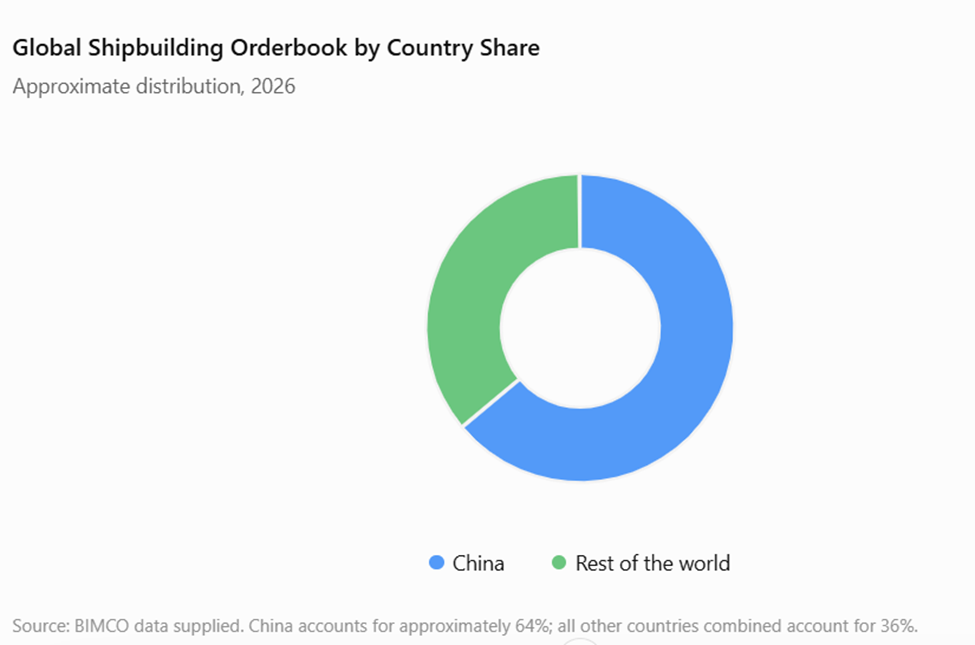
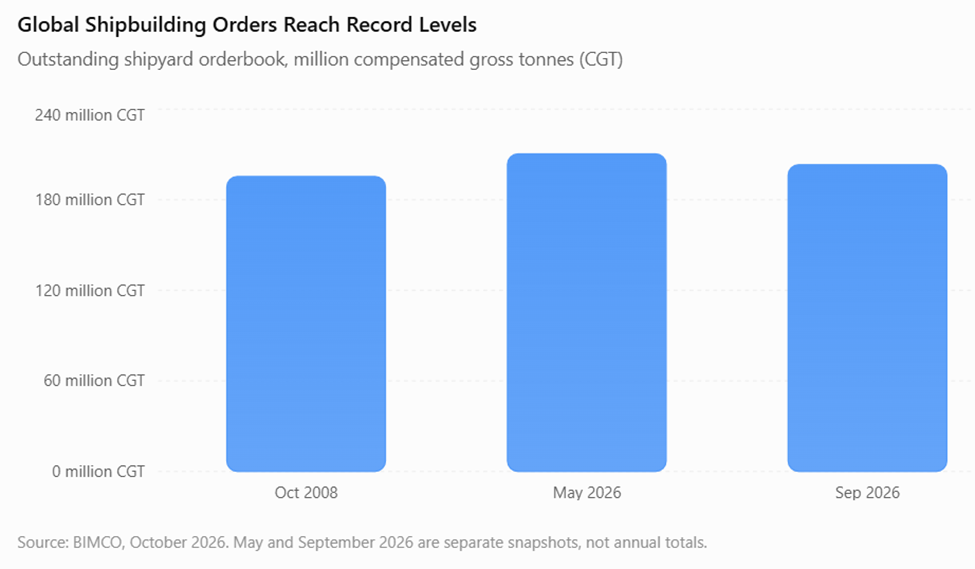
The size of the international shipbuilding market demonstrates the potential Bangladesh could tap into. According to BIMCO figures reported by Marine Log, world shipyards had 203.2 million compensated gross tonnes (CGT) of vessels on order as of September 1, 2026. This surpassed the previous record of 195.4 million CGT established in 2008, although it was below the all-time peak of 210.4 million CGT reached in May 2026.
China alone accounted for approximately 64 percent of outstanding global shipbuilding work, compared with South Korea’s 19 percent and Japan’s 6 percent, demonstrating the extraordinary concentration of industrial capacity in East Asia. The same figures show that Chinese shipyards secured approximately 74 percent of new CGT contracted over the preceding twelve months.
Maritime Gateway
Several factors explain this extraordinary expansion.
The shipping industry has enjoyed periods of substantial profitability, particularly in container shipping and certain tanker and bulk-carrier trades. This has allowed shipowners to invest in replacement vessels and fleet expansion. Another factor is geopolitical instability, including attacks on commercial shipping and uncertainty surrounding strategic sea lanes. When ships travel longer distances to avoid dangerous passages, additional shipping capacity is absorbed, potentially stimulating demand for new tonnage.
Environmental regulations are also changing the industry. The International Maritime Organization’s energy-efficiency and carbon-intensity requirements encourage improvements in ship performance and fuel efficiency. Shipowners are considering alternative fuels, new propulsion technologies, and improved vessel designs. Although the timing of the transition remains uncertain, environmental performance is becoming an increasingly important commercial consideration.
The global merchant fleet is also aging. As vessels approach the end of their economically useful lives, owners must decide whether to continue maintaining older ships or invest in more efficient replacements.
There are risks associated with this expansion. If shipyards produce more vessels than the market can absorb, or geopolitical disruptions diminish, freight rates and newbuilding demand could weaken. Indeed, BIMCO’s analysis of China’s expanding shipbuilding capacity warns that rapid capacity growth could eventually lead to underutilized shipyards.
Nevertheless, the present market offers opportunities for countries capable of delivering reliable vessels at competitive prices.
Bangladesh should have been among those countries.
Bangladesh’s Early Promise
Shipbuilding has a long history in Bengal. Wooden vessels constructed in the region served domestic and overseas trade for centuries. Modern industrial shipbuilding, however, requires sophisticated design techniques, certified welding procedures, classification-society approvals, reliable material suppliers, and substantial working capital.
During the first decade of the twenty-first century, several Bangladeshi companies demonstrated that the country could meet these requirements.
Ananda Shipyard & Slipways Limited emerged as a pioneer in exporting ocean-going commercial vessels. On September 14, 2008, the company exported a cargo vessel to Denmark, marking an important milestone in Bangladesh’s industrial development, as documented in bdnews24’s historical review of Bangladesh’s shipbuilding industry.
Western Marine Shipyard Limited, based in Chattogram, established an international reputation through contracts involving European, Asian, African, and Middle Eastern buyers. Other enterprises, including FMC Dockyard, also contributed to the development of Bangladesh’s shipbuilding capabilities.
Western Marine made significant contributions. According to The Business Standard’s investigation of Western Marine, the company had constructed approximately 150 vessels over two decades and exported 33 ships to 12 countries, generating approximately Tk 1,400 crore in foreign exchange.
These were not merely theoretical industrial ambitions. Bangladesh had demonstrated that it could produce vessels acceptable to international buyers.
Yet the industry’s subsequent export performance reveals how dramatically that promise deteriorated.
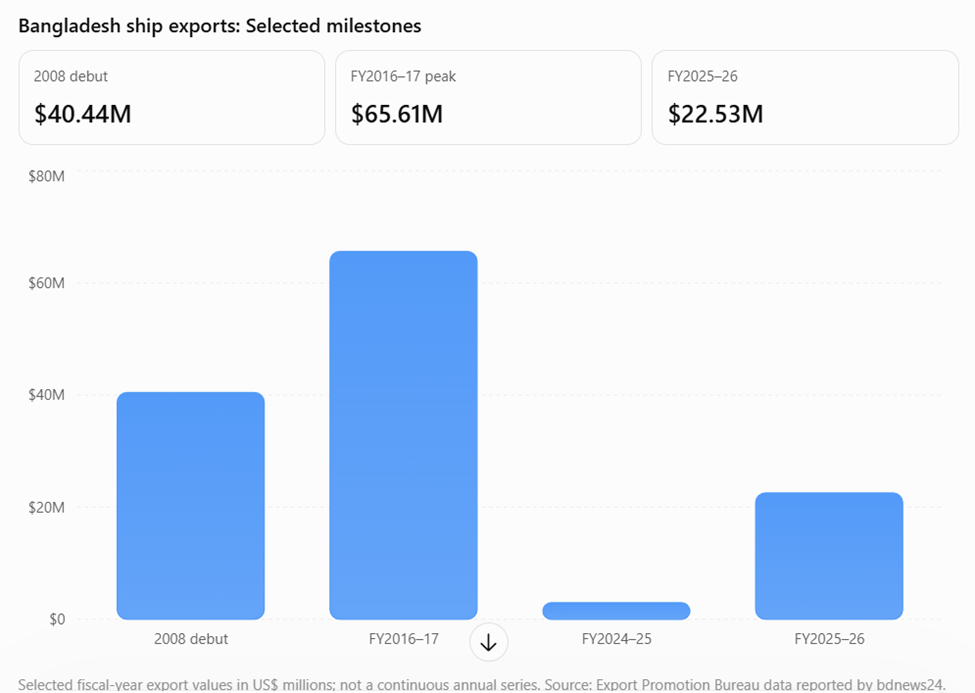
According to Export Promotion Bureau figures reported by bdnews24, Bangladesh earned no foreign currency from ship exports in FY2020–21, FY2021–22, and FY2023–24. The industry’s earlier export peak was $65.61 million in FY2016–17.
The recovery in FY2025–26 was encouraging, with exports reaching $22.53 million, compared with $2.94 million the previous year. Nevertheless, earnings remained far below the industry’s earlier peak.
Bangladesh has retained some shipbuilding expertise, but it has failed to establish the consistent production and export capacity required to compete internationally.
The Banking Crisis Behind the Industrial Collapse
Perhaps the most disturbing evidence of Bangladesh’s shipbuilding difficulties lies in its banking sector.
According to Bangladesh Bank data published by The Daily Star on January 20, 2026, outstanding loans in the combined shipbuilding and ship-breaking sector totaled approximately Tk 20,506 crore at the end of 2024. Of that amount, Tk 8,031 crore was classified as defaulted.
This represents a non-performing loan ratio of approximately 39.2 percent, an exceptionally high level of financial distress.
It is important to distinguish shipbuilding from ship-breaking. These are separate industries, and the combined figures cannot legitimately be attributed entirely to export-oriented shipbuilders. Nevertheless, the statistics demonstrate serious credit problems affecting Bangladesh’s broader maritime industrial economy.
Shipbuilding is capital-intensive. From purchasing steel and machinery to installing propulsion equipment, electrical systems, and navigation instruments, substantial expenditure must be incurred before a vessel can be delivered and the final contractual payment received.
Many leading shipbuilding nations have developed financing arrangements that recognize these realities. Export-credit guarantees, performance bonds, long-term industrial loans, and structured buyer payments help shipyards manage financial obligations.
Bangladeshi shipbuilders have frequently depended on commercial bank financing that did not adequately match vessel construction schedules or long-term investment requirements.
The 2008 global financial crisis and subsequent European economic difficulties caused numerous shipbuilders to lose contracts or experience delayed payments. Meanwhile, interest continued accumulating on outstanding loans.
But external difficulties cannot adequately explain every instance of excessive borrowing, questionable loan documentation, or failure to repay creditors.
The distinction between a business that cannot repay because of genuine commercial losses and one that deliberately avoids repayment despite having the means to do so is fundamental. Equally important is the distinction between documented diversion of loan proceeds and allegations that have not been judicially established.
Both distinctions are essential to understanding the cases of Bangladesh’s leading shipbuilders.
Ananda Shipyard: The Tk 1,300 Crore Loan Controversy
Ananda Shipyard & Slipways Limited illustrates the intersection of industrial ambition and questionable banking practices.
The company’s chairman, Abdullahel Bari, and director Afruja Bari were named in reporting concerning an Anti-Corruption Commission investigation into alleged irregularities involving approximately Tk 1,300 crore in loans from multiple financial institutions.
According to Prothom Alo’s report on the ACC investigation and questioning of seven bankers, the allegations involved loans obtained using allegedly false documentation. Bangladesh Bank inspections reportedly identified irregularities in the disbursement of loans by several financial institutions.
The reported lending exposures included approximately Tk 456.34 crore from Islami Bank Bangladesh, Tk 221.2 crore from Mercantile Bank, Tk 238 crore from Janata Bank, Tk 187 crore from AB Bank, and Tk 114.21 crore from One Bank, alongside loans from other financial institutions.
These figures represent reported lending exposures at the time of the investigation, not necessarily current outstanding balances or amounts proven to have been embezzled.
The ACC questioned banking officials who approved or processed the loans. This raises an important question: how could such substantial financing be extended without adequate verification of collateral, project viability, borrower capacity, and construction risks?
If banks knowingly disregarded lending regulations, responsibility cannot rest exclusively with the borrowing company. Banking officials who authorized questionable transactions must also be held accountable where misconduct is established.
Importantly, an ACC investigation does not establish that Bari, his family members, or other individuals personally diverted the money. The reviewed sources do not establish a final criminal conviction proving such diversion.
Ananda’s subsequent operations also demonstrate that the company retained shipbuilding capability. As reported in bdnews24’s review of the industry’s recovery, Ananda delivered a 5,500-deadweight-tonne multipurpose vessel to a Turkish buyer in September 2025.
The company’s management has expressed interest in resuming regular exports but has identified financial constraints as a major obstacle.
Therefore, it would be inaccurate to conclude that Ananda lacked the technical ability to construct ships. Rather, the case demonstrates that technical competence, commercial viability, financial discipline, and transparent governance must coexist for shipbuilding to become a sustainable export industry.
Western Marine: Industrial Achievement Overwhelmed by Debt
Western Marine Shipyard presents another troubling example.
In May 2023, National Bank filed a lawsuit seeking recovery of approximately Tk 938.72 crore in defaulted loans.
According to The Business Standard’s May 10, 2023 report on the National Bank lawsuit, the proceedings named the company’s chairman, Md Saiful Islam, managing director Captain Sohel Hasan, and eight directors. The company had reportedly stopped making regular repayments in 2019.
Western Marine’s wider financial position was even more serious.
In December 2024, The Daily Star’s report on Western Marine’s financial liabilities and recovery plans reported that company borrowings had reached approximately Tk 1,684 crore, with accumulated interest of Tk 1,402 crore. After reported repayments of Tk 952 crore, the company stated that approximately Tk 2,134 crore remained outstanding.
These figures demonstrate how unpaid interest can transform a serious commercial setback into an overwhelming financial burden.
Western Marine also experienced genuine external shocks. In 2008, it entered into a €94 million contract with German company Grona Shipping for twelve ice-class cargo vessels. According to the company’s account, four vessels were delivered at the original contractual price, another four at discounted prices, and the remaining four orders were canceled.
The company also reported cancellations involving Danish buyers, including vessels already under construction. These difficulties are discussed in The Daily Star’s account of Western Marine’s canceled orders and debt accumulation.
Such events can devastate shipyard finances because a partially completed vessel cannot always be sold readily to another customer. Ships are frequently constructed to specific designs, classification requirements, and operational purposes.
Nevertheless, creditors cannot indefinitely absorb losses without examining management’s financial decisions.
The Western Marine case raises questions about the adequacy of financial controls, the management of foreign contractual risks, excessive leverage, and the decisions that allowed interest liabilities to grow so substantially.
Default and fraud are different matters. The documented recovery proceedings establish serious debt problems, but they do not, by themselves, prove that the named directors personally diverted loan proceeds.
Western Marine has continued seeking opportunities to revive its business, demonstrating that productive capacity may still be recoverable with appropriate financing and management reforms.
FMC Dockyard: Serious Allegations of Embezzlement and Money Laundering
Among the cases examined, FMC Dockyard Limited faces particularly serious allegations concerning the possible diversion of borrowed funds.
In January 2023, the Bangladesh High Court directed the Anti-Corruption Commission, Bangladesh Financial Intelligence Unit, and Criminal Investigation Department to investigate allegations against Mohammad Yeasin Chowdhury, identified in contemporary reporting as FMC Dockyard’s managing director.
The allegations concerned approximately Tk 1,500 crore allegedly obtained from banks and other parties and reportedly embezzled or laundered.
According to The Daily Star’s January 9, 2023 report on the High Court investigation order, the court directed the relevant authorities to examine the allegations following newspaper reporting.
A separate Dhaka Tribune report on the High Court proceedings described pending cases and an arrest warrant mentioned in the underlying allegations.
The financial exposure subsequently remained substantial.
In 2025, The Business Standard’s report on major loan-default cases identified FMC Dockyard among significant defaulters associated with state financial institutions, reporting approximately Tk 1,175 crore in defaulted loans.
The reported amounts arise from different periods and financial scopes and should not be added together. They nevertheless demonstrate the magnitude of the financial controversy.
A bank’s classification of a borrower as a willful defaulter is a serious administrative finding, but it is not equivalent to a final judicial conviction for money laundering or embezzlement. The reviewed sources do not establish the final disposition of the High Court-ordered investigation.
Nevertheless, the central question remains: how could one enterprise accumulate such enormous liabilities without effective intervention by lenders and regulators?
If allegations of deliberate diversion are established through due legal process, the consequences should extend beyond ordinary debt recovery. Investigators should trace assets, recover unlawfully transferred funds, examine overseas financial transactions, and hold complicit banking officials accountable.
Greed, Weak Institutions, and the Culture of Non-Payment
A deeper problem confronting Bangladesh is the institutional environment in which large borrowers can accumulate extraordinary liabilities while banks struggle to recover their money.
In a properly functioning credit market, lenders assess risks, borrowers provide truthful financial disclosures, and defaults carry meaningful consequences.
Bangladesh’s experience suggests that these mechanisms have frequently been inadequate.
When borrowers believe that political influence, prolonged litigation, repeated loan rescheduling, or weak enforcement can protect them from repayment, an unhealthy incentive emerges. Borrowed money may be treated less as a financial obligation and more as an opportunity for personal enrichment.
This creates moral hazard: the possibility that individuals can enjoy the benefits of risky or dishonest decisions while transferring the losses to creditors, depositors, and ultimately the wider economy.
The difficulty of recovering large defaulted loans is reflected in The Business Standard’s investigation into delayed loan-default proceedings, which reported government efforts to accelerate the disposal of major cases involving state financial institutions.
The consequences extend beyond individual balance sheets.
When a shipyard fails to repay substantial loans, banks lose lending capacity. Other manufacturers face tighter credit conditions. Skilled workers lose employment. Equipment deteriorates, foreign buyers lose confidence, and industrial knowledge accumulated over decades begins to disappear.
The cost of such failures is therefore much greater than the nominal amount of unpaid loans.
However, establishing that borrowed money was siphoned abroad requires transaction records, beneficial-ownership investigations, financial intelligence, and judicial findings. It cannot responsibly be inferred from loan default alone.
A credible national investigation should identify the ultimate recipients of suspicious transactions, trace related-party payments, examine collateral valuations, and determine whether banks disbursed money against nonexistent or exaggerated assets.
Why Bangladesh Failed to Compete
Bangladesh’s shipbuilding difficulties also reflect structural weaknesses that cannot be attributed solely to corruption.
Unlike China and South Korea, Bangladesh never developed a comprehensive maritime industrial ecosystem connecting shipyards, steel suppliers, marine-equipment manufacturers, classification services, engineering institutions, and export-finance providers.
Domestic shipbuilders remain dependent on imported propulsion machinery, navigation equipment, specialized steel, and other components.
Import delays, currency fluctuations, high financing costs, and unreliable delivery schedules can quickly eliminate the price advantage created by lower labor costs.
As documented in The Business Standard’s investigation into Western Marine’s operational and financing problems, the industry’s difficulties have included short-term, high-interest borrowing for long-term investments, management disputes, and interrupted production.
Shipbuilding competitiveness cannot be measured simply by comparing wages. Productivity, engineering precision, project management, access to capital, and delivery reliability are equally important.
A low-cost workforce offers limited advantage if vessels are delivered months late or shipyards cannot obtain the guarantees required by international buyers.
Bangladesh also faces physical constraints. Draft limitations, yard layouts, river access, and infrastructure deficiencies restrict the size and types of vessels that particular facilities can construct economically.
Consequently, Bangladesh should not attempt to compete immediately with China in constructing large container ships, LNG carriers, or very large crude carriers.
Its more realistic opportunities lie in smaller and medium-sized merchant vessels, multipurpose cargo ships, tugs, ferries, landing craft, offshore support vessels, and specialized coastal shipping equipment.
These are sectors in which engineering competence, labor productivity, and reliable delivery can create competitive advantages without requiring the enormous capital investments associated with the world’s largest shipyards.
Can the Industry Be Revived?
Bangladesh Bank has acknowledged the industry’s financial difficulties.
In January 2026, the central bank introduced special loan restructuring arrangements for distressed shipbuilders. Eligible borrowers may reschedule or restructure their loans for up to ten years, including a maximum two-year grace period, subject to a three-percent down payment.
Crucially, the facility excludes firms found guilty of fraud, willful default, or loan manipulation.
The distinction must be rigorously enforced.
Bangladesh should establish an independent financial and technical review mechanism to assess distressed shipyards individually. Such reviews should determine whether a company possesses viable production facilities, genuine export contracts, competent management, and a credible repayment plan.
Viable enterprises suffering from external economic shocks deserve access to properly supervised restructuring. Enterprises whose controlling shareholders deliberately diverted funds should not receive taxpayer-supported relief without accountability and recovery measures.
A dedicated maritime industrial financing framework could provide longer-term credit, export guarantees, and milestone-based disbursements tied to verified construction progress.
International classification societies and independent marine surveyors could certify construction milestones before banks release further financing.
Bangladesh should also strengthen its marine-engineering education, technical training, design capabilities, and domestic equipment supply chains.
Most importantly, loan recovery must become a credible legal obligation rather than an endlessly negotiable political arrangement.
A National Opportunity That Must Not Be Lost Again
The worldwide shipbuilding expansion has exposed the enormous opportunity cost of Bangladesh’s industrial failures.
While other nations have secured substantial international orders, Bangladesh has spent years struggling with canceled contracts, accumulated interest, financial litigation, and the consequences of questionable lending.
The cases involving Ananda Shipyard, Western Marine, and FMC Dockyard demonstrate different dimensions of the problem: alleged lending irregularities, overwhelming debt burdens, serious allegations of financial misconduct, and institutional failures in credit supervision.
They also demonstrate why sweeping accusations are insufficient. Bangladesh must distinguish legitimate commercial failure from deliberate default and proven financial crime.
The country should not abandon its shipbuilding industry because some enterprises became financially distressed or because serious allegations emerged against particular business leaders. Equally, the industry’s strategic importance cannot justify unlimited debt forgiveness or immunity from prosecution.
Bangladesh needs industrial entrepreneurs who build ships, not financial arrangements that reward the accumulation of unrecoverable debt.
The nation has already demonstrated its capacity to construct vessels for international markets. Its engineers, naval architects, technicians, and skilled workers possess a foundation upon which a competitive industry can be rebuilt.
What remains missing is reliable financing, disciplined management, regulatory independence, and enforceable accountability.
The greatest tragedy would be to allow another global shipbuilding cycle to pass while Bangladesh continues debating how to recover money lent during the previous one.
We can build ships. We can train people to build ships. We can modernize our shipyards. But unless Bangladesh learns from past mistakes and restores integrity to industrial financing, the same cycle of ambitious promises, excessive borrowing, default, and industrial decline will continue.
If Bangladesh wants to become a serious shipbuilding nation, it must confront the failures that brought this promising industry to the brink of collapse.
The country did not simply lose shipbuilding orders. It came dangerously close to losing the industrial capability, international credibility, and financial foundations required to build ships at all.
https://www.dailyamardesh.com/op-ed/sub-editorial/amdpmdrua9uc5
Leave a Reply
Featured Post
- Worldwide Shipbuilding Boom and Bangladesh’s Lost Opportunity: How Financial Mismanagement, Loan Defaults, and Weak Governance Crippled a Promising Industry
An investigative analysis by Ghulam Suhrawardi Today, the world is witnessing one of the largest shipbuilding booms in history. Many countries are profiting from it. China, South Korea, and Japan have benefited from increased demand for new vessels due to fleet renewal, changing trade routes, environmental regulations, and strong financial […]
 বিশ্ব সমুদ্র দিবস: মেরিন একাডেমিকে আবার সামুদ্রিক শিক্ষার প্রাণকেন্দ্রে ফেরাতে হবে বাংলাদেশকে
গোলাম সোহরাওয়ার্দি বিশ্ব সমুদ্র দিবস ২০২৬ এবং সমন্বিত জাতীয় প্রশিক্ষণ কৌশলের প্রয়োজনীয়তা বিশ্ব সমুদ্র দিবসে আন্তর্জাতিক সামুদ্রিক সংস্থার (আইএমও) মহাসচিব আর্সেনিও ডমিঙ্গেজ খুব সহজ কিন্তু গভীর একটি বার্তা দিয়েছেন। আন্তর্জাতিক নিয়মকানুন সমুদ্র পরিবহন ব্যবস্থার উন্নতি তখনই করতে পারে, যখন দেশগুলো তা ঠিকমতো মেনে চলে। তিনি বলেন, “নাবিকদের কথাই সবার আগে […]



JOB SITES
CONTENTS
LINKS
Happy New Year

Découvrez les avantages de MadCasino
Dans le monde des casinos en ligne, MadCasino se distingue par ses offres attrayantes et ses services de qualité. Que vous soyez un joueur débutant ou un parieur aguerri, vous trouverez ici une variété de jeux qui sauront satisfaire toutes vos envies. Les machines à sous, les jeux de table et les options de paris en direct sont tous disponibles pour vous offrir une expérience de jeu inégalée. De plus, le casino propose régulièrement des bonus qui permettent d'augmenter vos chances de gagner, vous offrant ainsi une excellente opportunité de maximiser vos gains.
En matière de sécurité, MadCasino est un nom de confiance. Il est entièrement licencié et régulé, ce qui garantit un environnement de jeu sûr et équitable. Les joueurs peuvent se concentrer sur leur expérience de jeu sans se soucier des problèmes de sécurité. Les transactions financières sont également sécurisées grâce à des technologies de pointe.
Les jeux proposés par MadCasino sont issus des développeurs les plus réputés de l'industrie, vous assurant des graphismes époustouflants et des mécaniques de jeu innovantes. Les joueurs peuvent également profiter d'une expérience de jeu en direct qui simule l'atmosphère d'un casino terrestre, tout en restant dans le confort de leur maison.
Enfin, la plateforme de MadCasino est optimisée pour les appareils mobiles, permettant aux joueurs de parier à tout moment et de n'importe où. Que vous soyez sur votre smartphone ou votre tablette, l'accès à vos jeux préférés n'a jamais été aussi simple. Ne manquez pas l'opportunité de découvrir ce casino exceptionnel.
Les offres de Cresus Casino
Cresus Casino est un autre acteur majeur dans le domaine des jeux en ligne, offrant des promotions généreuses et une vaste sélection de jeux. Les joueurs peuvent profiter d'une expérience de jeu enrichissante grâce aux nombreux bonus disponibles, qui sont conçus pour attirer tant les nouveaux utilisateurs que les joueurs réguliers. Ces avantages permettent non seulement de prolonger votre temps de jeu, mais aussi d'augmenter vos chances de gains conséquents.
Le casino se distingue également par sa ludothèque impressionnante, comprenant une sélection variée de machines à sous, de jeux de table et de jeux en direct. Les clients peuvent choisir parmi des titres populaires et appréciés, ainsi que des nouveautés qui enrichissent constamment l'offre. L'interface utilisateur est conviviale, rendant la navigation sur la plateforme fluide et agréable.
En termes de sécurité, Cresus Casino assure à ses joueurs un environnement de jeu fiable. La plateforme utilise des protocoles de sécurité avancés pour protéger les données personnelles et financières des utilisateurs. Cela permet aux joueurs de se sentir en sécurité tout en jouant à leurs jeux préférés.
Avec un service client réactif et professionnel, Cresus Casino s'assure que toutes vos questions et préoccupations sont traitées rapidement. Que ce soit pour des questions concernant les bonus, les retraits ou les jeux, vous bénéficierez d'une assistance rapide et efficace.
Explorez Nine Casino et ses avantages
Dans l'univers des casinos en ligne, Nine Casino a su se faire une place de choix grâce à son approche innovante et à ses nombreux avantages pour les joueurs. Les utilisateurs peuvent s'attendre à une expérience de jeu enrichissante, avec des bonus attractifs qui sont régulièrement mis à jour. Ces offres sont une excellente façon de découvrir de nouveaux jeux tout en maximisant votre potentiel de gain.
La plateforme de Nine Casino est riche en options de jeux, allant des machines à sous aux jeux de table, en passant par le live casino. Chaque jeu est conçu pour offrir une expérience immersive grâce à des graphismes de haute qualité et des fonctionnalités innovantes. Les parieurs peuvent profiter de sessions de jeu captivantes, comme s'ils étaient dans un véritable casino.
La sécurité est une priorité pour Nine Casino, qui utilise des technologies de cryptage avancées pour protéger les informations de ses joueurs. Cela garantit un environnement de jeu sûr et fiable, permettant aux utilisateurs de se concentrer sur ce qu'ils aiment le plus : jouer.
Enfin, le service clientèle fourni par Nine Casino est exceptionnel, avec des agents disponibles pour répondre à toutes vos questions et résoudre vos problèmes. Vous pourrez ainsi jouer en toute tranquillité, sachant que votre satisfaction est au cœur de leurs préoccupations.
Profitez de l'expérience Lucky31
Lucky31 est un casino en ligne qui se distingue par son approche orientée vers le joueur, offrant une multitude d'options de jeux et des bonus généreux. Que vous soyez amateur de machines à sous ou passionné de jeux de table, vous trouverez une large sélection pour satisfaire toutes vos envies de jeu. Les promotions fréquentes permettent aux joueurs de prolonger leur expérience tout en augmentant leurs chances de gains.
La convivialité de la plateforme de Lucky31 est l'un de ses plus grands atouts. Les joueurs peuvent naviguer facilement entre les différents jeux, et l'interface est conçue pour être intuitive, quel que soit le niveau d'expérience de l'utilisateur. De plus, le casino est entièrement optimisé pour les appareils mobiles, ce qui permet de parier où que vous soyez.
En matière de sécurité, Lucky31 prend les préoccupations des joueurs très au sérieux. Le casino est agréé et régulé, garantissant un environnement de jeu équitable et sécurisé. Les joueurs peuvent ainsi se concentrer sur leur expérience de jeu sans se soucier des risques liés à la sécurité.
Pour ceux qui recherchent un support client efficace, Lucky31 offre un service réactif et professionnel. Que ce soit pour des questions sur les bonus, les jeux ou les paiements, vous aurez accès à une assistance de qualité, vous garantissant une expérience de jeu fluide et agréable.
This is a powerful and timely analysis of Bangladesh’s missed opportunity in the global shipbuilding industry. Bangladesh has demonstrated that it possesses the skilled workforce, engineering knowledge, and geographical advantages needed to build ships for international markets. However, sustainable industrial growth requires more than technical capability—it demands responsible financial management, transparent governance, reliable export financing, and strong institutional accountability.
The article rightly highlights the importance of distinguishing genuine commercial difficulties from deliberate loan default and proven financial misconduct. While viable shipyards deserve a fair opportunity to recover, allegations of financial irregularities must be investigated impartially, with accountability established through due legal process.
As a maritime nation, Bangladesh should not abandon its shipbuilding ambitions. Instead, it should strengthen marine engineering education, modernize shipyards, develop export-credit facilities, improve project management, and rebuild international confidence through reliable delivery and financial discipline.
*Bangladesh has the potential to build ships, but rebuilding trust, governance, and financial integrity is essential to building a sustainable shipbuilding industry.* Let this be a lesson—and an opportunity—for the country’s maritime future.
https://www.dailyamardesh.com/op-ed/sub-editorial/amdpmdrua9uc5