search the site


The New Federation of American Shipyards
SAM LAGRONE
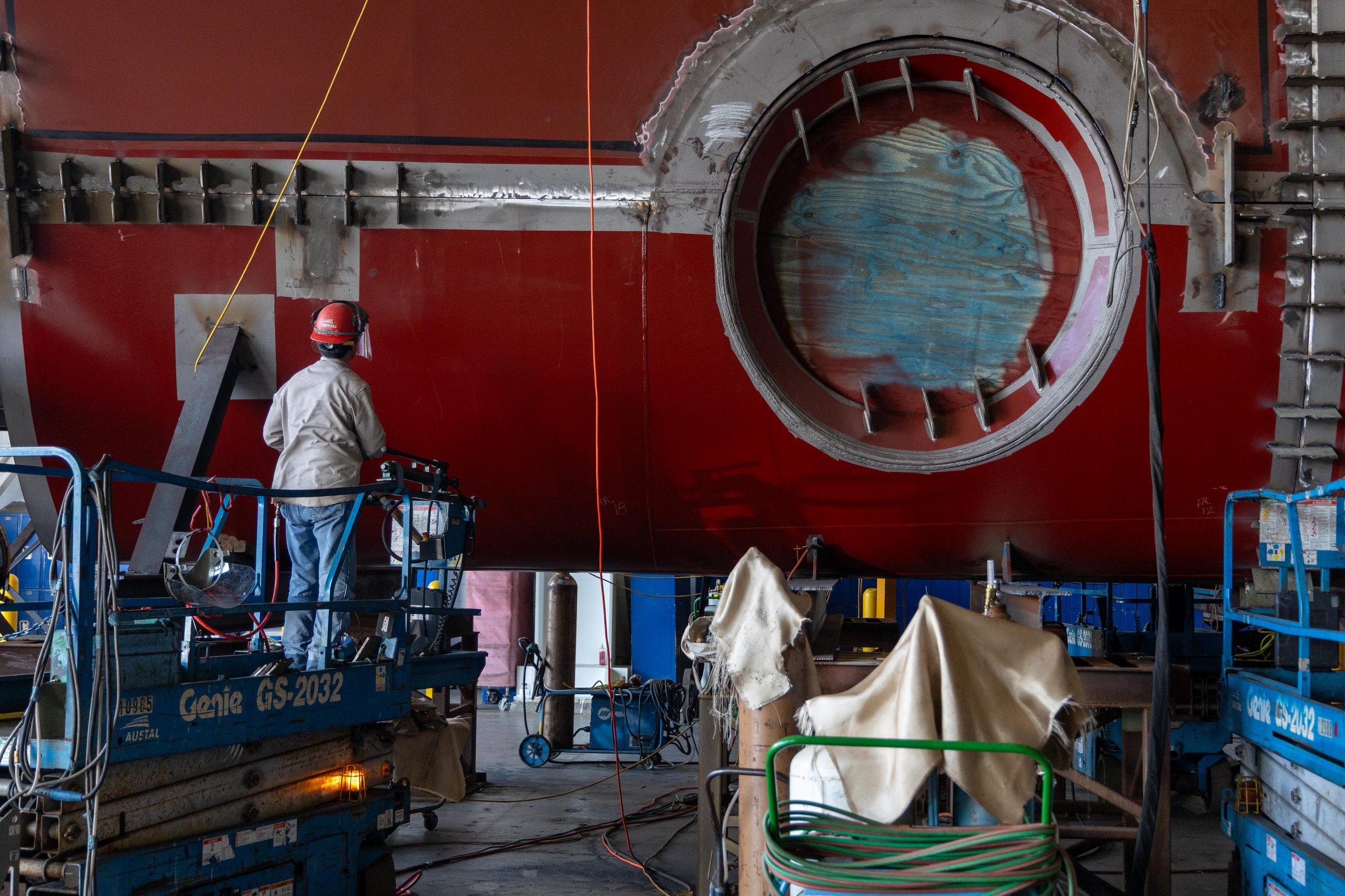
MOBILE, Ala. —Three decks high and shrouded in a plastic, air-conditioned barrier, some of the most important spaces of a pair of Virginia-class attack boats are taking shape on the shores of the Mobile River — 1,200 miles from the rest of the submarine.
Already painted in the Navy’s calming shade of seafoam green, the control room modules are being outfitted with hatches, chairs, terminals, doors, desks, screens, outlets, fixtures, lightbulbs and a chart table before getting shrink-wrapped and barged up the East Coast to General Dynamics Electric Boat’s facility in Rhode Island. Then, the modules will be slid into the pressure hulls of Block V Virginia-class boats Silversides (SSGN-807) and John H. Dalton (SSGN-808) before the sections are welded shut to make the submarines whole.
A short walk from the modules on Pinto Island in Mobile Bay, Austal is putting the finishing touches on the 400,000-square-foot Module Manufacturing Facility 3. The $450 million Navy-funded MMF 3 promises to deliver an annual output of 1 million labor hours by 2027 devoted to building four types of modules for the Virginia- and Columbia-class submarines, Austal officials told USNI News.
Modular manufacturing is creating new opportunities for Austal’s shipyard, which has a reputation for quality work but has stumbled with management turnover, underbid contracts, a federal investigation and is now up for sale by its Australian parent company. For more than 20 years, the yard has focused on building all-aluminum ships like the fast expeditionary transports and the Navy’s Independence-class littoral ships, but now is focused largely on steel ship production.
As Austal and its workforce of 3,000 shipbuilders search for a new identity, the Navy and the White House are placing pressure on the service’s traditional warship builders.
The outlay for module construction in Austal is part of a larger Department of the Navy push to accelerate surface ship and submarine production by moving work from major assembly yards like HII’s Ingalls Shipbuilding and Newport News and GD’s Bath Iron Works and EB to smaller yards like Austal, Eastern Shipbuilding in Florida and Rhoads in Philadelphia. Known as distributed or federated shipbuilding, a network of shipyards produces modules across a wide geographical area.
Compared to the last U.S. naval buildup in the 1980s, the U.S. shipbuilding workforce is smaller and the ships are taking longer to build. Every class of battleforce ship in production is taking longer, according to April testimony from the Congressional Budget Office. It now takes 10 years to build an attack submarine, up from six years in the 2000s. The construction timeline for destroyers and big-deck amphibious warships has jumped from five years to nine since then, while aircraft carriers now take close to 15 years, according to the CBO’s April congressional testimony.
Chinese shipbuilders surpassed the U.S. on the pace of warship deliveries more than a decade ago and can deliver more than an aircraft carrier’s worth of tonnage to the People’s Liberation Army Navy every year.
While the U.S. can’t match the number of shipbuilders at China’s disposal, the Navy and the White House are pushing U.S. shipbuilders to move work out of the primary assembly yards for submarines, destroyers and amphibious warships to less stressed yards to speed up delivery.
“Today, roughly 10 percent of shipbuilding work is performed at distributed sites. Our goal is 50 percent,” reads the Navy’s long-range shipbuilding plan issued in May. “New hulls will prioritize modular, digital designs that enable distributed shipbuilding across multiple yards and suppliers. Modular construction expands production capacity, reduces bottlenecks and accelerates delivery by leveraging industrial capability across the country — not just at a handful of legacy shipyards.”
Post-World War II Modular Origins

Modern modular shipbuilding started in post-war Japan with the drydock that built the infamous battleship IJN Yamato. The Kure Naval Arsenal near Hiroshima was converted to commercial shipbuilding by a combination of the Japanese IHI Corporation and the American National Bulk Carriers in the 1950s using lessons from both German and U.S. shipbuilders.
“Japanese shipbuilders were especially impressed by the new shipbuilding method employed by NBC, enabling the yard to cut the ship construction period tremendously, and also by NBC’s leadership in the trend toward larger and larger ships,” reads a 1966 piece on Japanese shipbuilding in Proceedings by retired Japanese Admiral Sadayoshi Nakayama and Masataka Chihaya.
Perfecting the process over decades, Japanese shipbuilders built modules the size of houses and outfitted them in controlled conditions with pipes and other fittings precisely positioned to align with other blocks that would be welded together to make a whole ship. Major components like engines, boilers and turbines were installed while the modular sections were built around them.
Around the same time, Swedish shipbuilder Götaverken also developed modular ship construction. In 1968, then Litton-owned Ingalls Shipbuilding built a new shipyard rooted in Swedish modular principles — the Litton Advanced Marine Production Division. LAMP was built to be a 611-acre assembly line. Warships were split into grand blocks that rolled across the yard in wheeled cradles on a network of custom rails. The yard used this method to produce the 31 Spruance-class destroyers for the U.S. Navy.
In the 1970s, modular production helped the Ohio-class nuclear ballistic missile program increase delivery speed. General Dynamics Electric Boat moved production of some modules from its Groton, Conn., yard to custom-built facilities in Quonset Point, R.I. The Ohio modules were then barged from Narraganset Bay up the Thames River to Groton.
In the late 1990s, Congress required EB and HII’s Newport News to work together to build separate sections of the Virginia-class submarines. Each yard barged sections up and down the East Coast for final assembly, with the yards taking turns joining the sections together to deliver the finished submarine. That teaming arrangement has continued through the Columbia-class program, with HII building the bow and stern sections and EB building the central barrel of the boomers, the Navy announced in 2016. All new Columbia-class subs will be completed at EB.
Necessity drove this teaming. The defense industrial base was shrinking after the Cold War, and the hedge kept two nuclear yards operating in the U.S.
In a written statement to the Senate Armed Services Committee in 1997, top Navy acquisition official John Douglass said the teaming arrangement was “a rational approach to sustaining a very low rate production of submarines.”
Thirty years later, the Navy and shipbuilders are faced with a backlog of orders, international submarine commitments as part of the AUKUS submarine program and slow deliveries. Distributed shipbuilding is an old solution to a new set of problems.
Strategic Distribution

In the boardroom of Ingalls Shipbuilding there’s a 1977 photograph of a line of Spruance-class destroyers progressing across the Ingalls yard. It looks like a gargantuan version of a Detroit car factory floor, with workers teeming over “Sprucan” modules and skyscraper-sized mobile cranes hovering over the assembling warships.
A plaque underneath the photo reads: 23,707 employees.
“What a lot of people don’t look at is two years later is the next picture, and it’s 10,800 shipbuilders,” Ingalls Shipbuilding president Brain Blanchette told USNI News in an interview at the yard in August. “In the span of two years, the workforce was cut in half, because at the time, it was viewed as a renewable resource.”
Ingalls, currently at 11,000 workers, still has the floor space of its 1970s peak, but the workers aren’t available. From when the photo in the boardroom was taken to now, the American shipbuilding workforce has fallen 40 percent and competition in the overheated labor pool along the Gulf Coast between Ingalls, Austal USA and Bollinger Mississippi Shipbuilding — all within a commuting distance of one another — is fierce.
“Things have changed. The labor resource is precious. We need to protect it. We need to plan for it. We need to treat it as a strategic asset,” Blanchette said.
Ingalls’ workforce is more stable now after new collective bargaining agreements with its unions that upped worker wages, but the labor pool is slow to grow, prompting the Navy and HII to push the Ingalls to shift some work to other yards.
With the blessing of the Navy, Ingalls is moving work out of Pascagoula to a network of vetted yards that can build up to 37 of the 78 blocks that make up an Arleigh Burke-class destroyer and make better use of the workers Ingalls does have.
“We’re taking some of the early stage production work, particularly structural unit construction and outfitting, in partnering with other fabricators who are on the Gulf Coast, close enough where the logistics are manageable for barge transport, but far enough away that we’re not competing for the same labor pool,” Blanchette said.
Eastern Shipbuilding in Florida and Gulf Copper in Texas built four blocks between the two yards in a pilot program for future destroyer Thad Cochran (DDG-135). Future work is slated for distribution to more yards. Ingalls is launching an eight-block pilot program for San Antonio-class amphibious warship Philadelphia (LPD-32) and has plans to outsource more modules for the follow-on Travis Manion (LPD-33).
The last time Ingalls relied on distributed shipbuilding was 20 years ago. At that time, it wasn’t by choice.
On Aug. 29, 2005, Hurricane Katrina pushed a 22-foot wall of water across the shipyard. The damage upended construction schedules for almost a dozen warships and cutters.
“The Pascagoula yard sustained water damage to transporters, translation cars, electrical systems, and other property, as well as wind damage to the roofs of the buildings,” reads a legal filing in the subsequent insurance court case. ”Photographs on the day of the hurricane showed trucks in the shipyard halfway submerged in water, and [shipyard manager Steve Pierce] estimated that buildings were covered in six to ten feet of water in some parts of the shipyard.”
Ingalls, Gulfport in Mississippi and Avondale in New Orleans suffered $1.2 billion in damage. As a result, Ingalls had to farm out work to other Gulf Coast yards to keep the shipbuilding programs going — particularly the San Antonio-class amphibious warship program, Blanchette said.
“At that point it was more survival mode. It was tactical, not strategic, and we learned a lot of lessons as a result,” he said.
USS Green Bay (LPD-20), USS New York (LPD-21), USS San Diego (LPD-22), USS Anchorage (LPD-23), and USS Arlington (LPD-24) all had modules built at shipyards across the Gulf Coast.
When the Navy blessed distributed shipbuilding as a workable strategy again for Ingalls, the shipyard dusted off the engineering specs and quality control processes the company developed for its builder network in 2005.
“Because we’d written it down, none of that got lost over that time, and so we put a lot of effort into the engineering products to make sure they’re clean and clear and understandable …to make sure the distributed shipbuilding partner understands what we’re giving them,” Blanchette said. “We have been very happy.”
‘More Blue Dots’
The distributed model for shipbuilding fills a gap for smaller Gulf Coast yards that are getting fewer orders from their customers in the oil and gas industry.
In late September the newly minted Portfolio Acquisition Executive Maritime Rear Adm. Casey Moton pointed to a map of the Navy’s network of distributed shipbuilders during a speech at the American Society of Naval Engineers Fleet Maintenance and Modernization conference. Black dots represented major shipbuilders; blue dots showed outsourcing yards.
“It’s right there from the White House how important the investment in increasing capacity and throughput is,” he said. “You can see the black dots are our major shipbuilders, and then outsourcing sites in blue. We want more blue dots.”
Austal in Mobile, Ingalls Shipbuilding and Bollinger Mississippi across the border in Pascagoula account for the bulk of shipbuilding in the region, but across the Gulf Coast commercial yards that grew to support the offshore oil and gas industry are thinking about government business, Matt Paxton with the Shipbuilders Council of America told USNI News last month.
“That industry met the demand of a large offshore oil and gas industry, and it has technology. It has capacity,” Paxton said.
Some boat builders in the interior bayous of Louisiana are pitching proposals to build new classes of autonomous ships for the Navy while others have tapped into the distributed network for more government work.

“We do want to start tapping into this ecosystem of small and mid-sized yards to work with the prime so that they can do what they do best, which is assembly, and they can outsource some of this to all these Gulf yards in their local regional areas,” a senior Department of Navy official told USNI News in an interview last month.
While the promised time savings from distributed shipbuilding are high, the risk of delays is greater as well.
The Australian government in the late 2000s farmed out module work for the Hobart-class guided-missile combatant to four different domestic shipyards in the hopes that parallel modular construction would be more efficient. But the companies didn’t follow the plan correctly, and the government reaped delays instead. For example, the keel block of lead-ship HMAS Hobart (DDG-39), constructed by BAE Systems Australia, was built to the incorrect dimensions and didn’t fit with the rest of the modules.
The delays and cost overruns prompted then-Australian Defense Minister David Johnson to say in 2014 about Hobart prime shipbuilder Australian Submarine Corporation, “Why, I wouldn’t trust them to build a canoe.”
Back in the U.S., delivery delays for the future USS District of Columbia (SSBN-826) submarine’s bow and stern modules contributed to an overall delivery delay of almost two years.
So far, Austal’s modules have required some rework, but the program has been a net positive for Electric Boat, sources familiar with the program told USNI News.
Speaking to USNI News in August, Blanchette said that as of now, faced with shipbuilding workforce limitations and the pressure to deliver ships faster, spreading the work out to different yards was the best option.
“If I could hire all of those shipbuilders here, there’s room for them, and there’s the ability to process that work through this facility,” Blanchette said. “But I don’t think we’re going to see people move from Galveston, from Panama City, from Houma … The reality is if we can put the work where the workers are, that’s going to yield a better near-term result.”
source : news.usni.org
Featured Post
 বিশ্ব সমুদ্র দিবস: মেরিন একাডেমিকে আবার সামুদ্রিক শিক্ষার প্রাণকেন্দ্রে ফেরাতে হবে বাংলাদেশকে
 গোলাম সোহরাওয়ার্দি বিশ্ব সমুদ্র দিবস ২০২৬ এবং সমন্বিত জাতীয় প্রশিক্ষণ কৌশলের প্রয়োজনীয়তা বিশ্ব সমুদ্র দিবসে আন্তর্জাতিক সামুদ্রিক সংস্থার (আইএমও) মহাসচিব আর্সেনিও ডমিঙ্গেজ খুব সহজ কিন্তু গভীর একটি বার্তা দিয়েছেন। আন্তর্জাতিক নিয়মকানুন সমুদ্র পরিবহন ব্যবস্থার উন্নতি তখনই করতে পারে, যখন দেশগুলো তা ঠিকমতো মেনে চলে। তিনি বলেন, “নাবিকদের কথাই সবার আগে […]
 World Maritime Day: Bangladesh Must Put Its Marine Academy Back at the Center of Maritime Education
 World Maritime Day: Bangladesh Must Put Its Marine Academy Back at the Center of Maritime Education by Ghulam Suhrawardi World Maritime Day 2026 and the case for a coherent national training strategy On World Maritime Day, International Maritime Organization Secretary-General Arsenio Dominguez delivered a deceptively simple message: international rules improve […]



JOB SITES
CONTENTS
LINKS
Happy New Year

Découvrez les avantages de MadCasino
Dans le monde des casinos en ligne, MadCasino se distingue par ses offres attrayantes et ses services de qualité. Que vous soyez un joueur débutant ou un parieur aguerri, vous trouverez ici une variété de jeux qui sauront satisfaire toutes vos envies. Les machines à sous, les jeux de table et les options de paris en direct sont tous disponibles pour vous offrir une expérience de jeu inégalée. De plus, le casino propose régulièrement des bonus qui permettent d'augmenter vos chances de gagner, vous offrant ainsi une excellente opportunité de maximiser vos gains.
En matière de sécurité, MadCasino est un nom de confiance. Il est entièrement licencié et régulé, ce qui garantit un environnement de jeu sûr et équitable. Les joueurs peuvent se concentrer sur leur expérience de jeu sans se soucier des problèmes de sécurité. Les transactions financières sont également sécurisées grâce à des technologies de pointe.
Les jeux proposés par MadCasino sont issus des développeurs les plus réputés de l'industrie, vous assurant des graphismes époustouflants et des mécaniques de jeu innovantes. Les joueurs peuvent également profiter d'une expérience de jeu en direct qui simule l'atmosphère d'un casino terrestre, tout en restant dans le confort de leur maison.
Enfin, la plateforme de MadCasino est optimisée pour les appareils mobiles, permettant aux joueurs de parier à tout moment et de n'importe où. Que vous soyez sur votre smartphone ou votre tablette, l'accès à vos jeux préférés n'a jamais été aussi simple. Ne manquez pas l'opportunité de découvrir ce casino exceptionnel.
Les offres de Cresus Casino
Cresus Casino est un autre acteur majeur dans le domaine des jeux en ligne, offrant des promotions généreuses et une vaste sélection de jeux. Les joueurs peuvent profiter d'une expérience de jeu enrichissante grâce aux nombreux bonus disponibles, qui sont conçus pour attirer tant les nouveaux utilisateurs que les joueurs réguliers. Ces avantages permettent non seulement de prolonger votre temps de jeu, mais aussi d'augmenter vos chances de gains conséquents.
Le casino se distingue également par sa ludothèque impressionnante, comprenant une sélection variée de machines à sous, de jeux de table et de jeux en direct. Les clients peuvent choisir parmi des titres populaires et appréciés, ainsi que des nouveautés qui enrichissent constamment l'offre. L'interface utilisateur est conviviale, rendant la navigation sur la plateforme fluide et agréable.
En termes de sécurité, Cresus Casino assure à ses joueurs un environnement de jeu fiable. La plateforme utilise des protocoles de sécurité avancés pour protéger les données personnelles et financières des utilisateurs. Cela permet aux joueurs de se sentir en sécurité tout en jouant à leurs jeux préférés.
Avec un service client réactif et professionnel, Cresus Casino s'assure que toutes vos questions et préoccupations sont traitées rapidement. Que ce soit pour des questions concernant les bonus, les retraits ou les jeux, vous bénéficierez d'une assistance rapide et efficace.
Explorez Nine Casino et ses avantages
Dans l'univers des casinos en ligne, Nine Casino a su se faire une place de choix grâce à son approche innovante et à ses nombreux avantages pour les joueurs. Les utilisateurs peuvent s'attendre à une expérience de jeu enrichissante, avec des bonus attractifs qui sont régulièrement mis à jour. Ces offres sont une excellente façon de découvrir de nouveaux jeux tout en maximisant votre potentiel de gain.
La plateforme de Nine Casino est riche en options de jeux, allant des machines à sous aux jeux de table, en passant par le live casino. Chaque jeu est conçu pour offrir une expérience immersive grâce à des graphismes de haute qualité et des fonctionnalités innovantes. Les parieurs peuvent profiter de sessions de jeu captivantes, comme s'ils étaient dans un véritable casino.
La sécurité est une priorité pour Nine Casino, qui utilise des technologies de cryptage avancées pour protéger les informations de ses joueurs. Cela garantit un environnement de jeu sûr et fiable, permettant aux utilisateurs de se concentrer sur ce qu'ils aiment le plus : jouer.
Enfin, le service clientèle fourni par Nine Casino est exceptionnel, avec des agents disponibles pour répondre à toutes vos questions et résoudre vos problèmes. Vous pourrez ainsi jouer en toute tranquillité, sachant que votre satisfaction est au cœur de leurs préoccupations.
Profitez de l'expérience Lucky31
Lucky31 est un casino en ligne qui se distingue par son approche orientée vers le joueur, offrant une multitude d'options de jeux et des bonus généreux. Que vous soyez amateur de machines à sous ou passionné de jeux de table, vous trouverez une large sélection pour satisfaire toutes vos envies de jeu. Les promotions fréquentes permettent aux joueurs de prolonger leur expérience tout en augmentant leurs chances de gains.
La convivialité de la plateforme de Lucky31 est l'un de ses plus grands atouts. Les joueurs peuvent naviguer facilement entre les différents jeux, et l'interface est conçue pour être intuitive, quel que soit le niveau d'expérience de l'utilisateur. De plus, le casino est entièrement optimisé pour les appareils mobiles, ce qui permet de parier où que vous soyez.
En matière de sécurité, Lucky31 prend les préoccupations des joueurs très au sérieux. Le casino est agréé et régulé, garantissant un environnement de jeu équitable et sécurisé. Les joueurs peuvent ainsi se concentrer sur leur expérience de jeu sans se soucier des risques liés à la sécurité.
Pour ceux qui recherchent un support client efficace, Lucky31 offre un service réactif et professionnel. Que ce soit pour des questions sur les bonus, les jeux ou les paiements, vous aurez accès à une assistance de qualité, vous garantissant une expérience de jeu fluide et agréable.