search the site


Shipping rewinds the future
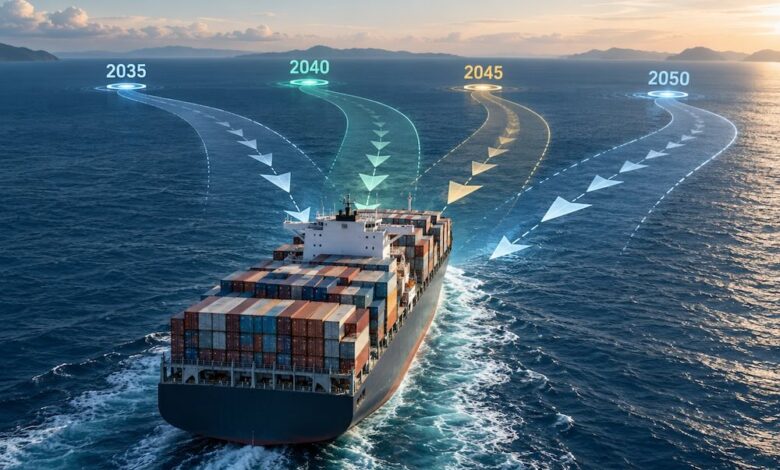
Rather than forecasting from today, backcasting starts with possible futures and works backwards — an approach gaining traction as shipping’s long-term bets become harder to call. Splash’s Europe Editor Bojan Lepic explains.
Shipping has never been short on forecasts. Fleet growth, trade demand, freight rates, fuel choices, and asset values are all projected years ahead, even though the industry has a habit of making long-range predictions look fragile.
A different planning technique is now gaining attention. Rather than starting with today’s market and projecting forward, backcasting begins with a future scenario and works backwards to establish what needs to happen to get there.
Japanese liner Ocean Network Express (ONE) has brought the concept into sharper focus through its View of the World project, which examines several possible versions of the global economy and container shipping in 2050 and considers what those futures mean for decisions made today. The carrier examines how long-lived investments such as ships and terminals fit across different scenarios rather than relying on a single projection of how the market develops.
A spokesperson for ONE stresses that the exercise is not designed to produce another forecast.
“Backcasting is one of several strategic frameworks ONE uses, and we apply it as a planning discipline rather than a prediction tool. We set out multiple plausible scenarios for how the global economy and container shipping could look in 2050, drawing on a wide range of external and internal perspectives. By backcasting from that future, we can determine the strategic actions we must take today.”
The idea is not new. Governments and international organisations already use variations of backcasting. The Organisation for Economic Cooperation and Development incorporates it into strategic foresight work, the UN Development Programme includes it in its strategic planning toolkit, while the UK government and Singapore’s Centre for Strategic Futures use versions of the technique in public-sector planning.
For shipping, the attraction is the mismatch between the industry’s volatile short-term markets and the long life of its assets. Mark Williams, head of consultancy Shipping Strategy, says backcasting is already established, although it is more common outside commercial shipping. He argues that ships’ long lifespans make the method particularly relevant.
Backcasting asks what would have to be true for a given future to arrive
“So backcasting has already caught on, but for long-range planning rather than within the current business cycle,” he tells Splash. “As ships are 25-30 year lifespan assets, backcasting can be a useful tool for strategic planning for ship owners investigating what the net zero world of 2050, or later, will look like.”
A conventional forecast might extrapolate container demand and calculate the fleet required to meet it. Backcasting can, for example, start with a competitive net-zero liner network in 2050 without a radically different pattern of world trade and work backwards through the ships, fuels, terminals, and technology required in 2045, 2040, and 2035.
Williams sees an advantage in escaping assumptions embedded in today’s market but also identifies one of the method’s central weaknesses.
“The danger of backcasting is that it can induce wishful thinking,” Williams says. “Circumstances outside your control can emerge over the backcasting period, so the backcast needs constant revision. Say, teleportation, for argument’s sake, is discovered, and shipping of inorganic objects becomes unnecessary. Or a future in which the human population peaks much earlier than currently expected. That could affect demand for container shipping, dry bulk shipping, and liquid fuel shipping.”
Tristan Smith, professor of energy and transport at the UCL Energy Institute, sees merit in the concept but says its usefulness depends on the futures being tested.
Katsuhiro Nishinari, professor at the University of Tokyo, is more bullish.
“Backcasting is a powerful methodology, especially in rapidly changing and highly uncertain environments like global shipping. Traditional forecasting tends to extrapolate current trends, which often fail when disruptive changes occur,” Nishinari says. He has been helping ONE with its backcasting project.
Nishinari does not see the technique replacing forecasting entirely but expects it to become more relevant as shipping deals with decarbonisation and other structural changes.
“While it requires a mindset shift and cannot completely replace traditional forecasting, backcasting is extremely useful for long-term strategic planning, particularly in areas like sustainability and decarbonisation. As companies face unprecedented future challenges, I believe more industries will adopt this approach,” he says.
Mikael Lind, senior strategic research advisor at RISE, sees another application: using backcasting to coordinate a fragmented maritime ecosystem.
“I do think backcasting has considerable potential in shipping, although I would not primarily see it as a better way of predicting the future,” Lind says, adding: “Backcasting means starting with a desired future and working backwards to identify what must happen to achieve it. That is fundamentally different from forecasting, where we start from where we are today and ask where current trends may take us.”
This matters because shipowners cannot deliver many of shipping’s biggest transitions alone. New fuels require producers and bunkering infrastructure. Ports require investment. Cargo owners, banks, regulators, shipyards, and technology providers all influence whether a future shipping system is achievable.
“This is where I think backcasting becomes particularly powerful. If the actors concerned jointly define a desired future state around a common object of interest, they can then work backwards together to identify what needs to be in place to reach it,” Lind says.
Prioritise resilience, agility, adaptability, and continuity
For Lind, forecasting and backcasting therefore serve different purposes: “Forecasting helps us understand where current developments may take us. Backcasting allows us to define where we want to go and then identify what is required to get there.”
Shipping finance may already contain more backcasting than the industry realises, as Christopher Rex, head of innovation and research at Danish Ship Finance, points out.
“Backcasting will catch on, but it should not be sold as a better way of predicting shipping markets. It answers a different question. A forecast asks what is likely to happen,” Rex explains. “Backcasting asks what would have to be true for a given future to arrive, and what that implies for decisions taken today. For an industry that commits capital to ships trading well into the 2050s, that discipline is valuable.”
Rex says the Poseidon Principles trajectories effectively work backwards from the IMO’s 2050 ambition into annual carbon-intensity pathways. But a critical limitation remains for an industry where timing determines investment returns.
“The limitation is timing,” Rex argues. “Backcasting tells you where the industry is heading and which ships risk becoming unfinanceable before the end of their economic life. It says nothing about when to buy, at what price or with how much leverage, and in shipping, that is where most capital is made or lost.”
As is noticeable, backcasting has many positives, and some believe it is a potent tool in the shipping toolbox for building a clearer picture of the future. Others are more sceptical.
Kate Adamson, one of shipping’s best-known futurists, argues that the technique belongs to an earlier era of strategic planning.
“I’m afraid the 1990s just called and would like its scenario planning tool back. Backcasting has been around for decades, used by companies whose preferred future involved up-and-to-the-right growth in a VUCA – volatile, uncertain, complex, and ambiguous – world.”
Adamson argues today’s environment is instead brittle, anxious, non-linear, and incomprehensible, making the starting assumptions behind any long-term exercise particularly vulnerable.
“Everyone has a plan until they get punched in the face,” she quips. “The ones who will get back up are currently prioritising resilience, agility, adaptability, and continuity, not another buzzword.”
Nick Gross, Lloyd Register’s global containership segment director, takes a more measured position.
“Shipping has always relied on a range of tools to help navigate uncertainty, and backcasting is one of several approaches that organisations may choose to incorporate into their strategic planning,” he tells Splash.
Gross says its value depends heavily on the assumptions underpinning the scenario, while geopolitics, technology and economic shocks can quickly change shipping’s trajectory.
“For this reason,” he says, “we would not view backcasting as a substitute for forecasting or other forms of scenario analysis. Rather, it is one tool among many that can help support decision-making.”
That thinking is already visible among major shipmanagers.
Bjorn Hojgaard, chief executive of Anglo-Eastern, told the recent Splash Singapore event that the biggest strategic change is accepting that forecasting itself is becoming less dependable.
“It’s less about predicting the future and more about asking what we need to have in place in order to have optionality and cater to different futures,” he said.
Anglo-Eastern has run a long-range scenario exercise, working backwards from two very different versions of 2035 rather than trying to identify one future and plan exclusively around it.
That may be where backcasting ultimately finds its place in shipping. Few proponents argue that it can tell an owner what freight rates will be in five years, what a vessel will be worth at the bottom of the next cycle, or which fuel wins the race to replace conventional bunkers. Instead, it offers a way to test today’s long-lived investments against several possible tomorrows.
source: splash247
Featured Post
 বিশ্ব সমুদ্র দিবস: মেরিন একাডেমিকে আবার সামুদ্রিক শিক্ষার প্রাণকেন্দ্রে ফেরাতে হবে বাংলাদেশকে
 গোলাম সোহরাওয়ার্দি বিশ্ব সমুদ্র দিবস ২০২৬ এবং সমন্বিত জাতীয় প্রশিক্ষণ কৌশলের প্রয়োজনীয়তা বিশ্ব সমুদ্র দিবসে আন্তর্জাতিক সামুদ্রিক সংস্থার (আইএমও) মহাসচিব আর্সেনিও ডমিঙ্গেজ খুব সহজ কিন্তু গভীর একটি বার্তা দিয়েছেন। আন্তর্জাতিক নিয়মকানুন সমুদ্র পরিবহন ব্যবস্থার উন্নতি তখনই করতে পারে, যখন দেশগুলো তা ঠিকমতো মেনে চলে। তিনি বলেন, “নাবিকদের কথাই সবার আগে […]
 World Maritime Day: Bangladesh Must Put Its Marine Academy Back at the Center of Maritime Education
 World Maritime Day: Bangladesh Must Put Its Marine Academy Back at the Center of Maritime Education by Ghulam Suhrawardi World Maritime Day 2026 and the case for a coherent national training strategy On World Maritime Day, International Maritime Organization Secretary-General Arsenio Dominguez delivered a deceptively simple message: international rules improve […]



JOB SITES
CONTENTS
LINKS
Happy New Year

Découvrez les avantages de MadCasino
Dans le monde des casinos en ligne, MadCasino se distingue par ses offres attrayantes et ses services de qualité. Que vous soyez un joueur débutant ou un parieur aguerri, vous trouverez ici une variété de jeux qui sauront satisfaire toutes vos envies. Les machines à sous, les jeux de table et les options de paris en direct sont tous disponibles pour vous offrir une expérience de jeu inégalée. De plus, le casino propose régulièrement des bonus qui permettent d'augmenter vos chances de gagner, vous offrant ainsi une excellente opportunité de maximiser vos gains.
En matière de sécurité, MadCasino est un nom de confiance. Il est entièrement licencié et régulé, ce qui garantit un environnement de jeu sûr et équitable. Les joueurs peuvent se concentrer sur leur expérience de jeu sans se soucier des problèmes de sécurité. Les transactions financières sont également sécurisées grâce à des technologies de pointe.
Les jeux proposés par MadCasino sont issus des développeurs les plus réputés de l'industrie, vous assurant des graphismes époustouflants et des mécaniques de jeu innovantes. Les joueurs peuvent également profiter d'une expérience de jeu en direct qui simule l'atmosphère d'un casino terrestre, tout en restant dans le confort de leur maison.
Enfin, la plateforme de MadCasino est optimisée pour les appareils mobiles, permettant aux joueurs de parier à tout moment et de n'importe où. Que vous soyez sur votre smartphone ou votre tablette, l'accès à vos jeux préférés n'a jamais été aussi simple. Ne manquez pas l'opportunité de découvrir ce casino exceptionnel.
Les offres de Cresus Casino
Cresus Casino est un autre acteur majeur dans le domaine des jeux en ligne, offrant des promotions généreuses et une vaste sélection de jeux. Les joueurs peuvent profiter d'une expérience de jeu enrichissante grâce aux nombreux bonus disponibles, qui sont conçus pour attirer tant les nouveaux utilisateurs que les joueurs réguliers. Ces avantages permettent non seulement de prolonger votre temps de jeu, mais aussi d'augmenter vos chances de gains conséquents.
Le casino se distingue également par sa ludothèque impressionnante, comprenant une sélection variée de machines à sous, de jeux de table et de jeux en direct. Les clients peuvent choisir parmi des titres populaires et appréciés, ainsi que des nouveautés qui enrichissent constamment l'offre. L'interface utilisateur est conviviale, rendant la navigation sur la plateforme fluide et agréable.
En termes de sécurité, Cresus Casino assure à ses joueurs un environnement de jeu fiable. La plateforme utilise des protocoles de sécurité avancés pour protéger les données personnelles et financières des utilisateurs. Cela permet aux joueurs de se sentir en sécurité tout en jouant à leurs jeux préférés.
Avec un service client réactif et professionnel, Cresus Casino s'assure que toutes vos questions et préoccupations sont traitées rapidement. Que ce soit pour des questions concernant les bonus, les retraits ou les jeux, vous bénéficierez d'une assistance rapide et efficace.
Explorez Nine Casino et ses avantages
Dans l'univers des casinos en ligne, Nine Casino a su se faire une place de choix grâce à son approche innovante et à ses nombreux avantages pour les joueurs. Les utilisateurs peuvent s'attendre à une expérience de jeu enrichissante, avec des bonus attractifs qui sont régulièrement mis à jour. Ces offres sont une excellente façon de découvrir de nouveaux jeux tout en maximisant votre potentiel de gain.
La plateforme de Nine Casino est riche en options de jeux, allant des machines à sous aux jeux de table, en passant par le live casino. Chaque jeu est conçu pour offrir une expérience immersive grâce à des graphismes de haute qualité et des fonctionnalités innovantes. Les parieurs peuvent profiter de sessions de jeu captivantes, comme s'ils étaient dans un véritable casino.
La sécurité est une priorité pour Nine Casino, qui utilise des technologies de cryptage avancées pour protéger les informations de ses joueurs. Cela garantit un environnement de jeu sûr et fiable, permettant aux utilisateurs de se concentrer sur ce qu'ils aiment le plus : jouer.
Enfin, le service clientèle fourni par Nine Casino est exceptionnel, avec des agents disponibles pour répondre à toutes vos questions et résoudre vos problèmes. Vous pourrez ainsi jouer en toute tranquillité, sachant que votre satisfaction est au cœur de leurs préoccupations.
Profitez de l'expérience Lucky31
Lucky31 est un casino en ligne qui se distingue par son approche orientée vers le joueur, offrant une multitude d'options de jeux et des bonus généreux. Que vous soyez amateur de machines à sous ou passionné de jeux de table, vous trouverez une large sélection pour satisfaire toutes vos envies de jeu. Les promotions fréquentes permettent aux joueurs de prolonger leur expérience tout en augmentant leurs chances de gains.
La convivialité de la plateforme de Lucky31 est l'un de ses plus grands atouts. Les joueurs peuvent naviguer facilement entre les différents jeux, et l'interface est conçue pour être intuitive, quel que soit le niveau d'expérience de l'utilisateur. De plus, le casino est entièrement optimisé pour les appareils mobiles, ce qui permet de parier où que vous soyez.
En matière de sécurité, Lucky31 prend les préoccupations des joueurs très au sérieux. Le casino est agréé et régulé, garantissant un environnement de jeu équitable et sécurisé. Les joueurs peuvent ainsi se concentrer sur leur expérience de jeu sans se soucier des risques liés à la sécurité.
Pour ceux qui recherchent un support client efficace, Lucky31 offre un service réactif et professionnel. Que ce soit pour des questions sur les bonus, les jeux ou les paiements, vous aurez accès à une assistance de qualité, vous garantissant une expérience de jeu fluide et agréable.