search the site


World Maritime Day 2026 Observed in Bangladesh
World Maritime Day 2026 Observed in Bangladesh
by ASM Abdul Baten, Rear Admiral (retd)
From Policy to Practice: Powering Maritime Excellence
Bangladesh observed World Maritime Day 2026 on 27 September with programmes highlighting the country’s maritime potential, development of ports and shipping, seafarer training and welfare, digitalization, maritime security, environmental protection and the need to translate policy commitments into practical results.
The international theme for 2026–2027, selected by the International Maritime Organization (IMO), is “From Policy to Practice: Powering Maritime Excellence.” For the first time, the World Maritime Day theme is being applied over a two-year period. The theme emphasizes that international maritime rules and national policies have value only when they are effectively implemented through legislation, enforcement, training, technology and day-to-day maritime operations.
In Bangladesh, the day’s discussions brought together senior government officials, naval leadership, maritime administrators, ship-owners, maritime professionals, seafarers and representatives of the wider maritime sector. The discussions demonstrated that Bangladesh possesses considerable maritime opportunities, but that realizing them will require stronger coordination, consistent policies, modern infrastructure, skilled manpower and more effective implementation.
Programme in Dhaka
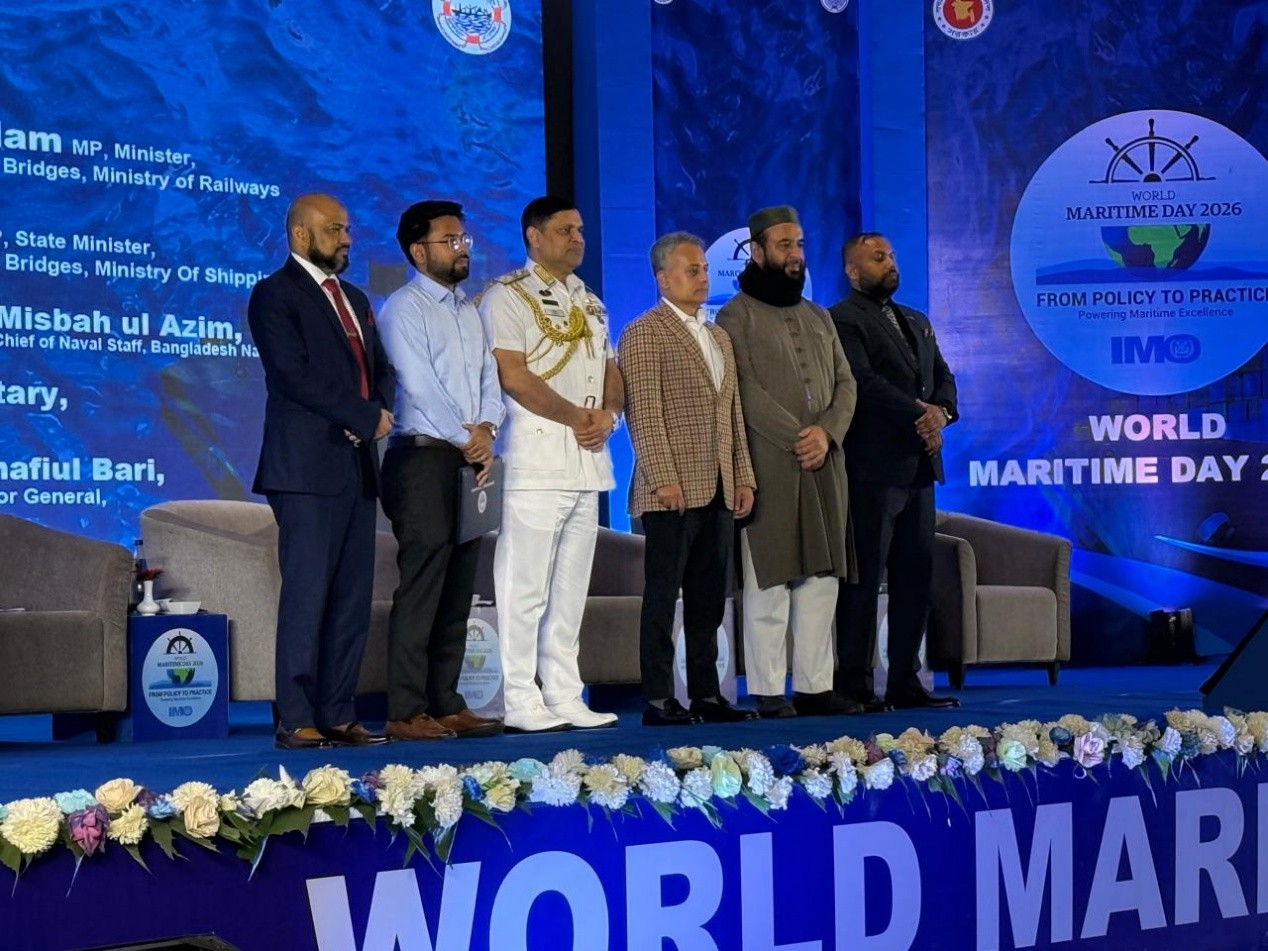
The Department of Shipping, headed by Director General Shipping Commodore Md Shafiul Bari, (ND),OSP,ndc, psc BN organized a half-day programme at the Ruposhi Bangla Grand Ballroom of Hotel InterContinental Dhaka. Mr Shaikh Rabiul Alam, MP, Minister for Road Transport and Bridges, Railways and Shipping, attended as the Chief Guest, while Admiral Khondokar Misbah-ul-Azim, NBP, NPP, ndu, afwc, psc, PhD, Chief of Naval Staff, Bangladesh Navy, attended as Special Guest. The programme provided an opportunity for the government, Navy, maritime administration and private shipping sector to discuss how Bangladesh can convert its maritime policies and ambitions into measurable outcomes.
It is worth noting that World Maritime Day was also observed through programmes outside Dhaka. In Chattogram, for example, a major event was held at the Bangladesh Marine Academy, coinciding with the academy’s 64th anniversary. National newspapers reported participation by the Shipping Minister, Director General of the Department of Shipping, senior port and maritime officials, maritime professionals and cadets.
The event started with the recitation from the Holy Qoran followed by a video clip from the Secretary-General of the International Maritime Organization Arsenio Dominguez. Dominguez’s message centred on the IMO theme: “From Policy to Practice: Powering Maritime Excellence.” The theme covers 2026 and 2027 and is intended to emphasise that international maritime rules must not remain merely policies or conventions on paper; they have to be translated into implementation, concrete actions like national legislation, enforcement, training and actual day-to-day maritime operations. The central message from Dominguez was: Implementation must make a difference where it matters most – for the people working at sea. Seafarers come first. Always.
Minister: Bangladesh Must Make Better Use of Its Maritime Potential.
Hon’ble Shipping Minister Shaikh Rabiul Alam, MP, in his speech, highlighted the enormous potential of Bangladesh’s maritime resources and stressed the need to make effective use of the vast opportunities offered by the sea. He emphasized that the success of national policies, plans and international commitments would ultimately depend on their proper implementation through hard work, coordinated efforts and a clear national vision. He stressed a closely related point: simply joining international maritime conventions or making laws is not enough; Bangladesh needs safe ships, modern and clean ports, skilled seafarers, effective regulation and sustainable maritime trade.
Referring to the changing global maritime landscape, the Minister observed that developed nations are increasingly concentrating on opportunities and interests on land, while vast areas of the oceans remain available for developing countries such as Bangladesh to explore and harness. He therefore underscored the need for Bangladesh to work with greater determination, develop the necessary human resources and technology, and translate its maritime policies and plans into practical results. In his address, Minister Shaikh Rabiul Alam emphasized the enormous potential of Bangladesh’s maritime resources and the importance of developing skills and human resources to take advantage of these opportunities.
He stressed that realizing maritime potential would require hard work, appropriate policy implementation and sustained national commitment. He also pointed to the changing global economic landscape, arguing that developed countries are increasingly concentrating on opportunities on land while substantial opportunities remain in the oceans for developing countries such as Bangladesh.
The Minister’s remarks reflected the central message of the 2026 World Maritime Day theme: Bangladesh needs to move from recognizing maritime opportunities at the policy level to actually implementing programmes capable of generating economic and social benefits.
Chief of Naval Staff: Modernization, Security and the Blue Economy
Admiral Khondokar Misbah-ul-Azim, Chief of Naval Staff, emphasized several areas that are fundamental to the development of a modern maritime nation.He highlighted the necessity of expanding, modernizing, automating and digitalizing port infrastructure, particularly at the country’s major ports such as Chattogram, Mongla and Payra. Modern ports are no longer simply places where ships load and discharge cargo. They form part of integrated logistics systems involving shipping, customs, transportation, information technology, warehousing and supply chains. Port modernization therefore has implications for Bangladesh’s overall trade competitiveness. The CNS also stressed the importance of institutional coordination. Bangladesh’s maritime domain involves numerous institutions responsible for ports, shipping, waterways, maritime security, fisheries, environment, ship registration, seafarer certification, customs and trade. Greater coordination among these institutions is essential if the country is to develop its maritime economy effectively. This emphasis closely reflects the IMO’s interpretation of the 2026 theme, which calls for international rules to be translated into national legislation, effective enforcement and practical day-to-day operations. The CNS emphasized the importance of improving national maritime training standards and investing in:This is particularly important because Bangladeshi seafarers constitute one of the country’s most internationally mobile maritime resources. Their competence, safety and professional reputation directly influence Bangladesh’s ability to expand its participation in global shipping.
From Regulation to Implementation: Department of Shipping
Director General of the Department of Shipping, Commodore Md Shafiul Bari, focused particularly on the practical implications of the theme “From Policy to Practice.” His message centered on the need to close the gap between policy, regulation and actual implementation.One major priority is bringing Bangladesh’s maritime regulatory system into closer alignment with the requirements of the International Maritime Organization, including the mandatory IMO Member State Audit Scheme (IMSAS). The importance of this issue has increased in 2026 because IMO has completed the first mandatory audit cycle under IMSAS. According to IMO, 168 Member States—94% of its membership—had been audited during the first cycle, with the results identifying continuing weaknesses in national legislation, technical expertise, infrastructure and oversight in many countries. For Bangladesh, effective implementation of international maritime conventions is therefore not simply a matter of legal compliance. It affects the country’s credibility as a flag State, port State and maritime service provider. The DG also emphasized digital integration and automation. The DG further emphasized the transition towards environmentally friendly shipping, including cleaner fuels and stronger development of compliant ship-recycling facilities. For Bangladesh, this has particular significance because the country has an established ship-recycling industry as well as a growing merchant fleet. The challenge is to ensure that expansion of the sector takes place in accordance with international environmental, safety and labour standards.
Strengthening the Bangladesh Merchant Fleet
A significant contribution to the Dhaka programme came from Mr Azam J. Chowdhury, Chairman of East Coast Group and Bangladesh Ocean Going Ship Owners’ Association (BOGSOA). Speaking on “Anchoring Prosperity: Strengthening Bangladesh Merchant Fleet for 2026 and Beyond,” he focused on the development of Bangladesh’s privately owned ocean-going merchant fleet and the policy environment required for its continued expansion. He described how a relatively small group of Bangladeshi entrepreneurs had built the country’s ocean-going merchant fleet from a modest base to 108 vessels within roughly half a decade where there is earning of 1Bn $ from freight only. The development, he argued, demonstrates that Bangladeshi entrepreneurs can invest substantially in international shipping when an appropriate policy environment exists. A central message of the Chairman was the importance of stable and predictable government policy. According to him, frequent changes in policy create uncertainty for entrepreneurs whose investments involve large amounts of capital and long repayment periods. Shipping is a particularly capital-intensive industry, and decisions to acquire vessels are normally made with a long-term investment horizon. Therefore, policy stability is important not merely as an administrative matter but as an investment consideration. Mr Chowdhury also argued that ocean-going shipping could become one of Bangladesh’s major sources of economic opportunity after the ready-made garment sector. The underlying argument is that a larger national merchant fleet can retain a greater portion of freight earnings within the country rather than allowing those earnings to accrue entirely to foreign-flag shipping companies. This issue deserves consideration in the broader context of Bangladesh’s trade. The BOGSOA Chairman also called for reforms to the regulatory framework governing Bangladesh-flag vessels.
Among the issues he raised were:
- reducing bureaucratic obstacles affecting private shipowners;
- simplifying procedures for acquiring and disposing of commercial vessels;
- reducing unnecessary administrative delays; and
- creating a regulatory environment more responsive to the speed of international shipping markets.
- He questioned requirements that can make relatively routine commercial decisions dependent upon lengthy government procedures.
His broader argument was that policy should facilitate responsible private investment rather than unintentionally slow it down.
Fostering Bangladesh’s Maritime Potential in Global Shipping
The final paper was presented by Maritime Engineer Rafiqul Quader, C Eng, FIMarEST, on “Fostering Bangladesh’s Maritime Potential in Global Shipping.” His presentation placed Bangladesh’s maritime manpower in the context of the global shipping industry. Quader emphasized that more than 80% of global trade by volume is carried by sea, underlining the scale and importance of international shipping. Against this global background, he drew attention to Bangladesh’s comparatively small participation in the international seafarer market. He cited an estimated nearly 20,000 active Bangladeshi mariners serving on foreign-flag vessels who send $750M + in annual remittances to Bangladesh. He argued that the number remains small compared with major maritime labour-supplying countries such as the Philippines and India. The precise number of Bangladeshi seafarers may vary according to the definition and data source used—active seafarers, certified seafarers, officers, ratings or those currently serving aboard ships—so such figures should be treated as estimates rather than a single definitive national statistic. He cited examples on Singapore model of Maritime Excellence i.e., Singapore’s blue print for maritime success. Out of 2.57 M sea farers currently serving the world merchant fleet, 39,100 STCW –certified officer shortfall in 2026 alone and 113,735 additional officers needed globally by 2030. A grimmer part is that 600 a year qualified mariners face prolonged delays or career drop-off in Bangladesh which needs proper attention. Their research findings include challenges in recruiting Bangladeshi seafarers be mitigated soon. These include: VISA/Immigration constraints, training quality and competence, retention and attrition concerns, cultural compatibilities etc.
Quader also drew attention to the continuing international requirement for qualified marine officers, engineers and other specialized maritime professionals. This creates an opportunity for Bangladesh because the country has a large young population and an expanding network of maritime education and training institutions. The challenge, however, is not simply producing graduates. It is ensuring that graduates acquire:
- internationally recognized certification;
- practical sea experience;
- adequate English-language proficiency;
- modern technical skills;
- digital competence;
- safety awareness; and
- reliable access to employment opportunities aboard vessels.
One of the important issues raised was the situation of Bangladeshi maritime graduates who, despite completing academy training and obtaining relevant certification, may remain unemployed or wait for extended periods before obtaining their first sea placement. This highlights an important distinction between training capacity and employability. Producing more cadets and graduates alone will not necessarily increase Bangladesh’s share of the international maritime labour market. The country also needs stronger links among maritime academies, shipowners, manning agencies, training institutions and international shipping companies.
Special Highlight: Honouring Valuable Contributions
This year, the Department of Shipping, Bangladesh, took a commendable and inspiring initiative by honouring and recognising professionals, researchers, and other individuals for their valuable contributions to the maritime sector. Such recognition not only acknowledges their dedication, expertise, and achievements but also serves as a powerful source of encouragement for the next generation of maritime professionals and researchers. It will undoubtedly inspire them to pursue excellence, devote greater attention to their respective fields, and contribute more meaningfully to the continued development of Bangladesh’s maritime sector.
Major Issues Emerging from World Maritime Day 2026
The discussions in Dhaka point towards several interconnected priorities for Bangladesh’s maritime development.
- Policy must become implementation
- The central message of World Maritime Day 2026 is especially relevant to Bangladesh. The country has numerous maritime laws, policies, institutions and development plans. The challenge is ensuring these translate into effective implementation and measurable outcomes.
- Maritime infrastructure must be modernized
- Ports such as Chattogram, Mongla and Payra require continuous modernization, automation, digitalization and improved connectivity if Bangladesh is to compete effectively in regional and international maritime trade.
- A stronger national merchant fleet
- The expansion of Bangladesh-owned ocean-going vessels shows the potential to increase national participation in international shipping. Stable policies and commercially responsive regulations will be important for continued private investment.
- Seafarers are a national asset
- Bangladeshi seafarers should be regarded not merely as workers but as part of the country’s international maritime presence. Training, certification, welfare and employment pathways therefore require sustained attention.
- Blue economy requires coordination
- The country’s marine resources extend well beyond shipping. Ports, fisheries, offshore resources, marine tourism, shipbuilding, ship recycling, marine services and ocean-based industries all form part of the broader blue economy.
- Realizing this potential requires coordination among government agencies, the Navy, private industry, academia and research institutions.
- Digitalization is no longer optional
- Ship registration, port operations, customs, cargo documentation, maritime safety and regulatory administration are increasingly digital. Bangladesh therefore needs interoperable and secure digital systems rather than isolated institutional platforms.
- Environmental compliance must accompany growth
- Growth in shipping, ports and ship recycling must be accompanied by stronger environmental safeguards. The IMO’s current theme explicitly connects maritime excellence with safety, resilience and environmental sustainability.
Conclusion
World Maritime Day 2026 in Bangladesh provided an important forum for examining the country’s maritime future from several complementary perspectives—government policy, naval security, maritime administration, private ship ownership, seafarer development and global shipping opportunities.
The message emerging from the Dhaka discussions was not that Bangladesh lacks maritime potential. Rather, the central challenge is how to convert that potential into sustained economic activity, employment, foreign-exchange earnings, maritime security and national development.
The international theme, “From Policy to Practice: Powering Maritime Excellence,” is therefore particularly relevant to Bangladesh. IMO itself stresses that international maritime regulations achieve their purpose only when they are incorporated into national legislation, enforced effectively and applied in everyday operations.
For Bangladesh, moving from policy to practice means more than preparing new policies. It means consistent implementation, modern ports, efficient maritime administration, a competitive national merchant fleet, internationally employable seafarers, effective inter-agency coordination, digital governance, cybersecurity and environmentally responsible maritime development.
The discussions of World Maritime Day 2026 thus remind us that Bangladesh’s maritime future will depend not simply on the size of its coastline or the resources of the Bay of Bengal, but on its ability to organize, invest, regulate, and execute.
In short, Bangladesh’s real challenge is no longer simply to recognize the opportunities of the sea, but to turn maritime policy into maritime practice.
Featured Post
 বিশ্ব সমুদ্র দিবস: মেরিন একাডেমিকে আবার সামুদ্রিক শিক্ষার প্রাণকেন্দ্রে ফেরাতে হবে বাংলাদেশকে
 গোলাম সোহরাওয়ার্দি বিশ্ব সমুদ্র দিবস ২০২৬ এবং সমন্বিত জাতীয় প্রশিক্ষণ কৌশলের প্রয়োজনীয়তা বিশ্ব সমুদ্র দিবসে আন্তর্জাতিক সামুদ্রিক সংস্থার (আইএমও) মহাসচিব আর্সেনিও ডমিঙ্গেজ খুব সহজ কিন্তু গভীর একটি বার্তা দিয়েছেন। আন্তর্জাতিক নিয়মকানুন সমুদ্র পরিবহন ব্যবস্থার উন্নতি তখনই করতে পারে, যখন দেশগুলো তা ঠিকমতো মেনে চলে। তিনি বলেন, “নাবিকদের কথাই সবার আগে […]
 World Maritime Day: Bangladesh Must Put Its Marine Academy Back at the Center of Maritime Education
 World Maritime Day: Bangladesh Must Put Its Marine Academy Back at the Center of Maritime Education by Ghulam Suhrawardi World Maritime Day 2026 and the case for a coherent national training strategy On World Maritime Day, International Maritime Organization Secretary-General Arsenio Dominguez delivered a deceptively simple message: international rules improve […]



JOB SITES
CONTENTS
LINKS
Happy New Year

Découvrez les avantages de MadCasino
Dans le monde des casinos en ligne, MadCasino se distingue par ses offres attrayantes et ses services de qualité. Que vous soyez un joueur débutant ou un parieur aguerri, vous trouverez ici une variété de jeux qui sauront satisfaire toutes vos envies. Les machines à sous, les jeux de table et les options de paris en direct sont tous disponibles pour vous offrir une expérience de jeu inégalée. De plus, le casino propose régulièrement des bonus qui permettent d'augmenter vos chances de gagner, vous offrant ainsi une excellente opportunité de maximiser vos gains.
En matière de sécurité, MadCasino est un nom de confiance. Il est entièrement licencié et régulé, ce qui garantit un environnement de jeu sûr et équitable. Les joueurs peuvent se concentrer sur leur expérience de jeu sans se soucier des problèmes de sécurité. Les transactions financières sont également sécurisées grâce à des technologies de pointe.
Les jeux proposés par MadCasino sont issus des développeurs les plus réputés de l'industrie, vous assurant des graphismes époustouflants et des mécaniques de jeu innovantes. Les joueurs peuvent également profiter d'une expérience de jeu en direct qui simule l'atmosphère d'un casino terrestre, tout en restant dans le confort de leur maison.
Enfin, la plateforme de MadCasino est optimisée pour les appareils mobiles, permettant aux joueurs de parier à tout moment et de n'importe où. Que vous soyez sur votre smartphone ou votre tablette, l'accès à vos jeux préférés n'a jamais été aussi simple. Ne manquez pas l'opportunité de découvrir ce casino exceptionnel.
Les offres de Cresus Casino
Cresus Casino est un autre acteur majeur dans le domaine des jeux en ligne, offrant des promotions généreuses et une vaste sélection de jeux. Les joueurs peuvent profiter d'une expérience de jeu enrichissante grâce aux nombreux bonus disponibles, qui sont conçus pour attirer tant les nouveaux utilisateurs que les joueurs réguliers. Ces avantages permettent non seulement de prolonger votre temps de jeu, mais aussi d'augmenter vos chances de gains conséquents.
Le casino se distingue également par sa ludothèque impressionnante, comprenant une sélection variée de machines à sous, de jeux de table et de jeux en direct. Les clients peuvent choisir parmi des titres populaires et appréciés, ainsi que des nouveautés qui enrichissent constamment l'offre. L'interface utilisateur est conviviale, rendant la navigation sur la plateforme fluide et agréable.
En termes de sécurité, Cresus Casino assure à ses joueurs un environnement de jeu fiable. La plateforme utilise des protocoles de sécurité avancés pour protéger les données personnelles et financières des utilisateurs. Cela permet aux joueurs de se sentir en sécurité tout en jouant à leurs jeux préférés.
Avec un service client réactif et professionnel, Cresus Casino s'assure que toutes vos questions et préoccupations sont traitées rapidement. Que ce soit pour des questions concernant les bonus, les retraits ou les jeux, vous bénéficierez d'une assistance rapide et efficace.
Explorez Nine Casino et ses avantages
Dans l'univers des casinos en ligne, Nine Casino a su se faire une place de choix grâce à son approche innovante et à ses nombreux avantages pour les joueurs. Les utilisateurs peuvent s'attendre à une expérience de jeu enrichissante, avec des bonus attractifs qui sont régulièrement mis à jour. Ces offres sont une excellente façon de découvrir de nouveaux jeux tout en maximisant votre potentiel de gain.
La plateforme de Nine Casino est riche en options de jeux, allant des machines à sous aux jeux de table, en passant par le live casino. Chaque jeu est conçu pour offrir une expérience immersive grâce à des graphismes de haute qualité et des fonctionnalités innovantes. Les parieurs peuvent profiter de sessions de jeu captivantes, comme s'ils étaient dans un véritable casino.
La sécurité est une priorité pour Nine Casino, qui utilise des technologies de cryptage avancées pour protéger les informations de ses joueurs. Cela garantit un environnement de jeu sûr et fiable, permettant aux utilisateurs de se concentrer sur ce qu'ils aiment le plus : jouer.
Enfin, le service clientèle fourni par Nine Casino est exceptionnel, avec des agents disponibles pour répondre à toutes vos questions et résoudre vos problèmes. Vous pourrez ainsi jouer en toute tranquillité, sachant que votre satisfaction est au cœur de leurs préoccupations.
Profitez de l'expérience Lucky31
Lucky31 est un casino en ligne qui se distingue par son approche orientée vers le joueur, offrant une multitude d'options de jeux et des bonus généreux. Que vous soyez amateur de machines à sous ou passionné de jeux de table, vous trouverez une large sélection pour satisfaire toutes vos envies de jeu. Les promotions fréquentes permettent aux joueurs de prolonger leur expérience tout en augmentant leurs chances de gains.
La convivialité de la plateforme de Lucky31 est l'un de ses plus grands atouts. Les joueurs peuvent naviguer facilement entre les différents jeux, et l'interface est conçue pour être intuitive, quel que soit le niveau d'expérience de l'utilisateur. De plus, le casino est entièrement optimisé pour les appareils mobiles, ce qui permet de parier où que vous soyez.
En matière de sécurité, Lucky31 prend les préoccupations des joueurs très au sérieux. Le casino est agréé et régulé, garantissant un environnement de jeu équitable et sécurisé. Les joueurs peuvent ainsi se concentrer sur leur expérience de jeu sans se soucier des risques liés à la sécurité.
Pour ceux qui recherchent un support client efficace, Lucky31 offre un service réactif et professionnel. Que ce soit pour des questions sur les bonus, les jeux ou les paiements, vous aurez accès à une assistance de qualité, vous garantissant une expérience de jeu fluide et agréable.