
search the site


Bangladesh’s maritime crossroads

Ghulam Suhrawardi | April 03, 2025
India’s grand assertion of securing control over Bangladesh’s Mongla Port has become a major diplomatic embarrassment. After months of celebrating its perceived strategic victory over China and strengthening its regional influence, India has now been confronted with an unexpected reality-Pakistan’s cargo ships docking at the very port it claimed to control. This geopolitical twist has cast doubts over India’s long-term maritime strategy in Bangladesh, highlighting the volatile regional power struggle.
This article delves into the geopolitical and economic ramifications of the Mongla Port controversy, situating it within the broader contest for influence over Bangladesh’s maritime infrastructure. The Mongla Port deal, initially perceived as a strategic win for India, has now been thrust into uncertainty, particularly with Pakistan’s unexpected presence. Beyond Mongla, Bangladesh’s port network-including Matarbari, Chattogram, and Payra-has become a pivotal arena in the India-China rivalry, with Japan and Pakistan emerging as influential stakeholders in the Bay of Bengal.
As Bangladesh aspires to solidify its position as a key maritime hub, its ports’ comparative strengths and strategic significance will be assessed against regional counterparts like Sri Lanka’s Colombo and Hambantota, Myanmar’s Sittwe, and Pakistan’s Gwadar. The article also examines how Bangladesh can balance foreign investments, economic growth, and security considerations, ensuring its maritime ambitions are pursued without compromising sovereignty. The Mongla dispute has already exposed the fragility of India’s influence, raising pressing questions about the future of Bangladesh’s port strategy. Will Bangladesh emerge as an independent maritime force, or will its strategic choices be shaped by external powers vying for dominance in the Indian Ocean.
ASSESSING THE FEASIBILITY OF BANGLADESH’S PORT INFRASTRUCTURE PLANS: Bangladesh’s maritime sector is the lifeline of its economy, with over 92 per cent of trade conducted through its ports. As the country’s trade volume continues to grow, its existing port infrastructure faces increasing pressure, necessitating deep-sea port projects to accommodate larger vessels and enhance connectivity. Recognising this need, Bangladesh has pursued three key projects-Matarbari, Payra, and Sonadia-each with distinct potential, challenges, and geopolitical implications. While some projects have gained international backing and momentum, others have struggled with feasibility issues or geopolitical roadblocks.
MATARBARI, PAYRA, AND SONADIA: BANGLADESH’S PORT DILEMMA IN A SHIFTING GEOPOLITICAL LANDSCAPE: As Bangladesh advances its efforts to modernise its maritime infrastructure and expand its role in regional trade, three deep-sea port projects-Matarbari, Payra, and Sonadia-have come to represent not only the country’s economic aspirations but also the complex web of geopolitical forces shaping South Asia. Each project embodies a distinct set of opportunities and challenges, reflecting the broader strategic contest between major global powers vying for influence in the Bay of Bengal.
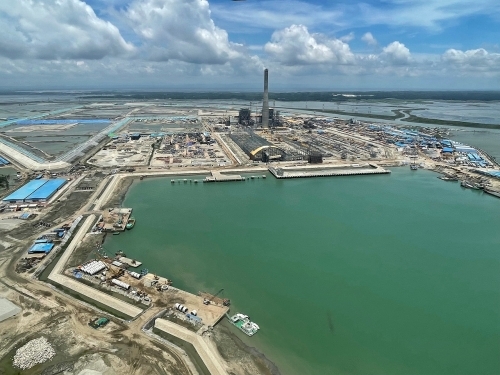
MATARBARI: THE CROWN JEWEL OF BANGLADESH’S MARITIME FUTURE: Among the three, Matarbari is the most viable and strategically promising option. Backed by Japanese investment through JICA (Japan International Cooperation Agency), the port benefits from cutting-edge engineering, sound financial planning, and strong regional support. Designed as an artificial deep-sea port with a 16-meter draft, it can handle Panamax and Capesize vessels, ensuring Bangladesh can accommodate larger cargo ships and expand its trade capacity. Its proximity to Chattogram makes integration with existing transport networks seamless, reinforcing its potential as the country’s primary maritime gateway.
Despite the high construction costs and environmental considerations, Matarbari’s strong financial and technical backing from Japan ensures steady progress. With full-scale operations expected by 2030, it is poised to become Bangladesh’s premier deep-sea port, strengthening its position as a key player in regional trade.
PAYRA: AN AMBITIOUS PROJECT FACING UNCERTAIN WATERS: Payra, once envisioned as a deep-sea port capable of revolutionizing Bangladesh’s maritime sector, has encountered severe feasibility challenges that cast doubt on its long-term sustainability. The high sedimentation rates in its location require costly and continuous dredging, leading experts to question whether the project can justify its enormous maintenance costs. Without substantial foreign investment or technical assistance, Payra remains a high-risk venture that may not deliver the expected economic benefits. As a result, what was initially planned as a deep-sea port has now been downgraded to a standard port, significantly reducing its strategic importance. Without a viable economic model or external funding, Payra risks becoming an expensive miscalculation, struggling to maintain relevance in Bangladesh’s evolving port landscape.
SONADIA: THE GEOPOLITICAL PAWN THAT NEVER MATERIALISED: Sonadia was once Bangladesh’s most promising deep-sea port project, with China poised to finance and develop it as part of its Belt and Road Initiative (BRI). However, the project became a flashpoint in the India-China rivalry, as New Delhi strongly opposed Beijing’s involvement, citing security concerns and strategic influence in the Bay of Bengal. Under pressure from India, Bangladesh ultimately scrapped the Sonadia project, redirecting its deep-sea port ambitions toward Japan-backed Matarbari instead. This move reflected India’s successful diplomatic influence in preventing a Chinese foothold in Bangladesh’s maritime sector. While Sonadia was once seen as a game-changer for regional trade, it has become a symbol of geopolitical sacrifice, effectively buried under the weight of great power competition.
NAVIGATING BANGLADESH’S MARITIME FUTURE: Among Bangladesh’s deep-sea port ambitions, Matarbari has emerged as the clear frontrunner, benefiting from robust financial backing, strategic planning, and long-term feasibility. Payra, meanwhile, faces existential challenges, with doubts over its economic viability and sustainability. Sonadia, once a promising prospect, has been politically sidelined, with India ensuring that Bangladesh remains aligned with its regional strategic interests over China’s economic expansion. As Bangladesh charts its maritime future, its choices will have profound implications-not just for its own economic growth and trade expansion but also for the geopolitical balance in the Indian Ocean. With Matarbari taking center stage, the question remains: Can Bangladesh leverage its ports to assert economic independence, or will its maritime strategy continue to be shaped by competing global interests?
BANGLADESH’S STRATEGIC TIGHTROPE: BALANCING ECONOMIC GROWTH AND GEOPOLITICAL PRESSURES IN THE BAY OF BENGAL: Situated at the nexus of South and Southeast Asia, Bangladesh has emerged as a critical player in the geopolitical contest for influence over the Indian Ocean region. With India, China, Japan, and the United States all seeking strategic footholds in its maritime infrastructure, Bangladesh’s approach to port development and economic expansion has become a high-stakes balancing act. As it undertakes ambitious port projects, Dhaka must navigate the fine line between attracting foreign investment and safeguarding its sovereignty, ensuring that economic growth does not come at the expense of strategic autonomy.
Bangladesh’s port development strategy is shaped by economic imperatives and geopolitical realities. Matarbari, backed by Japan, is the most financially and technically viable deep-sea port project, offering a sustainable solution to Bangladesh’s growing maritime trade demands. In contrast, Payra faces mounting feasibility concerns, with high maintenance costs and infrastructure challenges threatening its long-term viability. Meanwhile, Sonadia-a once-promising deep-sea project backed by China-was politically sidelined due to Indian opposition, reflecting the broader power struggle between Beijing and New Delhi over Bangladesh’s strategic alignment.
As Bangladesh moves forward, its port investments must prioritize long-term economic benefits over external political pressures. By maintaining a diverse network of trade and investment partnerships, Bangladesh can leverage its strategic location without becoming overly dependent on any single global power. The challenge lies in ensuring that its ports remain engines of economic prosperity rather than arenas of geopolitical contestation-a delicate yet essential balance in shaping the nation’s maritime future.
INDIA’S STRATEGIC IMPERATIVES: INFLUENCE AND CONNECTIVITY: For India, Bangladesh serves as a crucial transit hub, particularly for its landlocked northeastern states, making access to Bangladesh’s ports a key strategic objective. New Delhi has actively opposed Chinese involvement in Sonadia, citing security concerns, but remains comfortable with Japan’s investment in Matarbari, which aligns with its regional interests. India aims to secure preferential access to Mongla and Chattogram ports, solidifying its influence in Bangladesh’s coastal and inland connectivity while countering Chinese expansion.
CHINA’S EXPANDING FOOTPRINT: THE MARITIME SILK ROAD IN BANGLADESH: As part of its Maritime Silk Road Initiative, China views Bangladesh as a critical link in its broader Indian Ocean trade network. Beijing has already invested heavily in Bangladesh’s infrastructure, spanning rail, ports, and energy sectors, with active involvement in Mongla, Chattogram, and Payra port projects. However, this growing presence has triggered resistance from India, which sees Chinese influence as a strategic challenge in its own backyard. Despite geopolitical friction, Bangladesh continues to welcome Chinese investments, recognizing their potential to transform its maritime sector and enhance its global trade competitiveness.
JAPAN’S ROLE — A NEUTRAL BUT STRATEGIC PLAYER: Unlike India and China, Japan has historically maintained friendly relations with Bangladesh without causing significant geopolitical tensions. Through JICA (Japan International Cooperation Agency), Tokyo is funding the Matarbari Deep-Sea Port, a move widely interpreted as a counterbalance to China’s growing influence in Bangladesh’s port development. Japan’s involvement is seen as a diplomatic middle ground, allowing Bangladesh to expand its maritime capabilities without fully aligning with either China or India.
THE UNITED STATES: A STRATEGIC COUNTERWEIGHT TO CHINA: The United States has shown increasing interest in the Bay of Bengal, viewing it as a crucial theater in its Indo-Pacific strategy. While Washington’s direct involvement in Bangladesh’s port infrastructure has been limited so far, it is closely monitoring China’s growing foothold in the country. Recent U.S. support for Bangladesh’s defense modernization suggests an effort to strengthen security ties and prevent an excessive tilt toward China. This aligns with India’s broader Indo-Pacific strategy, potentially leading to greater U.S. engagement in Bangladesh’s strategic affairs.
STEERING THROUGH THE CROSSCURRENTS OF GLOBAL POWER RIVALRIES: As Bangladesh charts its course through the complex waters of economic expansion and geopolitical competition, it must master the art of strategic diplomacy to ensure that its maritime policies align with national interests and regional stability. With China offering extensive infrastructure funding, India asserting its regional influence, Japan presenting a neutral yet strategic alternative, and the United States monitoring Beijing’s growing presence, Bangladesh’s port development strategy is far more than an economic endeavor-it is a test of its diplomatic agility. The choices Dhaka makes today will shape its trade potential and define its geopolitical alignment in the evolving Indo-Pacific order.
At the heart of Bangladesh’s maritime ambitions lies a delicate balancing act-harnessing foreign investments to fuel economic growth while preserving sovereignty and avoiding excessive dependence on any single power. The competing interests of global players offer both opportunities and risks, requiring Bangladesh to strategically diversify its partnerships while ensuring that its ports remain engines of economic progress rather than pawns in geopolitical conflicts.
By carefully managing these relationships, Bangladesh can assert itself as an independent maritime and economic force, strengthening its position as a regional trade hub without compromising its autonomy. The road ahead is intricate, but with pragmatic diplomacy, innovative investment strategies, and a commitment to national interests, Bangladesh can cement its role as a rising economic power in the Indian Ocean-one that navigates global rivalries with confidence and foresight.
Ghulam Suhrawardi is the publisher of the USA-based South Asia Journal, author of Bangladesh Maritime History and nautical publications, and President of the Bangladesh Marine Academy Alumni Association. Contact: suhrawardi@southasiajournal.net
source : thefinancialexpress
Featured Post
 বড় জাহাজ মেরামতে মাতারবাড়ীতে ১ বিলিয়ন ডলারের প্রকল্প
 মাতারবাড়ীতে প্রায় ১ বিলিয়ন মার্কিন ডলার ব্যয়ে পরিবেশবান্ধব ডকইয়ার্ড ও জাহাজ নির্মাণ কেন্দ্র স্থাপনের উদ্যোগে নীতিগত অনুমোদন দিয়েছে নৌপরিবহন মন্ত্রণালয়। এখন প্রকল্পটির কারিগরি ও আর্থিক মূল্যায়নের জন্য প্রস্তাবটি সরকারি-বেসরকারি অংশীদারত্ব (পিপিপি) কর্তৃপক্ষের কাছে পাঠানো হয়েছে। সম্পূর্ণ বেসরকারি অর্থায়নে সরকারি জমির মালিকানা অক্ষুণ্ন রেখে প্রকল্পটি বাস্তবায়নের পরিকল্পনা রয়েছে। বন্দর কর্তৃপক্ষ জানায়, […]
 Industry on alert over scam messages offering ships “safe passage” on Hormuz
 Credit: Shutterstock Fraudulent messages offering safe passage through the Strait of Hormuz in exchange for cryptocurrency have been circulated to shipping companies with vessels stranded west of the waterway, according to MARISKS. In an alert issued on 20 April, MARISKS cautioned that unknown actors posing as Iranian authorities had contacted […]



JOB SITES
CONTENTS
LINKS
Happy New Year

Découvrez les avantages de MadCasino
Dans le monde des casinos en ligne, MadCasino se distingue par ses offres attrayantes et ses services de qualité. Que vous soyez un joueur débutant ou un parieur aguerri, vous trouverez ici une variété de jeux qui sauront satisfaire toutes vos envies. Les machines à sous, les jeux de table et les options de paris en direct sont tous disponibles pour vous offrir une expérience de jeu inégalée. De plus, le casino propose régulièrement des bonus qui permettent d'augmenter vos chances de gagner, vous offrant ainsi une excellente opportunité de maximiser vos gains.
En matière de sécurité, MadCasino est un nom de confiance. Il est entièrement licencié et régulé, ce qui garantit un environnement de jeu sûr et équitable. Les joueurs peuvent se concentrer sur leur expérience de jeu sans se soucier des problèmes de sécurité. Les transactions financières sont également sécurisées grâce à des technologies de pointe.
Les jeux proposés par MadCasino sont issus des développeurs les plus réputés de l'industrie, vous assurant des graphismes époustouflants et des mécaniques de jeu innovantes. Les joueurs peuvent également profiter d'une expérience de jeu en direct qui simule l'atmosphère d'un casino terrestre, tout en restant dans le confort de leur maison.
Enfin, la plateforme de MadCasino est optimisée pour les appareils mobiles, permettant aux joueurs de parier à tout moment et de n'importe où. Que vous soyez sur votre smartphone ou votre tablette, l'accès à vos jeux préférés n'a jamais été aussi simple. Ne manquez pas l'opportunité de découvrir ce casino exceptionnel.
Les offres de Cresus Casino
Cresus Casino est un autre acteur majeur dans le domaine des jeux en ligne, offrant des promotions généreuses et une vaste sélection de jeux. Les joueurs peuvent profiter d'une expérience de jeu enrichissante grâce aux nombreux bonus disponibles, qui sont conçus pour attirer tant les nouveaux utilisateurs que les joueurs réguliers. Ces avantages permettent non seulement de prolonger votre temps de jeu, mais aussi d'augmenter vos chances de gains conséquents.
Le casino se distingue également par sa ludothèque impressionnante, comprenant une sélection variée de machines à sous, de jeux de table et de jeux en direct. Les clients peuvent choisir parmi des titres populaires et appréciés, ainsi que des nouveautés qui enrichissent constamment l'offre. L'interface utilisateur est conviviale, rendant la navigation sur la plateforme fluide et agréable.
En termes de sécurité, Cresus Casino assure à ses joueurs un environnement de jeu fiable. La plateforme utilise des protocoles de sécurité avancés pour protéger les données personnelles et financières des utilisateurs. Cela permet aux joueurs de se sentir en sécurité tout en jouant à leurs jeux préférés.
Avec un service client réactif et professionnel, Cresus Casino s'assure que toutes vos questions et préoccupations sont traitées rapidement. Que ce soit pour des questions concernant les bonus, les retraits ou les jeux, vous bénéficierez d'une assistance rapide et efficace.
Explorez Nine Casino et ses avantages
Dans l'univers des casinos en ligne, Nine Casino a su se faire une place de choix grâce à son approche innovante et à ses nombreux avantages pour les joueurs. Les utilisateurs peuvent s'attendre à une expérience de jeu enrichissante, avec des bonus attractifs qui sont régulièrement mis à jour. Ces offres sont une excellente façon de découvrir de nouveaux jeux tout en maximisant votre potentiel de gain.
La plateforme de Nine Casino est riche en options de jeux, allant des machines à sous aux jeux de table, en passant par le live casino. Chaque jeu est conçu pour offrir une expérience immersive grâce à des graphismes de haute qualité et des fonctionnalités innovantes. Les parieurs peuvent profiter de sessions de jeu captivantes, comme s'ils étaient dans un véritable casino.
La sécurité est une priorité pour Nine Casino, qui utilise des technologies de cryptage avancées pour protéger les informations de ses joueurs. Cela garantit un environnement de jeu sûr et fiable, permettant aux utilisateurs de se concentrer sur ce qu'ils aiment le plus : jouer.
Enfin, le service clientèle fourni par Nine Casino est exceptionnel, avec des agents disponibles pour répondre à toutes vos questions et résoudre vos problèmes. Vous pourrez ainsi jouer en toute tranquillité, sachant que votre satisfaction est au cœur de leurs préoccupations.
Profitez de l'expérience Lucky31
Lucky31 est un casino en ligne qui se distingue par son approche orientée vers le joueur, offrant une multitude d'options de jeux et des bonus généreux. Que vous soyez amateur de machines à sous ou passionné de jeux de table, vous trouverez une large sélection pour satisfaire toutes vos envies de jeu. Les promotions fréquentes permettent aux joueurs de prolonger leur expérience tout en augmentant leurs chances de gains.
La convivialité de la plateforme de Lucky31 est l'un de ses plus grands atouts. Les joueurs peuvent naviguer facilement entre les différents jeux, et l'interface est conçue pour être intuitive, quel que soit le niveau d'expérience de l'utilisateur. De plus, le casino est entièrement optimisé pour les appareils mobiles, ce qui permet de parier où que vous soyez.
En matière de sécurité, Lucky31 prend les préoccupations des joueurs très au sérieux. Le casino est agréé et régulé, garantissant un environnement de jeu équitable et sécurisé. Les joueurs peuvent ainsi se concentrer sur leur expérience de jeu sans se soucier des risques liés à la sécurité.
Pour ceux qui recherchent un support client efficace, Lucky31 offre un service réactif et professionnel. Que ce soit pour des questions sur les bonus, les jeux ou les paiements, vous aurez accès à une assistance de qualité, vous garantissant une expérience de jeu fluide et agréable.