search the site


Understanding International Waters: Boundaries, Jurisdiction And Legal Implications

National Oceanic and Atmospheric AdministrationU.S. Department of Commerce
Jurisdiction Over Vessels
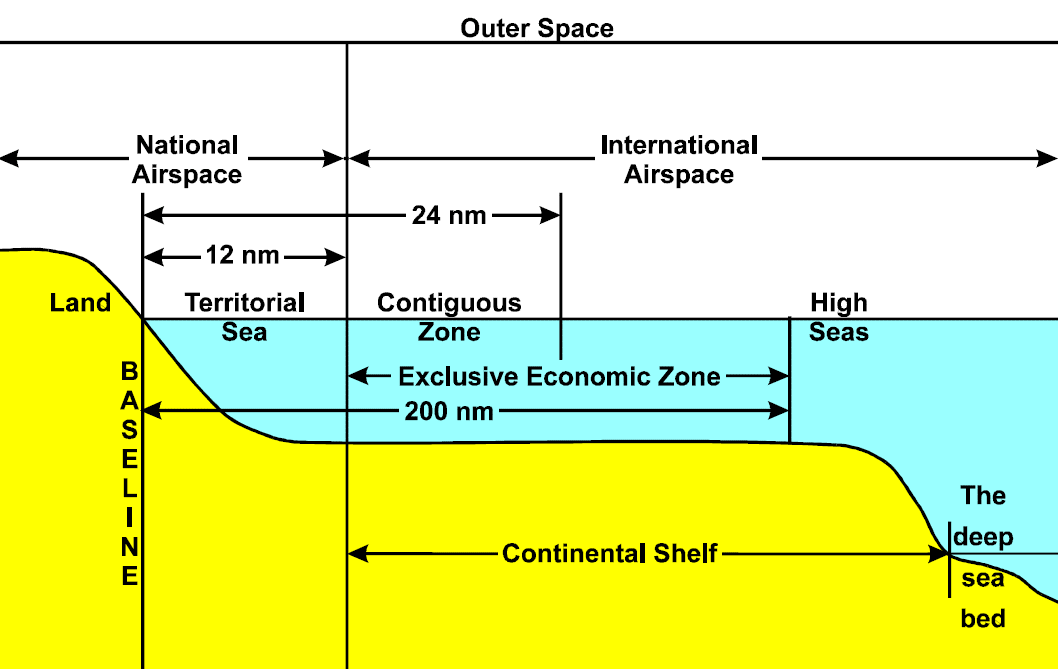
Image source MRAG
Prescriptive (or “law-making”) jurisdiction is the authority to make and apply laws. International law permits a State to exercise varying degrees of jurisdiction over its flagged vessels, vessels within its ports, and vessels within its maritime zones (including its internal waters, territorial sea, contiguous zone, and exclusive economic zone). These exercises of jurisdiction are derived from principles which are recognized as customary international law. The exercise of jurisdiction in each instance is also recognized under the Law of the Sea Convention (LOSC).
Flag State Jurisdiction
A State may exercise jurisdiction over a vessel that is registered with the State and flying its flag. This exercise of jurisdiction is based on the internationally recognized principle that a State may regulate the conduct of its nationals even when those nationals are acting outside of the State’s territory. See The Apollon, 22 U.S. (9 Wheat.) 362, 370 (1824)offsite link (“The laws of no nation can justly extend beyond its own territories, except so far as regards its own citizens.”). Because flag state jurisdiction depends on the nationality of the vessel, it may be exercised upon the high seas and within the waters over which a foreign State exercises jurisdiction.
The granting of nationality to a ship is a matter within the exclusive jurisdiction of the State concerned. See M/V Saiga (No.2) Case (St. Vincent and the Grenadines v. Guinea), ITLOS, Judgement of 4 Dec. 1999, Case No. 1offsite link. Therefore, it is up to that State to regulate by its domestic law the conditions for the grant of nationality. Once a grant of nationality has been made, a ship may not sail under a different flag unless it has been sold or the owner changes its registry. See United States v. Marino-Garcia, 679 F.2d 1373, 1378 n. 3 (11th Cir.1982)offsite link (“A vessel will be deemed stateless where it sails under the authority of two or more States and uses them according to convenience.”). Articles 91 and 94 of the LOSC reflect the exercise of flag state jurisdiction under the Law of the Sea. Article 91(1) provides that “[s]hips have the nationality of the State whose flag they are entitled to fly.” Article 94(4) affirms that “[e]very State shall effectively exercise its jurisdiction and control in administrative, technical and social matters over ships flying its flag.” In addition, Article 92(1) clarifies that flag state jurisdiction is exclusive, unless jurisdiction is provided for elsewhere in the LOSC, or in another international treaty.
Port State Jurisdiction
A State may exercise jurisdiction over foreign flagged merchant vessels within its ports and internal waters. Cunard S.S. Co. v. Mellon, 262 U.S. 100, 124 (1923)offsite link; Benz v. Companie Naviera Hidalgo, S.A. 353 U.S. 138, 142 (1957);offsite link Spector v. Norwegian Cruise Line Ltd., 545 U.S. 119, 130-31 (2005)offsite link; United States Department of State, “Immunity of Uruguayan Oil Tanker Presidente Rivera” (July 13, 1989). This exercise of jurisdiction derives from the principle of territoriality, which is recognized as customary international law. See The Schooner Exchange v. McFaddon, 11 U.S. (7 Cranch) 116, 136 (1812)offsite link (“The jurisdiction of a nation within its own territory is necessarily exclusive and absolute.”). Territoriality gives a State exclusive authority to regulate persons within its borders. The exercise of this type of jurisdiction is dependent on the location of the conduct. So long as the conduct regulated falls within the territory of the State, it has jurisdiction. Thus a State may apply its laws to foreign flagged merchant ships while they are within its ports and internal waters, which are considered part of its territory. Restatement (Third) of Foreign Relations Law § 512, comment h (1987).
While port state jurisdiction over foreign commercial ships is recognized as customary international law, port state jurisdiction does not extend to vessels owned or operated by a foreign state, except when they are used for commercial purposes. See The Schooner Exchange v. McFaddon, 11 U.S. (7 Cranch) 116 (1812)offsite link; the Foreign Sovereign Immunities Act, 28 U.S.C. § 1605(a)(2)offsite link. Although foreign government ships operated for non-commercial purposes are required to comply with a State’s laws while within its ports and internal waters, they are immune from inspection, arrest, or seizure by authorities of nations other than the flag state. See The “Ara Libertad” Case (Argentina v. Ghana), ITLOS, Order of 12 Dec. 2012, Case No. 20offsite link (holding that “in accordance with general international law, a warship enjoys immunity, including in internal waters” (¶ 95).) This is reflected in the Law of the Sea Convention (LOSC) Articles 32, 96, and 236 which provide immunity for government ships exclusively on non-commercial service.
The LOSC recognizes port state jurisdiction in Articles 25, 218, 219, and 220. Under Article 25(2) of the LOSC, “[i]n the case of ships proceeding to internal waters or a call at a port facility outside internal waters, the coastal State also has the right to take the necessary steps to prevent any breach of the conditions to which admission of those ships to internal waters or such a call is subject.” LOSC Article 218(1) also permits a State to investigate and institute proceedings with respect to pollution from a vessel when it is voluntarily within a port of the State.
Coastal State Jurisdiction in Zones of Adjacent Sea
A coastal State’s jurisdiction is different in the several zones of adjacent sea. See Restatement (Third) of Foreign Relations Law §§ 511-15 (1987). These zones may extend up to 200 nautical miles from the State’s baseline. See Maritime Zones and Boundaries. A State’s jurisdiction over the activities of vessels in its zones of adjacent sea diminishes as the distance from shore increases.
Territorial Sea
A State exercises almost complete sovereignty in its territorial sea, similar to that which it possesses over its land, internal waters, and ports. See Restatement (Third) of Foreign Relations Law § 512 (1987). This exercise of jurisdiction, like port state jurisdiction, is derived from the international law principle of territoriality, which gives a State exclusive authority to regulate persons within its borders. See The Schooner Exchange v. McFaddon, 11 U.S. (7 Cranch) 116, 136 (1812)offsite link. Thus a State has jurisdiction over all persons and vessels in its territorial sea, without regard to the person’s nationality or the vessel’s flag. Cunard S.S. Co. v. Mellon, 262 U.S. 100, 124 (1923).offsite link While this includes foreign government ships operated for non-commercial purposes, a failure of compliance by such vessels is subject only to diplomatic complaint or to coastal State orders to leave its territorial sea immediately. In addition, under the doctrine of hot pursuit a coastal State may stop, inspect, and seize a foreign merchant vessel attempting to leave its territorial sea when it has good reason to suspect that the vessel has violated its laws. See Gillam v. United States, 27 F.2d 296, 298 (4th Cir. 1928)offsite link.
The main limitation on a State’s sovereignty in its territorial sea is the right of innocent passage for foreign vessels. The right of innocent passage allows a foreign vessel to transit through the territorial sea of a coastal State unhindered, so long as its passage is not prejudicial to the “peace, good order, or security of the coastal State.” See Restatement (Third) of Foreign Relations Law § 513 (1987). The right of innocent passage has long been recognized as customary international law. See, e.g., Corfu Channel case (UK/Albania), I.C.J. Reports 1949 p.28offsite link; U.S. V. Louisiana, 394 U.S. 11, 22 (1969)offsite link. It prevents a State from hindering the passage of a foreign vessel through its territorial sea and from adopting measures to the same effect. See Restatement (Third) of Foreign Relations Law § 513 Comment b. (1987). Still, a State may adopt some measures to protect against passage through its territorial sea that is not innocent, including regulations relating to navigational safety and the prevention of pollution. See LOSC Article 21; Restatement (Third) of Foreign Relations Law § 513(2)(b) (1987).
The LOSC recognizes coastal state sovereignty over the territorial sea in Article 2(1), which states, “The sovereignty of a coastal State extends, beyond its land territory and internal waters…to an adjacent belt of sea, described as the territorial sea.” The LOSC also codifies the right of innocent passage in Article 17, which affirms that “all States, whether coastal or land-locked, enjoy the right of innocent through the territorial sea.” LOSC Articles 18-26, 37-44, and 53 provide the measures that coastal States may adopt to prevent passage that is not innocent within their territorial sea.
Additionally, Article 27(2) provides that a foreign ship passing through a coastal State’s territorial sea after leaving its internal waters is not accorded the right of innocent passage and may be stopped by the coastal State. A coastal State’s right of hot pursuit of a foreign merchant vessel leaving its territorial sea is set forth in LOSC Article 111.
Contiguous Zone
A coastal State has limited authority in its contiguous zone. It may only apply and enforce specific national laws relating to customs, taxes, immigration, and sanitation within its contiguous zone. See Restatement (Third) of Foreign Relations Law § 513 comment f. (The U.S. is of the view that such national laws include environmental laws. See., e.g., Vice-President Al Gore, “Extension of Federal Enforcement Zone in U.S. Coastal Waters Will Help Prevent Violations of Environmental, Customs, or Immigration Laws”(Sept. 2, 1999)). This limited jurisdiction is likely derived from the protective principle, which is recognized under international law. See United States v. Zehe, 601 F. Supp. 196 (D. Mass. 1985)offsite link (holding that under international law, a State can punish criminal acts that threaten national security or directly obstruct governmental functions even if committed outside its territory by persons who are not its citizens). The protective principle provides for jurisdiction over certain conduct outside of a State’s territory that threatens its security. See Restatement (Third) of Foreign Relations Law § 402(3).
The right of hot pursuit also permits a coastal State to stop a foreign merchant vessel attempting to leave its contiguous zone when it has good reason to suspect that the vessel has violated its laws that apply within that zone. See Restatement (Third) of Foreign Relations Law § 513 comment g. In addition, because the contiguous zone is a part of the EEZ, a coastal State has the same sovereign rights in its contiguous zone as in its EEZ, including the authority to regulate economic activities (see below).
A coastal State’s limited authority within its contiguous zone is reflected in Article 33 of the LOSC, which states that within its contiguous zone a “coastal State may exercise the control necessary to…prevent infringement of its customs, fiscal, immigration or sanitary laws and regulations within its territory or territorial sea.” In addition, LOSC Article 303(2) protects archaeological and historical objects found within a State’s contiguous zone by establishing the presumption that their removal without the State’s approval would violate its laws within its territorial sea.
Exclusive Economic Zone
A coastal State has sovereign rights to the management of natural resources and other economic activities within its Exclusive Economic Zone (EEZ). See Restatement (Third) of Foreign Relations Law § 514. It does not have sovereignty within its EEZ, so foreign vessels possess the same non-economic rights within a State’s EEZ as on the high seas. This type of limited jurisdiction is likely derived from the effects principle, which is a basis for exercising jurisdiction over an activity outside of the State, but having a substantial effect within its territory. See Restatement (Third) of Foreign Relations Law § 402(1)(c). This basis of jurisdiction is recognized under international law. See The S.S. Lotus Case (France/Turkey), P.C.I.J. Ser. A, No. 10, p. 4 (1927)offsite link (holding that international law permitted a Turkish court to exercise jurisdiction over the captain of a French ship, which had collided with and sank a Turkish ship on the high seas); U.S. v. F/V Taiyo Maru, 395 F. Supp. 413 (D. Maine 1975)offsite link.
The right of hot pursuit permits a coastal State to stop a foreign merchant vessel attempting to leave its EEZ when it has good reason to suspect that the vessel has violated its laws that apply within that zone. See Restatement (Third) of Foreign Relations Law § 513 comment g. The uninterrupted pursuit may continue on the high seas and within the EEZs of other states, as long as the pursued vessel does not enter the territorial sea of another coastal State. See Restatement § 513 comment g.
Article 56 of the LOSC recognizes a coastal State’s sovereign rights for the purpose of exploring, exploiting, conserving, and managing the natural resources within its EEZ. A coastal State also has sovereign rights to engage in other activities, such as the production of energy from the water, currents, and winds. The rights of other states to non-economic uses of a coastal State’s EEZ are reflected in Article 58. The LOSC also provides in Article 246 that a coastal state has the authority to regulate marine scientific research within its EEZ, but that the state should normally grant consent for research to be carried out by another state, unless the research has direct significance for the exploration of economic resources in the zone. And LOSC Article 210(5) specifies that dumping in the EEZ may not be carried out with the express prior approval of the coastal State. “Dumping” is defined in LOSC Article 1(5) to mean the deliberate disposal of wastes or other matter from vessels as well as the deliberate disposal of the vessel itself. “Dumping” does not, however, include the disposal of wastes or other matter incidental to, or derived from the normal operations of vessels.
Last updated October 4, 2022
Featured Post
 জাহাজ নির্মাণ শিল্প: হাতছাড়া হচ্ছে অপার সম্ভাবনা
 গোলাম সোহরাওয়ার্দি প্রকাশ : ২৭ অক্টোবর ২০২৬, ০৮: ০৪আপডেট : ২৭ অক্টোবর ২০২৬, ০৯: ২৪ সারা বিশ্ব এখন জাহাজ নির্মাণের এক বিশাল জোয়ার দেখছে। চীন, দক্ষিণ কোরিয়া ও জাপানের মতো দেশগুলো এ খাত থেকে বিপুল মুনাফা কামিয়ে নিচ্ছে। নতুন বাণিজ্যিক পথ তৈরি, জাহাজের […]
 Worldwide Shipbuilding Boom and Bangladesh’s Lost Opportunity: How Financial Mismanagement, Loan Defaults, and Weak Governance Crippled a Promising Industry
An investigative analysis by Ghulam Suhrawardi Today, the world is witnessing one of the largest shipbuilding booms in history. Many countries are profiting from it. China, South Korea, and Japan have benefited from increased demand for new vessels due to fleet renewal, changing trade routes, environmental regulations, and strong financial […]



JOB SITES
CONTENTS
LINKS
Happy New Year

Découvrez les avantages de MadCasino
Dans le monde des casinos en ligne, MadCasino se distingue par ses offres attrayantes et ses services de qualité. Que vous soyez un joueur débutant ou un parieur aguerri, vous trouverez ici une variété de jeux qui sauront satisfaire toutes vos envies. Les machines à sous, les jeux de table et les options de paris en direct sont tous disponibles pour vous offrir une expérience de jeu inégalée. De plus, le casino propose régulièrement des bonus qui permettent d'augmenter vos chances de gagner, vous offrant ainsi une excellente opportunité de maximiser vos gains.
En matière de sécurité, MadCasino est un nom de confiance. Il est entièrement licencié et régulé, ce qui garantit un environnement de jeu sûr et équitable. Les joueurs peuvent se concentrer sur leur expérience de jeu sans se soucier des problèmes de sécurité. Les transactions financières sont également sécurisées grâce à des technologies de pointe.
Les jeux proposés par MadCasino sont issus des développeurs les plus réputés de l'industrie, vous assurant des graphismes époustouflants et des mécaniques de jeu innovantes. Les joueurs peuvent également profiter d'une expérience de jeu en direct qui simule l'atmosphère d'un casino terrestre, tout en restant dans le confort de leur maison.
Enfin, la plateforme de MadCasino est optimisée pour les appareils mobiles, permettant aux joueurs de parier à tout moment et de n'importe où. Que vous soyez sur votre smartphone ou votre tablette, l'accès à vos jeux préférés n'a jamais été aussi simple. Ne manquez pas l'opportunité de découvrir ce casino exceptionnel.
Les offres de Cresus Casino
Cresus Casino est un autre acteur majeur dans le domaine des jeux en ligne, offrant des promotions généreuses et une vaste sélection de jeux. Les joueurs peuvent profiter d'une expérience de jeu enrichissante grâce aux nombreux bonus disponibles, qui sont conçus pour attirer tant les nouveaux utilisateurs que les joueurs réguliers. Ces avantages permettent non seulement de prolonger votre temps de jeu, mais aussi d'augmenter vos chances de gains conséquents.
Le casino se distingue également par sa ludothèque impressionnante, comprenant une sélection variée de machines à sous, de jeux de table et de jeux en direct. Les clients peuvent choisir parmi des titres populaires et appréciés, ainsi que des nouveautés qui enrichissent constamment l'offre. L'interface utilisateur est conviviale, rendant la navigation sur la plateforme fluide et agréable.
En termes de sécurité, Cresus Casino assure à ses joueurs un environnement de jeu fiable. La plateforme utilise des protocoles de sécurité avancés pour protéger les données personnelles et financières des utilisateurs. Cela permet aux joueurs de se sentir en sécurité tout en jouant à leurs jeux préférés.
Avec un service client réactif et professionnel, Cresus Casino s'assure que toutes vos questions et préoccupations sont traitées rapidement. Que ce soit pour des questions concernant les bonus, les retraits ou les jeux, vous bénéficierez d'une assistance rapide et efficace.
Explorez Nine Casino et ses avantages
Dans l'univers des casinos en ligne, Nine Casino a su se faire une place de choix grâce à son approche innovante et à ses nombreux avantages pour les joueurs. Les utilisateurs peuvent s'attendre à une expérience de jeu enrichissante, avec des bonus attractifs qui sont régulièrement mis à jour. Ces offres sont une excellente façon de découvrir de nouveaux jeux tout en maximisant votre potentiel de gain.
La plateforme de Nine Casino est riche en options de jeux, allant des machines à sous aux jeux de table, en passant par le live casino. Chaque jeu est conçu pour offrir une expérience immersive grâce à des graphismes de haute qualité et des fonctionnalités innovantes. Les parieurs peuvent profiter de sessions de jeu captivantes, comme s'ils étaient dans un véritable casino.
La sécurité est une priorité pour Nine Casino, qui utilise des technologies de cryptage avancées pour protéger les informations de ses joueurs. Cela garantit un environnement de jeu sûr et fiable, permettant aux utilisateurs de se concentrer sur ce qu'ils aiment le plus : jouer.
Enfin, le service clientèle fourni par Nine Casino est exceptionnel, avec des agents disponibles pour répondre à toutes vos questions et résoudre vos problèmes. Vous pourrez ainsi jouer en toute tranquillité, sachant que votre satisfaction est au cœur de leurs préoccupations.
Profitez de l'expérience Lucky31
Lucky31 est un casino en ligne qui se distingue par son approche orientée vers le joueur, offrant une multitude d'options de jeux et des bonus généreux. Que vous soyez amateur de machines à sous ou passionné de jeux de table, vous trouverez une large sélection pour satisfaire toutes vos envies de jeu. Les promotions fréquentes permettent aux joueurs de prolonger leur expérience tout en augmentant leurs chances de gains.
La convivialité de la plateforme de Lucky31 est l'un de ses plus grands atouts. Les joueurs peuvent naviguer facilement entre les différents jeux, et l'interface est conçue pour être intuitive, quel que soit le niveau d'expérience de l'utilisateur. De plus, le casino est entièrement optimisé pour les appareils mobiles, ce qui permet de parier où que vous soyez.
En matière de sécurité, Lucky31 prend les préoccupations des joueurs très au sérieux. Le casino est agréé et régulé, garantissant un environnement de jeu équitable et sécurisé. Les joueurs peuvent ainsi se concentrer sur leur expérience de jeu sans se soucier des risques liés à la sécurité.
Pour ceux qui recherchent un support client efficace, Lucky31 offre un service réactif et professionnel. Que ce soit pour des questions sur les bonus, les jeux ou les paiements, vous aurez accès à une assistance de qualité, vous garantissant une expérience de jeu fluide et agréable.