
search the site


The “Impossible” Fish That Broke Two Deep Sea Records
The “Impossible” Fish That Broke Two Deep Sea Records
The Maritime Executive 24 April 2023
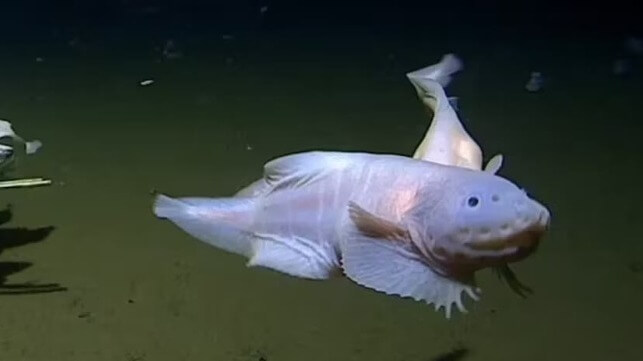
When thinking of animals that live in the most extreme environments on Earth most of us probably don’t think of the snailfish. Its name may not hint at extraordinary physical capabilities but the snailfish has broken the record for living at the deepest ocean depths known to humanity.
In fact scientists believed it was physiologically impossible for fish to survive conditions below 8,200 meters. Until recently, when Australian and Japanese researchers found one at a record-shattering 8,336 meters in the Izu-Ogasawara Trench, south of Japan. That’s 158 meters deeper than the previous record, also set by a snailfish during an encounter in 2017 in the Marianas Trench, about 2,000 kilometers east of the Philippines.
The deep ocean has yet again shown us there is still much to be discovered if we only have the willingness to look.
Defined as waters below 200 meters, this environment makes up 50 percent of Earth’s surface. Researchers estimate that only 10-28 percent of marine life is currently known, and most knowledge stems from researchers based in Europe, the US and Japan.
Scientists believe a lack of understanding of ocean life and its distribution is one of the biggest barriers to restoring marine biodiversity damaged by overfishing, pollution and climate change.
But when we do explore the deep ocean, we are often rewarded with new discoveries.
My current research focuses on the relatively shallow parts of the ocean from 0-500 meters. Even in relatively well-researched areas such as Bermuda, discoveries can still be made. In one oceanographic expedition, the international team I was part of discovered vast expanses of black wire coral gardens, the deepest record of the invasive lionfish, and several new species of red algae.
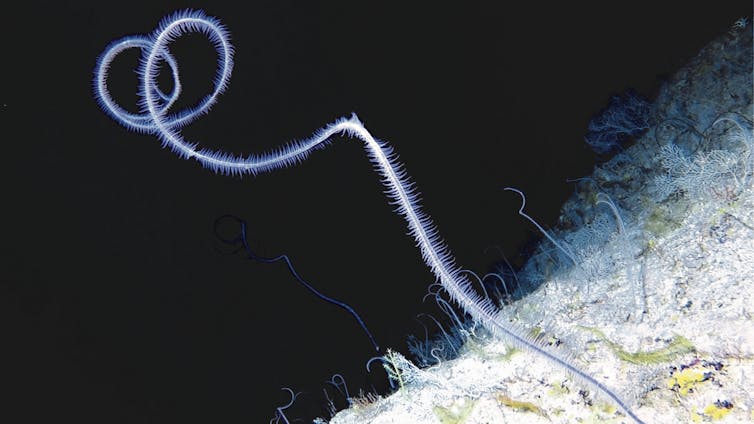
Black coral gardens in Bermuda. Nekton Foundation, Author provided
It’s common for up to 50 percent of all species (and sometimes almost 95 percent) sampled on a single deep-ocean expedition to be new to science. New habitat discoveries are also common. In March 2023 scientists on an expedition to the Mid-Atlantic ridge for the Schmidt Ocean Institute discovered numerous new hydrothermal vents also known as black smokers (like geysers, or hot springs, on the ocean floor).
Why deep ocean discoveries matter
Research suggests hydrothermal vents may have played a key role in the origin of life on our planet. So any new information about these unique ecosystems and their inhabitants has implications for humanity as well as extraterrestrial life.
Hydrothermal vents also show the astonishing adaptability of life. In 2012, scientists discovered new species of crabs in the Southern Ocean, the hairy-chested Hoff crabs. Named after their resemblance to the Baywatch actor David Hasselhoff, they construct crab cities around black smokers. There can be more than 700 crabs per square metre. The fur on their chest incubates microbes that can convert toxic chemicals that come out of scorching black smokers into energy. The crabs use special comb-like mouthparts to remove the energy-rich bacteria from their fur to eat. It is their main source of nourishment.
Apart from the excitement and wonder that comes with it, these discoveries provide new information that benefits society. Studies have found this habitat could harbour treatments for human diseases. Recently, researchers studied fungi found in cold-water animals called sea pens in the northeast Atlantic and discovered they produce compounds that show promise as potential drug treatments for chronic musculoskeletal diseases such as osteoarthritis.
Similarly, studies show bacteria living in deep-water sponges may have both antibiotic and antitumour properties.
The potential of bioprospecting – studying wildlife and plantlife for valuable new resources – has barely been explored in the case of deep ocean. But the industry is rapidly growing and already worth billions of dollars. Countries agreed to share the benefits as part of the UN high seas treaty in March 2023. But the new international law has not yet been ratified and it is too soon to tell whether developed nations will stick to their pledge to share the ocean’s resources with all member states.
Where do we go next?
Very little of the deep ocean has been systematically explored so far due to financial and logistical constraints. Remotely-operated vehicles cost from US$15,000 (£12,100) to millions of dollars, while a submarine built for deep ocean exploration can cost almost US$50 million. In addition, offshore exploration requires large research vessels to be deployed for weeks at sea which involves months of planning and logistics.
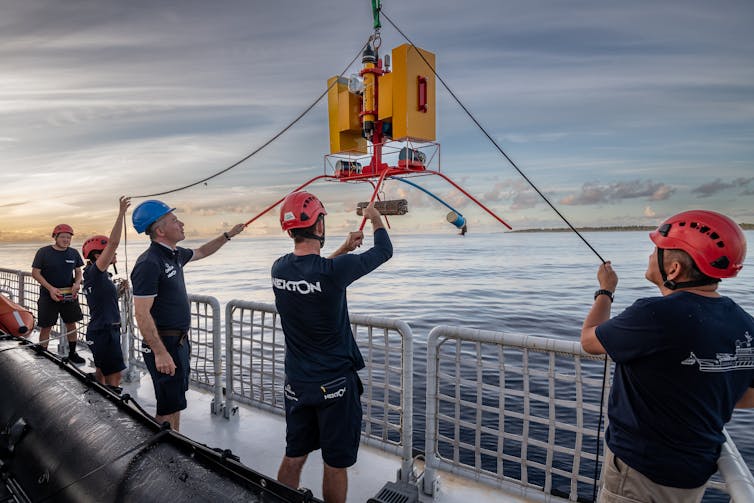
Landers being deployed on a deep ocean survey in the Maldives. Nekton Foundation, Author provided
The recent snailfish discovery was made during an international expedition involving Australian and Japanese researchers who set out to explore life in the trenches off Japan. For that study, the team used landers, metal cages that land on the seafloor using ballast weights. Landers are equipped with cameras, lights and bait for attracting predators. While it is possible to explore even the greatest ocean depths with submarines, landers are easier to operate, and can stay underwater for longer.
We are losing deep sea life before we can even discover it. Overfishing, noise pollution and global warming are already destroying deep ocean ecosystems and their inhabitants. Commercial deep seabed mining for minerals has not yet been carried out but it is a looming threat.
Governments allocate on average only 1.7 percent of their annual research budgets to explore beneath the ocean surface. If scientists make new discoveries with almost every study of the deep ocean, imagine what we could achieve if governments, charities and marine scientists worked more closely together and had better funding.
Paris Stefanoudis is a senior postdoctoral researcher at University of Oxford.
This article appears courtesy of The Conversation and may be found in its original form here.

The opinions expressed herein are the author’s and not necessarily those of The Maritime Executive.
When thinking of animals that live in the most extreme environments on Earth most of us probably don’t think of the snailfish. Its name may not hint at extraordinary physical capabilities but the snailfish has broken the record for living at the deepest ocean depths known to humanity.
In fact scientists believed it was physiologically impossible for fish to survive conditions below 8,200 meters. Until recently, when Australian and Japanese researchers found one at a record-shattering 8,336 meters in the Izu-Ogasawara Trench, south of Japan. That’s 158 meters deeper than the previous record, also set by a snailfish during an encounter in 2017 in the Marianas Trench, about 2,000 kilometers east of the Philippines.
The deep ocean has yet again shown us there is still much to be discovered if we only have the willingness to look.
Defined as waters below 200 meters, this environment makes up 50 percent of Earth’s surface. Researchers estimate that only 10-28 percent of marine life is currently known, and most knowledge stems from researchers based in Europe, the US and Japan.
Scientists believe a lack of understanding of ocean life and its distribution is one of the biggest barriers to restoring marine biodiversity damaged by overfishing, pollution and climate change.
But when we do explore the deep ocean, we are often rewarded with new discoveries.
My current research focuses on the relatively shallow parts of the ocean from 0-500 meters. Even in relatively well-researched areas such as Bermuda, discoveries can still be made. In one oceanographic expedition, the international team I was part of discovered vast expanses of black wire coral gardens, the deepest record of the invasive lionfish, and several new species of red algae.
Black coral gardens in Bermuda. Nekton Foundation, Author provided
It’s common for up to 50 percent of all species (and sometimes almost 95 percent) sampled on a single deep-ocean expedition to be new to science. New habitat discoveries are also common. In March 2023 scientists on an expedition to the Mid-Atlantic ridge for the Schmidt Ocean Institute discovered numerous new hydrothermal vents also known as black smokers (like geysers, or hot springs, on the ocean floor).
Why deep ocean discoveries matter
Research suggests hydrothermal vents may have played a key role in the origin of life on our planet. So any new information about these unique ecosystems and their inhabitants has implications for humanity as well as extraterrestrial life.
Hydrothermal vents also show the astonishing adaptability of life. In 2012, scientists discovered new species of crabs in the Southern Ocean, the hairy-chested Hoff crabs. Named after their resemblance to the Baywatch actor David Hasselhoff, they construct crab cities around black smokers. There can be more than 700 crabs per square metre. The fur on their chest incubates microbes that can convert toxic chemicals that come out of scorching black smokers into energy. The crabs use special comb-like mouthparts to remove the energy-rich bacteria from their fur to eat. It is their main source of nourishment.
Apart from the excitement and wonder that comes with it, these discoveries provide new information that benefits society. Studies have found this habitat could harbour treatments for human diseases. Recently, researchers studied fungi found in cold-water animals called sea pens in the northeast Atlantic and discovered they produce compounds that show promise as potential drug treatments for chronic musculoskeletal diseases such as osteoarthritis.
Similarly, studies show bacteria living in deep-water sponges may have both antibiotic and antitumour properties.
The potential of bioprospecting – studying wildlife and plantlife for valuable new resources – has barely been explored in the case of deep ocean. But the industry is rapidly growing and already worth billions of dollars. Countries agreed to share the benefits as part of the UN high seas treaty in March 2023. But the new international law has not yet been ratified and it is too soon to tell whether developed nations will stick to their pledge to share the ocean’s resources with all member states.
Where do we go next?
Very little of the deep ocean has been systematically explored so far due to financial and logistical constraints. Remotely-operated vehicles cost from US$15,000 (£12,100) to millions of dollars, while a submarine built for deep ocean exploration can cost almost US$50 million. In addition, offshore exploration requires large research vessels to be deployed for weeks at sea which involves months of planning and logistics.
Landers being deployed on a deep ocean survey in the Maldives. Nekton Foundation, Author provided
The recent snailfish discovery was made during an international expedition involving Australian and Japanese researchers who set out to explore life in the trenches off Japan. For that study, the team used landers, metal cages that land on the seafloor using ballast weights. Landers are equipped with cameras, lights and bait for attracting predators. While it is possible to explore even the greatest ocean depths with submarines, landers are easier to operate, and can stay underwater for longer.
We are losing deep sea life before we can even discover it. Overfishing, noise pollution and global warming are already destroying deep ocean ecosystems and their inhabitants. Commercial deep seabed mining for minerals has not yet been carried out but it is a looming threat.
Governments allocate on average only 1.7 percent of their annual research budgets to explore beneath the ocean surface. If scientists make new discoveries with almost every study of the deep ocean, imagine what we could achieve if governments, charities and marine scientists worked more closely together and had better funding.
Paris Stefanoudis is a senior postdoctoral researcher at University of Oxford.
This article appears courtesy of The Conversation and may be found in its original form here.
The opinions expressed herein are the author’s and not necessarily those of The Maritime Executive.
When thinking of animals that live in the most extreme environments on Earth most of us probably don’t think of the snailfish. Its name may not hint at extraordinary physical capabilities but the snailfish has broken the record for living at the deepest ocean depths known to humanity.
In fact scientists believed it was physiologically impossible for fish to survive conditions below 8,200 meters. Until recently, when Australian and Japanese researchers found one at a record-shattering 8,336 meters in the Izu-Ogasawara Trench, south of Japan. That’s 158 meters deeper than the previous record, also set by a snailfish during an encounter in 2017 in the Marianas Trench, about 2,000 kilometers east of the Philippines.
The deep ocean has yet again shown us there is still much to be discovered if we only have the willingness to look.
Defined as waters below 200 meters, this environment makes up 50 percent of Earth’s surface. Researchers estimate that only 10-28 percent of marine life is currently known, and most knowledge stems from researchers based in Europe, the US and Japan.
Scientists believe a lack of understanding of ocean life and its distribution is one of the biggest barriers to restoring marine biodiversity damaged by overfishing, pollution and climate change.
But when we do explore the deep ocean, we are often rewarded with new discoveries.
My current research focuses on the relatively shallow parts of the ocean from 0-500 meters. Even in relatively well-researched areas such as Bermuda, discoveries can still be made. In one oceanographic expedition, the international team I was part of discovered vast expanses of black wire coral gardens, the deepest record of the invasive lionfish, and several new species of red algae.
Black coral gardens in Bermuda. Nekton Foundation, Author provided
It’s common for up to 50 percent of all species (and sometimes almost 95 percent) sampled on a single deep-ocean expedition to be new to science. New habitat discoveries are also common. In March 2023 scientists on an expedition to the Mid-Atlantic ridge for the Schmidt Ocean Institute discovered numerous new hydrothermal vents also known as black smokers (like geysers, or hot springs, on the ocean floor).
Why deep ocean discoveries matter
Research suggests hydrothermal vents may have played a key role in the origin of life on our planet. So any new information about these unique ecosystems and their inhabitants has implications for humanity as well as extraterrestrial life.
Hydrothermal vents also show the astonishing adaptability of life. In 2012, scientists discovered new species of crabs in the Southern Ocean, the hairy-chested Hoff crabs. Named after their resemblance to the Baywatch actor David Hasselhoff, they construct crab cities around black smokers. There can be more than 700 crabs per square metre. The fur on their chest incubates microbes that can convert toxic chemicals that come out of scorching black smokers into energy. The crabs use special comb-like mouthparts to remove the energy-rich bacteria from their fur to eat. It is their main source of nourishment.
Apart from the excitement and wonder that comes with it, these discoveries provide new information that benefits society. Studies have found this habitat could harbour treatments for human diseases. Recently, researchers studied fungi found in cold-water animals called sea pens in the northeast Atlantic and discovered they produce compounds that show promise as potential drug treatments for chronic musculoskeletal diseases such as osteoarthritis.
Similarly, studies show bacteria living in deep-water sponges may have both antibiotic and antitumour properties.
The potential of bioprospecting – studying wildlife and plantlife for valuable new resources – has barely been explored in the case of deep ocean. But the industry is rapidly growing and already worth billions of dollars. Countries agreed to share the benefits as part of the UN high seas treaty in March 2023. But the new international law has not yet been ratified and it is too soon to tell whether developed nations will stick to their pledge to share the ocean’s resources with all member states.
Where do we go next?
Very little of the deep ocean has been systematically explored so far due to financial and logistical constraints. Remotely-operated vehicles cost from US$15,000 (£12,100) to millions of dollars, while a submarine built for deep ocean exploration can cost almost US$50 million. In addition, offshore exploration requires large research vessels to be deployed for weeks at sea which involves months of planning and logistics.
Landers being deployed on a deep ocean survey in the Maldives. Nekton Foundation, Author provided
The recent snailfish discovery was made during an international expedition involving Australian and Japanese researchers who set out to explore life in the trenches off Japan. For that study, the team used landers, metal cages that land on the seafloor using ballast weights. Landers are equipped with cameras, lights and bait for attracting predators. While it is possible to explore even the greatest ocean depths with submarines, landers are easier to operate, and can stay underwater for longer.
We are losing deep sea life before we can even discover it. Overfishing, noise pollution and global warming are already destroying deep ocean ecosystems and their inhabitants. Commercial deep seabed mining for minerals has not yet been carried out but it is a looming threat.
Governments allocate on average only 1.7 percent of their annual research budgets to explore beneath the ocean surface. If scientists make new discoveries with almost every study of the deep ocean, imagine what we could achieve if governments, charities and marine scientists worked more closely together and had better funding.
Paris Stefanoudis is a senior postdoctoral researcher at University of Oxford.
This article appears courtesy of The Conversation and may be found in its original form here.
The opinions expressed herein are the author’s and not necessarily those of
The “Impossible” Fish That Broke Two Deep Sea Records
When thinking of animals that live in the most extreme environments on Earth most of us probably don’t think of the snailfish. Its name may not hint at extraordinary physical capabilities but the snailfish has broken the record for living at the deepest ocean depths known to humanity.
In fact scientists believed it was physiologically impossible for fish to survive conditions below 8,200 meters. Until recently, when Australian and Japanese researchers found one at a record-shattering 8,336 meters in the Izu-Ogasawara Trench, south of Japan. That’s 158 meters deeper than the previous record, also set by a snailfish during an encounter in 2017 in the Marianas Trench, about 2,000 kilometers east of the Philippines.
The deep ocean has yet again shown us there is still much to be discovered if we only have the willingness to look.
Defined as waters below 200 meters, this environment makes up 50 percent of Earth’s surface. Researchers estimate that only 10-28 percent of marine life is currently known, and most knowledge stems from researchers based in Europe, the US and Japan.
Scientists believe a lack of understanding of ocean life and its distribution is one of the biggest barriers to restoring marine biodiversity damaged by overfishing, pollution and climate change.
But when we do explore the deep ocean, we are often rewarded with new discoveries.
My current research focuses on the relatively shallow parts of the ocean from 0-500 meters. Even in relatively well-researched areas such as Bermuda, discoveries can still be made. In one oceanographic expedition, the international team I was part of discovered vast expanses of black wire coral gardens, the deepest record of the invasive lionfish, and several new species of red algae.
Black coral gardens in Bermuda. Nekton Foundation, Author provided
It’s common for up to 50 percent of all species (and sometimes almost 95 percent) sampled on a single deep-ocean expedition to be new to science. New habitat discoveries are also common. In March 2023 scientists on an expedition to the Mid-Atlantic ridge for the Schmidt Ocean Institute discovered numerous new hydrothermal vents also known as black smokers (like geysers, or hot springs, on the ocean floor).
Why deep ocean discoveries matter
Research suggests hydrothermal vents may have played a key role in the origin of life on our planet. So any new information about these unique ecosystems and their inhabitants has implications for humanity as well as extraterrestrial life.
Hydrothermal vents also show the astonishing adaptability of life. In 2012, scientists discovered new species of crabs in the Southern Ocean, the hairy-chested Hoff crabs. Named after their resemblance to the Baywatch actor David Hasselhoff, they construct crab cities around black smokers. There can be more than 700 crabs per square metre. The fur on their chest incubates microbes that can convert toxic chemicals that come out of scorching black smokers into energy. The crabs use special comb-like mouthparts to remove the energy-rich bacteria from their fur to eat. It is their main source of nourishment.
Apart from the excitement and wonder that comes with it, these discoveries provide new information that benefits society. Studies have found this habitat could harbour treatments for human diseases. Recently, researchers studied fungi found in cold-water animals called sea pens in the northeast Atlantic and discovered they produce compounds that show promise as potential drug treatments for chronic musculoskeletal diseases such as osteoarthritis.
Similarly, studies show bacteria living in deep-water sponges may have both antibiotic and antitumour properties.
The potential of bioprospecting – studying wildlife and plantlife for valuable new resources – has barely been explored in the case of deep ocean. But the industry is rapidly growing and already worth billions of dollars. Countries agreed to share the benefits as part of the UN high seas treaty in March 2023. But the new international law has not yet been ratified and it is too soon to tell whether developed nations will stick to their pledge to share the ocean’s resources with all member states.
Where do we go next?
Very little of the deep ocean has been systematically explored so far due to financial and logistical constraints. Remotely-operated vehicles cost from US$15,000 (£12,100) to millions of dollars, while a submarine built for deep ocean exploration can cost almost US$50 million. In addition, offshore exploration requires large research vessels to be deployed for weeks at sea which involves months of planning and logistics.
Landers being deployed on a deep ocean survey in the Maldives. Nekton Foundation, Author provided
The recent snailfish discovery was made during an international expedition involving Australian and Japanese researchers who set out to explore life in the trenches off Japan. For that study, the team used landers, metal cages that land on the seafloor using ballast weights. Landers are equipped with cameras, lights and bait for attracting predators. While it is possible to explore even the greatest ocean depths with submarines, landers are easier to operate, and can stay underwater for longer.
We are losing deep sea life before we can even discover it. Overfishing, noise pollution and global warming are already destroying deep ocean ecosystems and their inhabitants. Commercial deep seabed mining for minerals has not yet been carried out but it is a looming threat.
Governments allocate on average only 1.7 percent of their annual research budgets to explore beneath the ocean surface. If scientists make new discoveries with almost every study of the deep ocean, imagine what we could achieve if governments, charities and marine scientists worked more closely together and had better funding.
Paris Stefanoudis is a senior postdoctoral researcher at University of Oxford.
This article appears courtesy of The Conversation and may be found in its original form here.
The opinions expressed herein are the author’s and not necessarily those of The Maritime Executive.
.
Featured Post
 বড় জাহাজ মেরামতে মাতারবাড়ীতে ১ বিলিয়ন ডলারের প্রকল্প
 মাতারবাড়ীতে প্রায় ১ বিলিয়ন মার্কিন ডলার ব্যয়ে পরিবেশবান্ধব ডকইয়ার্ড ও জাহাজ নির্মাণ কেন্দ্র স্থাপনের উদ্যোগে নীতিগত অনুমোদন দিয়েছে নৌপরিবহন মন্ত্রণালয়। এখন প্রকল্পটির কারিগরি ও আর্থিক মূল্যায়নের জন্য প্রস্তাবটি সরকারি-বেসরকারি অংশীদারত্ব (পিপিপি) কর্তৃপক্ষের কাছে পাঠানো হয়েছে। সম্পূর্ণ বেসরকারি অর্থায়নে সরকারি জমির মালিকানা অক্ষুণ্ন রেখে প্রকল্পটি বাস্তবায়নের পরিকল্পনা রয়েছে। বন্দর কর্তৃপক্ষ জানায়, […]
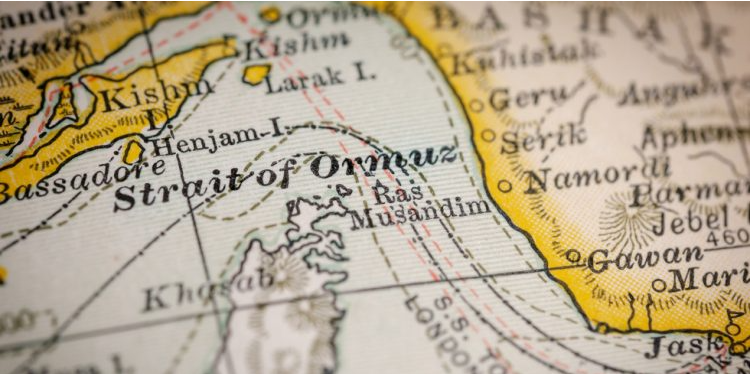 Industry on alert over scam messages offering ships “safe passage” on Hormuz
 Credit: Shutterstock Fraudulent messages offering safe passage through the Strait of Hormuz in exchange for cryptocurrency have been circulated to shipping companies with vessels stranded west of the waterway, according to MARISKS. In an alert issued on 20 April, MARISKS cautioned that unknown actors posing as Iranian authorities had contacted […]



JOB SITES
CONTENTS
LINKS
Happy New Year

Découvrez les avantages de MadCasino
Dans le monde des casinos en ligne, MadCasino se distingue par ses offres attrayantes et ses services de qualité. Que vous soyez un joueur débutant ou un parieur aguerri, vous trouverez ici une variété de jeux qui sauront satisfaire toutes vos envies. Les machines à sous, les jeux de table et les options de paris en direct sont tous disponibles pour vous offrir une expérience de jeu inégalée. De plus, le casino propose régulièrement des bonus qui permettent d'augmenter vos chances de gagner, vous offrant ainsi une excellente opportunité de maximiser vos gains.
En matière de sécurité, MadCasino est un nom de confiance. Il est entièrement licencié et régulé, ce qui garantit un environnement de jeu sûr et équitable. Les joueurs peuvent se concentrer sur leur expérience de jeu sans se soucier des problèmes de sécurité. Les transactions financières sont également sécurisées grâce à des technologies de pointe.
Les jeux proposés par MadCasino sont issus des développeurs les plus réputés de l'industrie, vous assurant des graphismes époustouflants et des mécaniques de jeu innovantes. Les joueurs peuvent également profiter d'une expérience de jeu en direct qui simule l'atmosphère d'un casino terrestre, tout en restant dans le confort de leur maison.
Enfin, la plateforme de MadCasino est optimisée pour les appareils mobiles, permettant aux joueurs de parier à tout moment et de n'importe où. Que vous soyez sur votre smartphone ou votre tablette, l'accès à vos jeux préférés n'a jamais été aussi simple. Ne manquez pas l'opportunité de découvrir ce casino exceptionnel.
Les offres de Cresus Casino
Cresus Casino est un autre acteur majeur dans le domaine des jeux en ligne, offrant des promotions généreuses et une vaste sélection de jeux. Les joueurs peuvent profiter d'une expérience de jeu enrichissante grâce aux nombreux bonus disponibles, qui sont conçus pour attirer tant les nouveaux utilisateurs que les joueurs réguliers. Ces avantages permettent non seulement de prolonger votre temps de jeu, mais aussi d'augmenter vos chances de gains conséquents.
Le casino se distingue également par sa ludothèque impressionnante, comprenant une sélection variée de machines à sous, de jeux de table et de jeux en direct. Les clients peuvent choisir parmi des titres populaires et appréciés, ainsi que des nouveautés qui enrichissent constamment l'offre. L'interface utilisateur est conviviale, rendant la navigation sur la plateforme fluide et agréable.
En termes de sécurité, Cresus Casino assure à ses joueurs un environnement de jeu fiable. La plateforme utilise des protocoles de sécurité avancés pour protéger les données personnelles et financières des utilisateurs. Cela permet aux joueurs de se sentir en sécurité tout en jouant à leurs jeux préférés.
Avec un service client réactif et professionnel, Cresus Casino s'assure que toutes vos questions et préoccupations sont traitées rapidement. Que ce soit pour des questions concernant les bonus, les retraits ou les jeux, vous bénéficierez d'une assistance rapide et efficace.
Explorez Nine Casino et ses avantages
Dans l'univers des casinos en ligne, Nine Casino a su se faire une place de choix grâce à son approche innovante et à ses nombreux avantages pour les joueurs. Les utilisateurs peuvent s'attendre à une expérience de jeu enrichissante, avec des bonus attractifs qui sont régulièrement mis à jour. Ces offres sont une excellente façon de découvrir de nouveaux jeux tout en maximisant votre potentiel de gain.
La plateforme de Nine Casino est riche en options de jeux, allant des machines à sous aux jeux de table, en passant par le live casino. Chaque jeu est conçu pour offrir une expérience immersive grâce à des graphismes de haute qualité et des fonctionnalités innovantes. Les parieurs peuvent profiter de sessions de jeu captivantes, comme s'ils étaient dans un véritable casino.
La sécurité est une priorité pour Nine Casino, qui utilise des technologies de cryptage avancées pour protéger les informations de ses joueurs. Cela garantit un environnement de jeu sûr et fiable, permettant aux utilisateurs de se concentrer sur ce qu'ils aiment le plus : jouer.
Enfin, le service clientèle fourni par Nine Casino est exceptionnel, avec des agents disponibles pour répondre à toutes vos questions et résoudre vos problèmes. Vous pourrez ainsi jouer en toute tranquillité, sachant que votre satisfaction est au cœur de leurs préoccupations.
Profitez de l'expérience Lucky31
Lucky31 est un casino en ligne qui se distingue par son approche orientée vers le joueur, offrant une multitude d'options de jeux et des bonus généreux. Que vous soyez amateur de machines à sous ou passionné de jeux de table, vous trouverez une large sélection pour satisfaire toutes vos envies de jeu. Les promotions fréquentes permettent aux joueurs de prolonger leur expérience tout en augmentant leurs chances de gains.
La convivialité de la plateforme de Lucky31 est l'un de ses plus grands atouts. Les joueurs peuvent naviguer facilement entre les différents jeux, et l'interface est conçue pour être intuitive, quel que soit le niveau d'expérience de l'utilisateur. De plus, le casino est entièrement optimisé pour les appareils mobiles, ce qui permet de parier où que vous soyez.
En matière de sécurité, Lucky31 prend les préoccupations des joueurs très au sérieux. Le casino est agréé et régulé, garantissant un environnement de jeu équitable et sécurisé. Les joueurs peuvent ainsi se concentrer sur leur expérience de jeu sans se soucier des risques liés à la sécurité.
Pour ceux qui recherchent un support client efficace, Lucky31 offre un service réactif et professionnel. Que ce soit pour des questions sur les bonus, les jeux ou les paiements, vous aurez accès à une assistance de qualité, vous garantissant une expérience de jeu fluide et agréable.