search the site


Developments in Ship Recycling in 2019
Developments in Ship Recycling in 2019
By Dr. Nikos Mikelis 2019-12-15
For the sixth year running I have been asked by The Maritime Executive to provide a review of the year’s notable developments on ship recycling and my expectations for the coming year. I have to acknowledge at the outset that, by nature, this must be a subjective exercise, based on my own vision of what is the definition of responsible ship recycling and what should an acceptable recycling yard look like. It is therefore relevant to disclose that for some time I have held an unchanging conviction that the only way possible for ship recycling yards across the globe to satisfy and maintain common minimum safety and environmental protection standards is through the entry into force of the IMO’s Hong Kong Convention.
For me, this is the filter that defines what helps and what hinders progress towards ship recycling becoming a responsible international industry.
The Hong Kong Convention
Although 2019 was the 10th anniversary of the Convention’s adoption in Hong Kong, by the beginning of the year only six countries had ratified it. (Note that a country wishing to become a Contracting State to an international convention can do this by accession to the convention or by a two-stage process that involves first signing the intent to become Party and then ratifying its signature. In this article the term ratification is used to mean either method.) Thereafter nine more countries ratified the Convention, as shown in the following table:
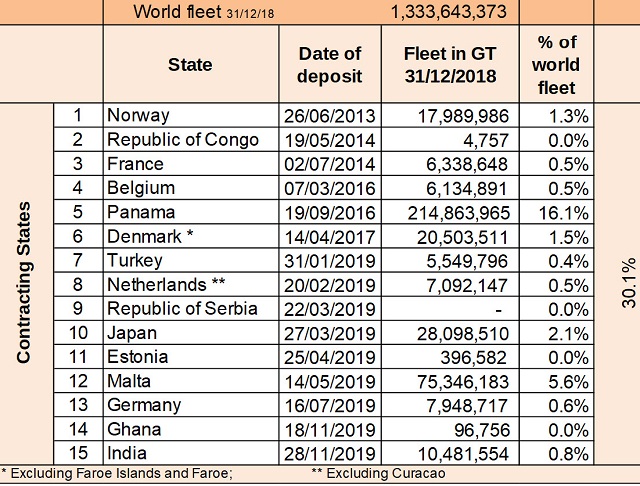
The ratification by Turkey was an important milestone, this being the first main ship recycling country to become a Contracting State of Hong Kong Convention. Note that in 2018 the four main ship recycling countries (Bangladesh, India, Pakistan and Turkey) recycled 96 percent of all tonnage, and that with the import ban of ships for recycling in China from December 31, 2018 this market share is expected to rise from 2019 to 98 percent.
Japan’s ratification in March was another milestone, partly because of the large tonnage that flies its flag, but also because of the great support that country has given, first to the development of the Convention, then to the voluntary implementation of the Convention to its ships, and last but not least to the support and aid it has already provided for the upgrading of recycling yards in India. Malta’s ratification in May was noteworthy because of its large fleet, which also is the largest in European Union.
All ratifications of the Convention are important and carry weight, but none as much as the ratification by India which took place near the end of the year. India happens to be the country with the largest “maximum annual recycling volume”, this being the measurement of recycling capacity that is defined in Hong Kong Convention (as the GT tonnage recycled in the year with the largest output, taken out of the preceding 10 years). According to this definition India has 31 percent of the world’s capacity based on its recycling of 12.2 million GT of ships in 2012.
However, the importance of India’s ratification does not stem only from its large capacity, but also from marking the anniversary date of Hong Kong Convention becoming the accepted standard for the ship recycling industry. The plain reality is that the international community decided to develop the Convention at the IMO to address the low safety and environmental standards that existed in the dominant recycling countries of South Asia, and not necessarily to address the standards that existed at the time in Turkey and China. The transformation that has taken place in most of the ship recycling yards of India in the last four years demonstrates the acceptance of the Convention as the mainstream industry’s working standard.
At the end of 2019 we face for the first time the real prospect of the Convention’s entry into force in the proximate future. The provisions for entry into force are: 24 months after the following three conditions are met: (1) ratification by at least 15 countries; (2) whose fleets together add-up to at least 40 percent of the world’s fleet; and (3) whose ship recycling capacities together add-up to at least three percent of their fleets. The first condition has already been met, while the second and third conditions are 75 percent and 87 percent satisfied, respectively.
To fully satisfy the second condition is quite straight forward as a ratification either by Liberia (currently 11.6 percent of the world’s fleet), or Marshall Islands (11.3 percent of the world’s fleet) is enough to meet the 40 percent requirement. However, on a point of detail, one needs to remember that the gross tonnage of the world fleet is presently increasing, with an annual rate of around 3.5 percent. Consequently, in subsequent years the market share of countries may vary from the figures quoted here, which relate to fleets at the end of 2018.
To satisfy the third condition, presently additional recycling capacity of 2.1 million GT is needed. This can only be provided by Bangladesh (present capacity 9.9 million GT), or Pakistan (5.7 million GT), or by China (8.2 million GT). The rest of the world (excepting Turkey and India who have already ratified) can only contribute 0.6 million GT altogether. Therefore, without one of these three countries the Convention cannot enter into force (unless a Diplomatic Conference was convened to agree different entry into force criteria through a Protocol– a very unlikely proposition).
Of course, as the world fleet increases the required capacity to satisfy the third condition will also increase from the 2.1 million GT mentioned above. Nevertheless, the conclusion remains unchanged, that the Convention cannot enter into force without the ratification by one more ship recycling country.
Interestingly, China will continue to have for a few more years significant “notional” ship recycling capacity arising from the tonnages it recycled before banning the import of end-of-life ships. This legacy capacity will stand at 8.2 million GT until April 2023 (which was the volume recycled in 2012), will then decline to 7.1 million GT until April 2024, to 5.0 million GT till April 2025, etc., until a decade has passed from the time the country stopped recycling foreign ships.
Therefore, noting that the Chinese fleet is currently 4.1 percent of the world’s fleet, and the fleet flying the flag of Hong Kong is 9.3 percent of the world’s fleet, it follows that if China with Hong Kong were to ratify the Convention today, then the three conditions will have been satisfied and the Convention would enter into force in just 24 months’ time.
Whereas it is tempting to hope that China will soon trigger the entry into force of the Convention using its notional ship recycling capacity, it must nevertheless be preferable to invite ratifications by countries with real ship recycling capacity. The eventual target must be for the ratification by both Bangladesh and Pakistan, which will cement the Convention as a truly global regulatory instrument, leaving no recycling capacity outside its reach.
In the meantime, it is likely that Bangladesh will be the first of the two countries to ratify the Convention. This is because the country’s administration is well aware of what is required to enable its industry to comply with the requirements of the Convention, thanks to a project funded by Norway and run by the IMO. Also, a leading recycling yard in Bangladesh has already transformed itself into a model industrial facility, becoming the first yard in the country to be awarded a Statement of Compliance (SoC) to Hong Kong Convention by an IACS classification society. A second yard in Bangladesh is expected to be awarded a Statement of Compliance soon, and it is understood that a few more yards are working towards compliance.
The Ministry of Industries of Bangladesh has declared its intention
to ratify the Convention by 2023. If China does not ratify the
Convention before then, a delay to 2023 to satisfy the entry into force
conditions appears to be a very long wait. It is therefore hoped that
the government of Bangladesh may be aided by a developed country or
countries in order to establish the necessary infrastructure and systems
in a shorter time scale.
Pakistan on the other hand does not yet appear to have made progress
towards compliance with the Convention. Furthermore, in 2019 the
country’s ship recycling industry suffered from adverse taxation;
adverse exchange rates; and the cheap imports of billets from Iran, and
consequently it has recycled very little tonnage.
The European Regulation on Ship Recycling (EU SRR)
From the beginning of 2019 the EU SRR mandates that European flagged ships must be recycled only in yards that are entered in the European List of approved yards. The 4th List of approved yards was published in December 2018 containing 23 yards based in the EU, two yards based in Turkey and one yard based in the U.S. In June 2019 the Commission updated its previous List by publishing its fifth List, containing 30 yards based in the EU, three yards based in Turkey and one yard based in the U.S.
The sixth European List of approved recycling facilities, which is expected to be published soon, will include a further four EU-based yards (in Lithuania, Latvia, the Netherlands and Norway) and a further three Turkish yards.
An EU List of approved yards that mostly comprise of EU-based recycling yards (incidentally, a number of which do not recycle ships) does not make sense, as the EU is the world’s largest net exporter of scrap steel, with the vast majority of its exports going to Turkey, Egypt, India, China and Pakistan. Obviously, it is not economically sustainable to be recycling large ships in Europe to produce scrap that will have to be transported to countries that already recycle ships.
The official data that are used by the IMO show that the EU’s combined maximum annual recycling volume (including Norway and the UK) is only 0.57 percent of the world’s capacity, while in 2018 the total tonnage recycled in the EU was 82,067 GT, representing just 0.45 percent of all tonnage recycled in the world (equivalent to a little more than two Panamax vessels).
As expected and foretold, in the first year of EU SRR’s application, only a handful of ocean-going ships were recycled in accordance with the Regulation. It must be concluded that many end-of-life EU flagged ships must have changed flag in 2019. It should be evident to all that EU SRR will fail in its enforcement unless its List includes a not-insignificant number of South Asian yards. It may therefore be logical to predict that within 2020 the first Indian yards may be approved and enter the European List.
One other important development that will take place in the next 12 months is the provision of Inventories of Hazardous Materials (IHMs) to all ships over 500GT that intend to call EU ports after the December 31, 2020.
Dr. Nikos Mikelis is Non-Executive Director of cash buyer GMS.
Featured Post
 বড় জাহাজ মেরামতে মাতারবাড়ীতে ১ বিলিয়ন ডলারের প্রকল্প
 মাতারবাড়ীতে প্রায় ১ বিলিয়ন মার্কিন ডলার ব্যয়ে পরিবেশবান্ধব ডকইয়ার্ড ও জাহাজ নির্মাণ কেন্দ্র স্থাপনের উদ্যোগে নীতিগত অনুমোদন দিয়েছে নৌপরিবহন মন্ত্রণালয়। এখন প্রকল্পটির কারিগরি ও আর্থিক মূল্যায়নের জন্য প্রস্তাবটি সরকারি-বেসরকারি অংশীদারত্ব (পিপিপি) কর্তৃপক্ষের কাছে পাঠানো হয়েছে। সম্পূর্ণ বেসরকারি অর্থায়নে সরকারি জমির মালিকানা অক্ষুণ্ন রেখে প্রকল্পটি বাস্তবায়নের পরিকল্পনা রয়েছে। বন্দর কর্তৃপক্ষ জানায়, […]
 Industry on alert over scam messages offering ships “safe passage” on Hormuz
 Credit: Shutterstock Fraudulent messages offering safe passage through the Strait of Hormuz in exchange for cryptocurrency have been circulated to shipping companies with vessels stranded west of the waterway, according to MARISKS. In an alert issued on 20 April, MARISKS cautioned that unknown actors posing as Iranian authorities had contacted […]



JOB SITES
CONTENTS
LINKS
Happy New Year

Découvrez les avantages de MadCasino
Dans le monde des casinos en ligne, MadCasino se distingue par ses offres attrayantes et ses services de qualité. Que vous soyez un joueur débutant ou un parieur aguerri, vous trouverez ici une variété de jeux qui sauront satisfaire toutes vos envies. Les machines à sous, les jeux de table et les options de paris en direct sont tous disponibles pour vous offrir une expérience de jeu inégalée. De plus, le casino propose régulièrement des bonus qui permettent d'augmenter vos chances de gagner, vous offrant ainsi une excellente opportunité de maximiser vos gains.
En matière de sécurité, MadCasino est un nom de confiance. Il est entièrement licencié et régulé, ce qui garantit un environnement de jeu sûr et équitable. Les joueurs peuvent se concentrer sur leur expérience de jeu sans se soucier des problèmes de sécurité. Les transactions financières sont également sécurisées grâce à des technologies de pointe.
Les jeux proposés par MadCasino sont issus des développeurs les plus réputés de l'industrie, vous assurant des graphismes époustouflants et des mécaniques de jeu innovantes. Les joueurs peuvent également profiter d'une expérience de jeu en direct qui simule l'atmosphère d'un casino terrestre, tout en restant dans le confort de leur maison.
Enfin, la plateforme de MadCasino est optimisée pour les appareils mobiles, permettant aux joueurs de parier à tout moment et de n'importe où. Que vous soyez sur votre smartphone ou votre tablette, l'accès à vos jeux préférés n'a jamais été aussi simple. Ne manquez pas l'opportunité de découvrir ce casino exceptionnel.
Les offres de Cresus Casino
Cresus Casino est un autre acteur majeur dans le domaine des jeux en ligne, offrant des promotions généreuses et une vaste sélection de jeux. Les joueurs peuvent profiter d'une expérience de jeu enrichissante grâce aux nombreux bonus disponibles, qui sont conçus pour attirer tant les nouveaux utilisateurs que les joueurs réguliers. Ces avantages permettent non seulement de prolonger votre temps de jeu, mais aussi d'augmenter vos chances de gains conséquents.
Le casino se distingue également par sa ludothèque impressionnante, comprenant une sélection variée de machines à sous, de jeux de table et de jeux en direct. Les clients peuvent choisir parmi des titres populaires et appréciés, ainsi que des nouveautés qui enrichissent constamment l'offre. L'interface utilisateur est conviviale, rendant la navigation sur la plateforme fluide et agréable.
En termes de sécurité, Cresus Casino assure à ses joueurs un environnement de jeu fiable. La plateforme utilise des protocoles de sécurité avancés pour protéger les données personnelles et financières des utilisateurs. Cela permet aux joueurs de se sentir en sécurité tout en jouant à leurs jeux préférés.
Avec un service client réactif et professionnel, Cresus Casino s'assure que toutes vos questions et préoccupations sont traitées rapidement. Que ce soit pour des questions concernant les bonus, les retraits ou les jeux, vous bénéficierez d'une assistance rapide et efficace.
Explorez Nine Casino et ses avantages
Dans l'univers des casinos en ligne, Nine Casino a su se faire une place de choix grâce à son approche innovante et à ses nombreux avantages pour les joueurs. Les utilisateurs peuvent s'attendre à une expérience de jeu enrichissante, avec des bonus attractifs qui sont régulièrement mis à jour. Ces offres sont une excellente façon de découvrir de nouveaux jeux tout en maximisant votre potentiel de gain.
La plateforme de Nine Casino est riche en options de jeux, allant des machines à sous aux jeux de table, en passant par le live casino. Chaque jeu est conçu pour offrir une expérience immersive grâce à des graphismes de haute qualité et des fonctionnalités innovantes. Les parieurs peuvent profiter de sessions de jeu captivantes, comme s'ils étaient dans un véritable casino.
La sécurité est une priorité pour Nine Casino, qui utilise des technologies de cryptage avancées pour protéger les informations de ses joueurs. Cela garantit un environnement de jeu sûr et fiable, permettant aux utilisateurs de se concentrer sur ce qu'ils aiment le plus : jouer.
Enfin, le service clientèle fourni par Nine Casino est exceptionnel, avec des agents disponibles pour répondre à toutes vos questions et résoudre vos problèmes. Vous pourrez ainsi jouer en toute tranquillité, sachant que votre satisfaction est au cœur de leurs préoccupations.
Profitez de l'expérience Lucky31
Lucky31 est un casino en ligne qui se distingue par son approche orientée vers le joueur, offrant une multitude d'options de jeux et des bonus généreux. Que vous soyez amateur de machines à sous ou passionné de jeux de table, vous trouverez une large sélection pour satisfaire toutes vos envies de jeu. Les promotions fréquentes permettent aux joueurs de prolonger leur expérience tout en augmentant leurs chances de gains.
La convivialité de la plateforme de Lucky31 est l'un de ses plus grands atouts. Les joueurs peuvent naviguer facilement entre les différents jeux, et l'interface est conçue pour être intuitive, quel que soit le niveau d'expérience de l'utilisateur. De plus, le casino est entièrement optimisé pour les appareils mobiles, ce qui permet de parier où que vous soyez.
En matière de sécurité, Lucky31 prend les préoccupations des joueurs très au sérieux. Le casino est agréé et régulé, garantissant un environnement de jeu équitable et sécurisé. Les joueurs peuvent ainsi se concentrer sur leur expérience de jeu sans se soucier des risques liés à la sécurité.
Pour ceux qui recherchent un support client efficace, Lucky31 offre un service réactif et professionnel. Que ce soit pour des questions sur les bonus, les jeux ou les paiements, vous aurez accès à une assistance de qualité, vous garantissant une expérience de jeu fluide et agréable.