search the site


Celebrating the U.S. Coast Guard’s 228th Anniversary
Celebrating the U.S. Coast Guard’s 228th Anniversary
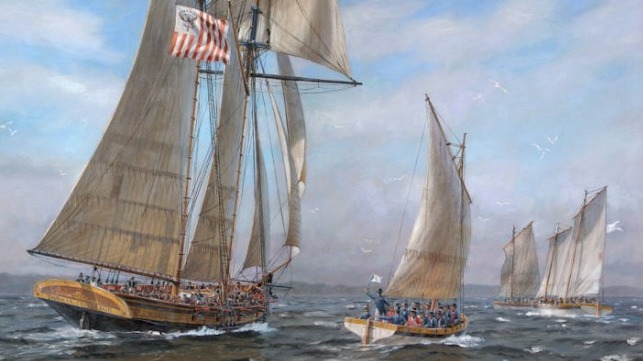
“Revenue Cutter Thomas Jefferson Captures Three Royal Navy Barges and Personnel in Hampton Roads, 11 April 1813” (Patrick O’Brien, image courtesy U.S. Coast Guard)

“You can kick this old service around, tear it to pieces, scream from the house-tops that it is worthless, ought to be abolished or transferred to the Navy, have the people in it fighting among themselves and working at cross purposes and it bobs up serenely bigger and stronger than ever.”
– Cmdr. Russell R. Waesche, Sr. (left)
As the quote by World War II Commandant Russell Waesche indicates, the evolution of the United States Coast Guard provides a unique study in organizational history. This August marks the 228th birthday of an agency that has endured through the absorption of other agencies and their missions, personnel, offices and assets. In spite of multiple reorganizations and departmental transfers, the service has expanded in range and mission set. Throughout it all, the Coast Guard has been shaped by national and world events, wars and all forms of maritime disasters, so that the Coast Guard’s motto, Semper Paratus, “Always Ready,” seems appropriate now more than ever.
The organizational model of the Coast Guard resulted from several federal agencies. Congress established the service’s original predecessor agency, the U.S. Revenue Cutter Service, in 1790 at the insistence of first Treasury Secretary Alexander Hamilton. Hamilton started the service with a fleet of 10 small sailing vessels, each one assigned to an East Coast seaport. A local customs collector oversaw each cutter’s operation and the collectors received their orders directly from the secretary of treasury. In addition to its original mission of law enforcement, the 1800s saw Congress assign the service the missions of defense (in time of war) and search and rescue. However, until the 20th century, the service remained a civilian agency militarized only in time of war.
Within 100 years of its founding, the Revenue Cutter Service began to develop a global reach. As the U.S. expanded from East Coast to Gulf Coast and on to the West Coast, revenue cutters populated regional ports, such as New Orleans and San Francisco. By 1867, cutters had begun cruising Alaskan waters and the Spanish-American War sent them as far away as southwest Pacific. With the annexation of Hawaii in 1898, cutters began regular patrols in various parts of the Pacific. With this territorial growth came an increase in missions, including fisheries enforcement and humanitarian response.
The second federal service that helped form the Coast Guard was the U.S. Life-Saving Service. Established by Congress in 1878, the Life-Saving Service incorporated a system of 12 districts to administer its boat stations, which numbered 183 by 1881. In 1915, President Woodrow Wilson merged the Life-Saving Service with the Revenue Cutter Service to form the U.S. Coast Guard. The new service became not only the nation’s foremost search and rescue agency, capable of coastal lifesaving operations and high seas rescues; it became an official U.S. military service.
The early 20th century saw the Coast Guard grow in scope and geographic reach. By 1915, the service had begun to conduct the International Ice Patrol, which located dangerous icebergs afloat in navigable waters of the North Atlantic. In World War I, the service came under Navy control. The war expanded the Coast Guard’s area of responsibility well beyond U.S. territorial waters. The service’s new cruising grounds included the Atlantic and Pacific oceans and adjoining bodies of water, such as the Mediterranean and Caribbean seas. In 1937, Congress placed responsibility for domestic icebreaking with the Coast Guard, a mission that would expand to international waters during World War II.

A Coast Guard icebreaker underway and breaking ice in a polar cruise. U.S. Coast Guard photo.
World War II accelerated change within the Coast Guard. In 1939, the war erupted in Europe and Franklin Roosevelt’s administration moved the Lighthouse Service from the Commerce Department into the Coast Guard. By absorbing the Lighthouse Service, the Coast Guard adopted the aids-to-navigation mission. Once again, the service came under Navy control for wartime operations. In 1942, the Bureau of Marine Inspection and Navigation moved as a temporary measure from the Commerce Department to the Coast Guard, adding marine safety to the service’s growing list of missions. At war’s end, the service returned to its place within the Department of Treasury after contributing 250,000 men and women to the war effort.
The postwar years saw the Coast Guard undergo dramatic changes. In 1946, the wartime adoption of the Bureau of Marine Inspection and Navigation was made permanent. In 1965, the Navy dropped its icebreaking mission making the Coast Guard the only federal agency providing domestic and polar icebreaking services. The year 1967 saw Lyndon Johnson’s administration move the Coast Guard from the Department of Treasury to the new Department of Transportation. That same year, Congress tasked the Coast Guard with regulating and administering bridges built over navigable waterways.
In the late 20th century, international environmental, economic and political developments created new missions for the Coast Guard. During this period, the frequency of major maritime oil spills grew dramatically adding the maritime environmental response mission to the service’s growing list. Political upheaval and poverty in the Caribbean began driving illegal aliens to U.S. shores increasing the need for migrant interdiction in Coast Guard’s 7th District. In addition, the rapid growth of illegal narcotics smuggling by sea drove the need for highly trained boarding teams known as Law Enforcement Detachments, which specialized in interdicting drug smuggling vessels. Late in the 20th century, the service also added an airborne drug interdiction unit called the Helicopter Interdiction Squadron.

Coast Guard Law Enforcement Detachment crew seizing suspected pirates. U.S. Coast Guard photo.
The beginning of the 21st century brought unexpected changes to the Coast Guard. The September 2001 terrorist attacks led to several alterations in the service’s organizational structure. In 2002, the service began establishing Maritime Safety and Security Teams in major ports and later founded specialized Maritime Security Response Teams. In 2003, the Coast Guard left the Department of Transportation to become a cornerstone agency within the new Department of Homeland Security. Including the wartime transfers to and from the Navy, it was a record sixth time that the Coast Guard had changed agencies. In addition, for the first time, homeland security had become an important part of the service’s overall mission.
In 1790, Alexander Hamilton established a small fleet of coastal law enforcement vessels to patrol off East Coast seaports. Over the next 228 years, the service experienced rapid growth in its geographic area of responsibility, mandated missions, and organization through mergers with other maritime services, reorganizations, and transfers from one federal agency to another. These frequent changes demanded remarkable flexibility and resourcefulness of the Coast Guard. The service has lived-up to its motto by adapting and evolving to meet the nation’s changing needs emerging as a global responder, known and respected at home and abroad.
William H. Thiesen is the Coast Guard Atlantic Area historian. This article appears courtesy of Coast Guard Compass and may be found in its original form here.
Featured Post
 বড় জাহাজ মেরামতে মাতারবাড়ীতে ১ বিলিয়ন ডলারের প্রকল্প
 মাতারবাড়ীতে প্রায় ১ বিলিয়ন মার্কিন ডলার ব্যয়ে পরিবেশবান্ধব ডকইয়ার্ড ও জাহাজ নির্মাণ কেন্দ্র স্থাপনের উদ্যোগে নীতিগত অনুমোদন দিয়েছে নৌপরিবহন মন্ত্রণালয়। এখন প্রকল্পটির কারিগরি ও আর্থিক মূল্যায়নের জন্য প্রস্তাবটি সরকারি-বেসরকারি অংশীদারত্ব (পিপিপি) কর্তৃপক্ষের কাছে পাঠানো হয়েছে। সম্পূর্ণ বেসরকারি অর্থায়নে সরকারি জমির মালিকানা অক্ষুণ্ন রেখে প্রকল্পটি বাস্তবায়নের পরিকল্পনা রয়েছে। বন্দর কর্তৃপক্ষ জানায়, […]
 Industry on alert over scam messages offering ships “safe passage” on Hormuz
 Credit: Shutterstock Fraudulent messages offering safe passage through the Strait of Hormuz in exchange for cryptocurrency have been circulated to shipping companies with vessels stranded west of the waterway, according to MARISKS. In an alert issued on 20 April, MARISKS cautioned that unknown actors posing as Iranian authorities had contacted […]



JOB SITES
CONTENTS
LINKS
Happy New Year

Découvrez les avantages de MadCasino
Dans le monde des casinos en ligne, MadCasino se distingue par ses offres attrayantes et ses services de qualité. Que vous soyez un joueur débutant ou un parieur aguerri, vous trouverez ici une variété de jeux qui sauront satisfaire toutes vos envies. Les machines à sous, les jeux de table et les options de paris en direct sont tous disponibles pour vous offrir une expérience de jeu inégalée. De plus, le casino propose régulièrement des bonus qui permettent d'augmenter vos chances de gagner, vous offrant ainsi une excellente opportunité de maximiser vos gains.
En matière de sécurité, MadCasino est un nom de confiance. Il est entièrement licencié et régulé, ce qui garantit un environnement de jeu sûr et équitable. Les joueurs peuvent se concentrer sur leur expérience de jeu sans se soucier des problèmes de sécurité. Les transactions financières sont également sécurisées grâce à des technologies de pointe.
Les jeux proposés par MadCasino sont issus des développeurs les plus réputés de l'industrie, vous assurant des graphismes époustouflants et des mécaniques de jeu innovantes. Les joueurs peuvent également profiter d'une expérience de jeu en direct qui simule l'atmosphère d'un casino terrestre, tout en restant dans le confort de leur maison.
Enfin, la plateforme de MadCasino est optimisée pour les appareils mobiles, permettant aux joueurs de parier à tout moment et de n'importe où. Que vous soyez sur votre smartphone ou votre tablette, l'accès à vos jeux préférés n'a jamais été aussi simple. Ne manquez pas l'opportunité de découvrir ce casino exceptionnel.
Les offres de Cresus Casino
Cresus Casino est un autre acteur majeur dans le domaine des jeux en ligne, offrant des promotions généreuses et une vaste sélection de jeux. Les joueurs peuvent profiter d'une expérience de jeu enrichissante grâce aux nombreux bonus disponibles, qui sont conçus pour attirer tant les nouveaux utilisateurs que les joueurs réguliers. Ces avantages permettent non seulement de prolonger votre temps de jeu, mais aussi d'augmenter vos chances de gains conséquents.
Le casino se distingue également par sa ludothèque impressionnante, comprenant une sélection variée de machines à sous, de jeux de table et de jeux en direct. Les clients peuvent choisir parmi des titres populaires et appréciés, ainsi que des nouveautés qui enrichissent constamment l'offre. L'interface utilisateur est conviviale, rendant la navigation sur la plateforme fluide et agréable.
En termes de sécurité, Cresus Casino assure à ses joueurs un environnement de jeu fiable. La plateforme utilise des protocoles de sécurité avancés pour protéger les données personnelles et financières des utilisateurs. Cela permet aux joueurs de se sentir en sécurité tout en jouant à leurs jeux préférés.
Avec un service client réactif et professionnel, Cresus Casino s'assure que toutes vos questions et préoccupations sont traitées rapidement. Que ce soit pour des questions concernant les bonus, les retraits ou les jeux, vous bénéficierez d'une assistance rapide et efficace.
Explorez Nine Casino et ses avantages
Dans l'univers des casinos en ligne, Nine Casino a su se faire une place de choix grâce à son approche innovante et à ses nombreux avantages pour les joueurs. Les utilisateurs peuvent s'attendre à une expérience de jeu enrichissante, avec des bonus attractifs qui sont régulièrement mis à jour. Ces offres sont une excellente façon de découvrir de nouveaux jeux tout en maximisant votre potentiel de gain.
La plateforme de Nine Casino est riche en options de jeux, allant des machines à sous aux jeux de table, en passant par le live casino. Chaque jeu est conçu pour offrir une expérience immersive grâce à des graphismes de haute qualité et des fonctionnalités innovantes. Les parieurs peuvent profiter de sessions de jeu captivantes, comme s'ils étaient dans un véritable casino.
La sécurité est une priorité pour Nine Casino, qui utilise des technologies de cryptage avancées pour protéger les informations de ses joueurs. Cela garantit un environnement de jeu sûr et fiable, permettant aux utilisateurs de se concentrer sur ce qu'ils aiment le plus : jouer.
Enfin, le service clientèle fourni par Nine Casino est exceptionnel, avec des agents disponibles pour répondre à toutes vos questions et résoudre vos problèmes. Vous pourrez ainsi jouer en toute tranquillité, sachant que votre satisfaction est au cœur de leurs préoccupations.
Profitez de l'expérience Lucky31
Lucky31 est un casino en ligne qui se distingue par son approche orientée vers le joueur, offrant une multitude d'options de jeux et des bonus généreux. Que vous soyez amateur de machines à sous ou passionné de jeux de table, vous trouverez une large sélection pour satisfaire toutes vos envies de jeu. Les promotions fréquentes permettent aux joueurs de prolonger leur expérience tout en augmentant leurs chances de gains.
La convivialité de la plateforme de Lucky31 est l'un de ses plus grands atouts. Les joueurs peuvent naviguer facilement entre les différents jeux, et l'interface est conçue pour être intuitive, quel que soit le niveau d'expérience de l'utilisateur. De plus, le casino est entièrement optimisé pour les appareils mobiles, ce qui permet de parier où que vous soyez.
En matière de sécurité, Lucky31 prend les préoccupations des joueurs très au sérieux. Le casino est agréé et régulé, garantissant un environnement de jeu équitable et sécurisé. Les joueurs peuvent ainsi se concentrer sur leur expérience de jeu sans se soucier des risques liés à la sécurité.
Pour ceux qui recherchent un support client efficace, Lucky31 offre un service réactif et professionnel. Que ce soit pour des questions sur les bonus, les jeux ou les paiements, vous aurez accès à une assistance de qualité, vous garantissant une expérience de jeu fluide et agréable.