search the site


Marine autonomous systems working independently and in connected systems are fast becoming a growth sector within the ocean industry space, including the oil and gas industry.
Marine autonomous systems working independently and in connected systems are fast becoming a growth sector within the ocean industry space, including the oil and gas industry.

The emergence of new marine autonomous systems appears to be a weekly occurrence. As costs have reduced in numerous areas, from sensors to satellites, some of these systems are also coming within the grasps of ordinary citizens, as well as ocean scientists, looking to unlock the secrets of the deep.
Part of the drive for these systems, in the oil and gas industry at least, is to reduce use of manned surface vessels, which are costly to operate and emit fumes, at best.
A goal set for Norway’s Norwegian University of Science and Technology (NTNU) is to reduce use of surface vessels by 80 percent in several oil and gas operations. The NTNU’s Center for Autonomous Marine Operations and Systems (AMOS) has the task of finding solutions to meet that goal, as well as targets to increase mapping and monitoring coverage by 10 at a tenth of the cost. Another goal is for “safe marine operations anywhere at any sea state at one-tenth of the cost,” says Asgeir Johan Sørensen, Professor and Director of AMOS.
Norway has other incentives to produce advanced ocean technologies. The country has ocean areas five to six times larger than its land mass, says Sørensen. Its key industries span fisheries, ocean transport and, for the last 50 years, oil and gas. “We are moving now into offshore wind and aquaculture,” says Sørensen. “To be competitive, we (Norwegians) always have to have high quality and low cost,” which is why firms are exploring use of autonomous systems. “Norway also has a huge responsibility when it comes to governance and management of the oceans, including into the arctic.”
Initially, it was work in the oil and gas sector, to avoid risk to divers, that led to Norway to pursue remote operated subsea technologies. It’s been more recently that the industry has been looking to develop more autonomous subsea systems, from processing equipment to subsea vehicles, such as pipeline tracking autonomous underwater vehicles.
Within the past year, Norway’s Statoil has been working towards subsea resident vehicle concepts, deploying two different remote operated vehicles (ROVs), one from Houston-headquartered Oceaneering (the e-Novus) and one from Norway-based IKM, on multi-week and even month deployments. However, while these deployments meant the vehicles were autonomous in that they no longer needed a support vessel, they were still tethered and operated by staff onshore.
The next step will be vehicles that can operate without a tether, such as Oceaneering’s new Freedom concept, which it unveiled at the Subsea Valley Conference in Oslo. It’s a resident ROV concept, based on a hybrid vehicle, that would live in a subsea docking station and be able to fly out on missions in either tethered (remote operated) or untethered (autonomous) mode. It would have onboard batteries that would be recharged at its docking station and a tooling “magazine” it could select from. The firm is hoping to perform offshore trials with a prototype, expected to be about 3.3m-long, next year, Arve Iversen, ROV operations manager, said at Subsea Valley.
Much more is being done to develop autonomous systems, however. NTNU AMOS was set up between The Departments of Marine Technology and Engineering Cybernetics at NTNU, working with other international research partners and Norwegian companies, as a Centre of Excellence (CoE) support by Norway’s Research Council, from 2013 for 10 years. Since 2013, it has already notched up 53 PhD students and multiple other spin-outs, including drone firm Scout, and BluEye, an observation ROV (deepest underwater commercial drone) company, with Go-Pro style usability. This mix of companies gives an idea of where the research is heading, i.e. interconnected networks of systems.
As well as also working on improving intelligence in systems, such as power systems, making them more intelligent to optimize energy consumption and battery use, AMOS is also looking at swarms and heterogenous systems, involving in air and subsea drones, as well as unmanned autonomous surface vessels, which would reply on satellite infrastructure for communication and connectivity.
Helpfully, the cost of sending up a satellite into space has reduced, to $390,000-$520,000, says Sørensen. “While they have limited functionality and only last three to five years, they’re important for autonomous systems,” he says. “We can use a satellite, send out a drone, working with unmanned ships, for joint operations.”
Norway is becoming a testing ground for these technologies, with a number of areas designated as test beds, including Trondheimsfjord in Northern Norway, Storfjord in the northernmost part of western Norway, an area with several ferry crossings deemed suitable for testing and developing sensor technology and management systems, and Horten on the Oslo fjord in southern Norway.
Indeed, Kongsberg, which is working heavily in autonomous shipping, including an “autonomous and all-electric” container ship, the Yara Birkeland, is working with NTNU unmanned, underwater resident “snake” robot spin-out Eelume. Kongsberg is also heavily involved in a number of other projects (having established its position in the autonomous underwater vehicle (AUV) market with the Munin and Hugin AUVs), including the Sea-Kit, a hybrid AUV-ASV, which will sport a Kongsberg K-MATE autonomous surface vessel control system.
But, we need to be careful in how we define autonomy, compared with automation, says Sørensen. “Automation is how you perform well-defined tasks without human intervention. Autonomy is when dealing with an unstructured environment and uncertainty. You typically go in with unmanned systems when there are the three Ds: dull, dirty and dangerous. Autonomous is when we don’t have links and that’s also why subsea is leading this field. It (a system or vehicle) has to be there on its own and make decisions. Pre-planned missions is not autonomy. It’s only autonomy when an unplanned event happens and it has to make a decision.”
There are also different levels of autonomy, he says and different approaches. One, the human is still in the loop. Two, management by consent, using teleoperators, a field which started in the space industry because of the time delay in relaying signals. Three, management by exception. “A lot of oil and gas rigs and offshore installations are on level three, management by exception. On ship, there’s thousands of signals just to control the power plant. So the system is more or less autonomous. Four, highly autonomous. Sørensen says fully autonomous tends not to be used – the discussion gets rather philosophical.
How autonomy is implemented can also take different forms. Platforms can sense then act, or sense, model, plan and then act. While something like Kongsberg’s power management system for dynamic positioning has autonomy, it’s not so much able to reconfigure and make deliberative choices, says Sørensen, giving an example. Similarly, an unmanned platform isn’t autonomous, it’s reactive, he says. It could be made more autonomous by introducing deliberative control architecture. Take it another step and the system can learn by sensing and by doing.
Critically, situational awareness needs to be built in, to provide a high level of autonomy. “That’s one of the crucial areas that’s related to sensor technology,” influencing how perceptive of the environment a system can be. “Is it able to perceive and sense information and then start to project that information in to future (i.e. make predictions and act on them)? That’s one crucial research areas we are working on.”
Examples of this include mapping systems which are able to detect, by themselves, any gaps in the data they have collected and go back and fill them in, during a mission. An intelligent system like this was used to track plankton in the water column, having had to find the plankton in the first place then follow it. These capabilities will be crucial when systems are working with and around subsea oil and gas systems, which is expected to be one of the main areas where autonomous systems are required, along with ocean science, says Sørensen.
For whatever the purpose, be it oil and gas exploration, renewables or aquaculture development, shipping or ocean science, the range and capability of subsea equipment and ancillary and support systems is expanding by the day, aided by developments in ICT, nanotechnology and even biotechnology (for the snake motion used by Eelume, for example), including new materials, microe-electric-mechanical systems, and big data. As an example, systems are being developed which could sense and distributed forces along the body of an underwater vehicle, in order to compensate for or reduce drag, says Sørensen. He also cites micro to macro actuation and sensing, and machine vision systems using hyperspectral sensing which can take in any wavelength to classify and detect things that we haven’t been able to before. The possibilities are vast.
Sørensen also sees a “democratization” of this space. With cheaper satellites and commercial underwater drones available to the public, “everyone can be an ocean scientist.” It’s a timely availability of technology, Sørensen says. “Everyone should be aware of the oceans, and how we care for them. Putting plastics in the ocean, we will not get away with that, the public will see it more and more.
“We see there is huge potential for unmanned autonomous systems, from space to the seafloor for mapping and monitoring of the oceans,” says Sørensen.
How this world will be ruled and regulated in yet to be answered. There are also concerns about cyber security. But, people also need to look at their business models, says Sørensen. “Where ever you are sitting, I would be worried about my business model. There are changes going on, you need to be awake,” says Sorensen.
(As published in the April 2018 edition of Marine Technology Reporter)
Featured Post
 জাহাজ নির্মাণ শিল্প: হাতছাড়া হচ্ছে অপার সম্ভাবনা
 গোলাম সোহরাওয়ার্দি প্রকাশ : ২৭ অক্টোবর ২০২৬, ০৮: ০৪আপডেট : ২৭ অক্টোবর ২০২৬, ০৯: ২৪ সারা বিশ্ব এখন জাহাজ নির্মাণের এক বিশাল জোয়ার দেখছে। চীন, দক্ষিণ কোরিয়া ও জাপানের মতো দেশগুলো এ খাত থেকে বিপুল মুনাফা কামিয়ে নিচ্ছে। নতুন বাণিজ্যিক পথ তৈরি, জাহাজের […]
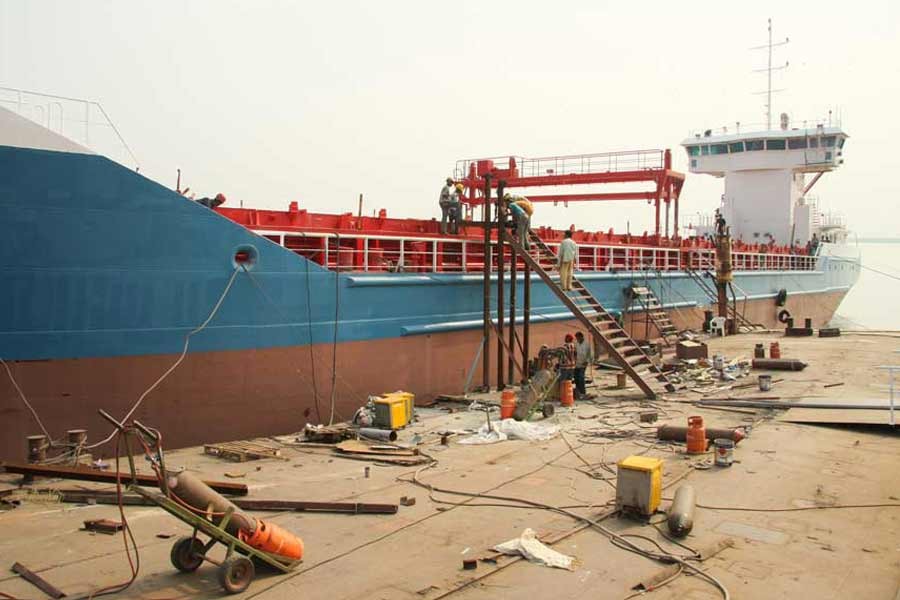 Worldwide Shipbuilding Boom and Bangladesh’s Lost Opportunity: How Financial Mismanagement, Loan Defaults, and Weak Governance Crippled a Promising Industry
An investigative analysis by Ghulam Suhrawardi Today, the world is witnessing one of the largest shipbuilding booms in history. Many countries are profiting from it. China, South Korea, and Japan have benefited from increased demand for new vessels due to fleet renewal, changing trade routes, environmental regulations, and strong financial […]



JOB SITES
CONTENTS
LINKS
Happy New Year

Découvrez les avantages de MadCasino
Dans le monde des casinos en ligne, MadCasino se distingue par ses offres attrayantes et ses services de qualité. Que vous soyez un joueur débutant ou un parieur aguerri, vous trouverez ici une variété de jeux qui sauront satisfaire toutes vos envies. Les machines à sous, les jeux de table et les options de paris en direct sont tous disponibles pour vous offrir une expérience de jeu inégalée. De plus, le casino propose régulièrement des bonus qui permettent d'augmenter vos chances de gagner, vous offrant ainsi une excellente opportunité de maximiser vos gains.
En matière de sécurité, MadCasino est un nom de confiance. Il est entièrement licencié et régulé, ce qui garantit un environnement de jeu sûr et équitable. Les joueurs peuvent se concentrer sur leur expérience de jeu sans se soucier des problèmes de sécurité. Les transactions financières sont également sécurisées grâce à des technologies de pointe.
Les jeux proposés par MadCasino sont issus des développeurs les plus réputés de l'industrie, vous assurant des graphismes époustouflants et des mécaniques de jeu innovantes. Les joueurs peuvent également profiter d'une expérience de jeu en direct qui simule l'atmosphère d'un casino terrestre, tout en restant dans le confort de leur maison.
Enfin, la plateforme de MadCasino est optimisée pour les appareils mobiles, permettant aux joueurs de parier à tout moment et de n'importe où. Que vous soyez sur votre smartphone ou votre tablette, l'accès à vos jeux préférés n'a jamais été aussi simple. Ne manquez pas l'opportunité de découvrir ce casino exceptionnel.
Les offres de Cresus Casino
Cresus Casino est un autre acteur majeur dans le domaine des jeux en ligne, offrant des promotions généreuses et une vaste sélection de jeux. Les joueurs peuvent profiter d'une expérience de jeu enrichissante grâce aux nombreux bonus disponibles, qui sont conçus pour attirer tant les nouveaux utilisateurs que les joueurs réguliers. Ces avantages permettent non seulement de prolonger votre temps de jeu, mais aussi d'augmenter vos chances de gains conséquents.
Le casino se distingue également par sa ludothèque impressionnante, comprenant une sélection variée de machines à sous, de jeux de table et de jeux en direct. Les clients peuvent choisir parmi des titres populaires et appréciés, ainsi que des nouveautés qui enrichissent constamment l'offre. L'interface utilisateur est conviviale, rendant la navigation sur la plateforme fluide et agréable.
En termes de sécurité, Cresus Casino assure à ses joueurs un environnement de jeu fiable. La plateforme utilise des protocoles de sécurité avancés pour protéger les données personnelles et financières des utilisateurs. Cela permet aux joueurs de se sentir en sécurité tout en jouant à leurs jeux préférés.
Avec un service client réactif et professionnel, Cresus Casino s'assure que toutes vos questions et préoccupations sont traitées rapidement. Que ce soit pour des questions concernant les bonus, les retraits ou les jeux, vous bénéficierez d'une assistance rapide et efficace.
Explorez Nine Casino et ses avantages
Dans l'univers des casinos en ligne, Nine Casino a su se faire une place de choix grâce à son approche innovante et à ses nombreux avantages pour les joueurs. Les utilisateurs peuvent s'attendre à une expérience de jeu enrichissante, avec des bonus attractifs qui sont régulièrement mis à jour. Ces offres sont une excellente façon de découvrir de nouveaux jeux tout en maximisant votre potentiel de gain.
La plateforme de Nine Casino est riche en options de jeux, allant des machines à sous aux jeux de table, en passant par le live casino. Chaque jeu est conçu pour offrir une expérience immersive grâce à des graphismes de haute qualité et des fonctionnalités innovantes. Les parieurs peuvent profiter de sessions de jeu captivantes, comme s'ils étaient dans un véritable casino.
La sécurité est une priorité pour Nine Casino, qui utilise des technologies de cryptage avancées pour protéger les informations de ses joueurs. Cela garantit un environnement de jeu sûr et fiable, permettant aux utilisateurs de se concentrer sur ce qu'ils aiment le plus : jouer.
Enfin, le service clientèle fourni par Nine Casino est exceptionnel, avec des agents disponibles pour répondre à toutes vos questions et résoudre vos problèmes. Vous pourrez ainsi jouer en toute tranquillité, sachant que votre satisfaction est au cœur de leurs préoccupations.
Profitez de l'expérience Lucky31
Lucky31 est un casino en ligne qui se distingue par son approche orientée vers le joueur, offrant une multitude d'options de jeux et des bonus généreux. Que vous soyez amateur de machines à sous ou passionné de jeux de table, vous trouverez une large sélection pour satisfaire toutes vos envies de jeu. Les promotions fréquentes permettent aux joueurs de prolonger leur expérience tout en augmentant leurs chances de gains.
La convivialité de la plateforme de Lucky31 est l'un de ses plus grands atouts. Les joueurs peuvent naviguer facilement entre les différents jeux, et l'interface est conçue pour être intuitive, quel que soit le niveau d'expérience de l'utilisateur. De plus, le casino est entièrement optimisé pour les appareils mobiles, ce qui permet de parier où que vous soyez.
En matière de sécurité, Lucky31 prend les préoccupations des joueurs très au sérieux. Le casino est agréé et régulé, garantissant un environnement de jeu équitable et sécurisé. Les joueurs peuvent ainsi se concentrer sur leur expérience de jeu sans se soucier des risques liés à la sécurité.
Pour ceux qui recherchent un support client efficace, Lucky31 offre un service réactif et professionnel. Que ce soit pour des questions sur les bonus, les jeux ou les paiements, vous aurez accès à une assistance de qualité, vous garantissant une expérience de jeu fluide et agréable.