search the site


A Renegade Trawler, Hunted for 10,000 Miles by Vigilantes
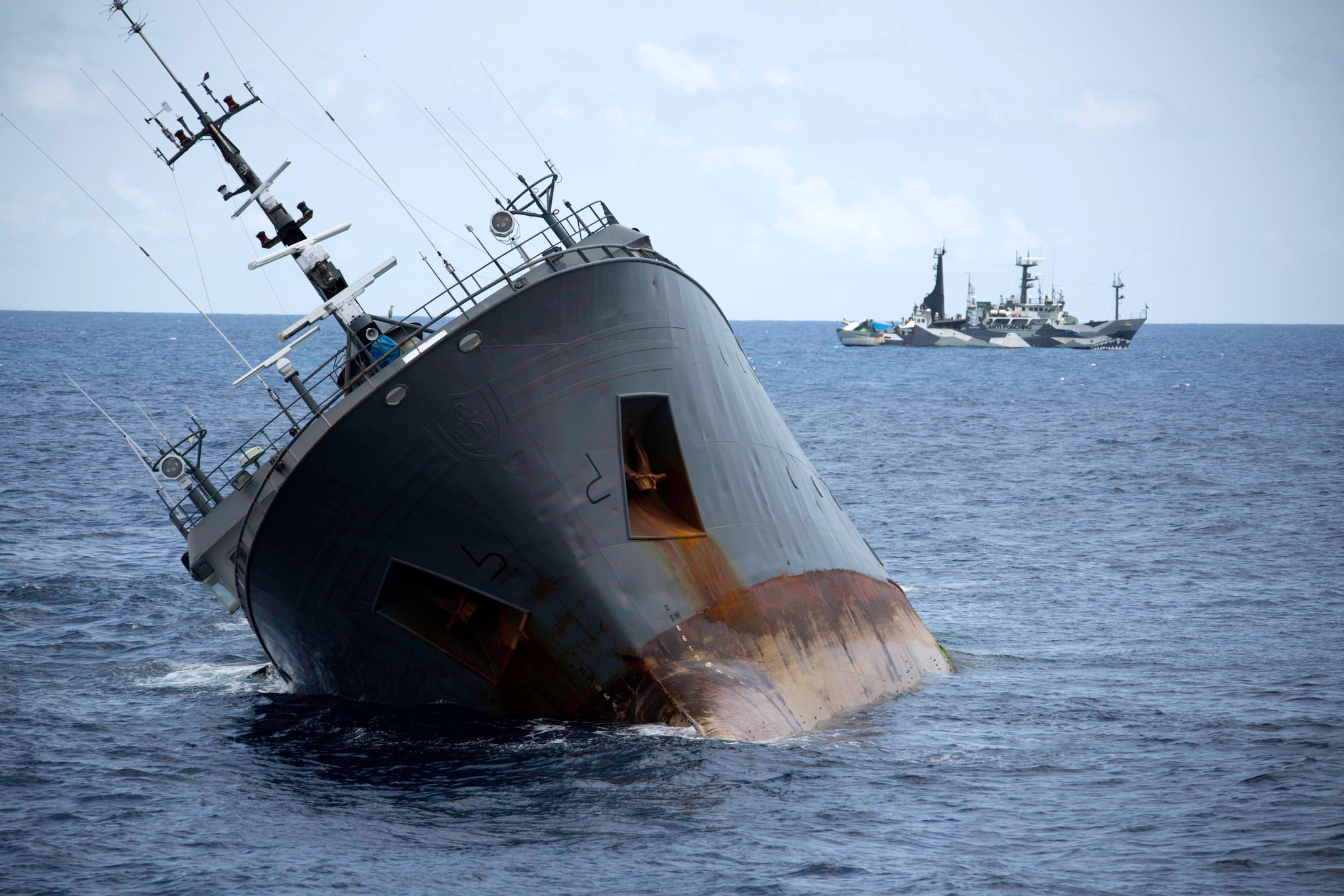
For 110 days and across two seas and three oceans, crews stalked a fugitive fishing ship considered the world’s most notorious poacher.
The Thunder, a trawler wanted for illegal fishing, was chased for 110 days and more than 10,000 nautical miles across two seas and three oceans, until it sank in April.
ABOARD THE BOB BARKER, in the South Atlantic — As the Thunder, a trawler considered the world’s most notorious fish poacher, began sliding under the sea a couple of hundred miles south of Nigeria, three men scrambled aboard to gather evidence of its crimes.
In bumpy footage from their helmet cameras, they can be seen grabbing everything they can over the next 37 minutes — the captain’s logbooks, a laptop computer, charts and a slippery 200-pound fish. The video shows the fishing hold about a quarter full with catch and the Thunder’s engine room almost submerged in murky water. “There is no way to stop it sinking,” the men radioed back to the Bob Barker, which was waiting nearby. Soon after they climbed off, the Thunder vanished below.
It was an unexpected end to an extraordinary chase. For 110 days and more than 10,000 nautical miles across two seas and three oceans, the Bob Barker and a companion ship, both operated by the environmental organization Sea Shepherd, had trailed the trawler, with the three captains close enough to watch one another’s cigarette breaks and on-deck workout routines. In an epic game of cat-and-mouse, the ships maneuvered through an obstacle course of giant ice floes, endured a cyclone-like storm, faced clashes between opposing crews and nearly collided in what became the longest pursuit of an illegal fishing vessel in history.
Industrial-scale violators of fishing bans and protected areas are a main reason more than half of the world’s major fishing grounds have been depleted and by some estimates over 90 percent of the ocean’s large fish like marlin, tuna and swordfish have vanished. Interpol had issued a Purple Notice on the Thunder (the equivalent of adding it to a Most Wanted List, a status reserved for only four other ships in the world), but
no government had been willing to dedicate the personnel and millions of dollars needed to go after it.
So Sea Shepherd did instead, stalking the fugitive 202-foot steel-sided ship from a desolate patch of ocean at the bottom of the Earth, deep in Antarctic waters, to any ports it neared, where its crews could alert the authorities. “The poachers thrive by staying in the shadows,” Peter Hammarstedt, captain of the Barker, said while trying to level his ship through battering waves. “Our plan was to put a spotlight on them that they couldn’t escape.”
The pursuit of the Thunder until its sinking in April, pieced together from radio transmissions, interviews, ship records and reporting on board the Bob Barker and its fellow ship, the Sam Simon, demonstrates the anything-goes nature of the high seas, where weak laws and a lack of policing allow both for persistent criminality and, at times, bold vigilantism.
Illegal fishing is a global business estimated at $10 billion in annual sales, and one that is thriving as improved technology has enabled fishing vessels to plunder the oceans with greater efficiency. While countries, with varying degrees of diligence, typically patrol their own coastlines, few ever do so in international waters, even though United Nations maritime regulations require them to hold vessels flying their flags accountable for illicit fishing.
That leaves room for organizations like Sea Shepherd, which describes itself as an eco-vigilante group, flies a variation of the Jolly Roger on its ships and often cites the motto, “It takes a pirate to catch a pirate.” In chasing the Thunder, Sea Shepherd’s goal was not just to protect a rapidly disappearing species of fish, its leaders said, but to show that flagrant violators of the law could be brought to justice.
Maritime lawyers question whether the group has legal authority for its actions — ranging from cutting nets and blocking fishermen to ramming whaling vessels — but Sea Shepherd claims its tactics are necessary. So do some Interpol officials.
“They’re maritime skip tracers,” one Interpol official said, speaking on the condition of anonymity because he was not permitted to talk to reporters. “And they’re getting results.”

Banned since 2006 from fishing in the Antarctic, the Thunder had been spotted there repeatedly in recent years, prompting Interpol to issue an all-points bulletin on it in December 2013. The vessel was described as the most egregious of the ships then on its Purple Notice list, collecting over $76 million from illicit sales in the past decade, more than any other ship, according to agency estimates. The Thunder’s prime catch was toothfish, more popularly called Chilean sea bass, known on docks as “white gold” because its fillets often sell for $30 a plate or more in upscale restaurants in the United States.
The Thunder’s status as a fugitive hardly slowed it down. By keeping its locational transponder turned off, it could fish and then slip in and out of ports undetected. The ship’s name and port registry, which have changed more than a half-dozen times, were not painted on its hull, the typical practice, but on a metal sign hung from its stern. (Sailors call such signs “James Bond license plates” because they can be easily swapped out.) In March, the Thunder was stripped of its registration by Nigeria and became officially stateless, which meant that marine authorities from any country could board and arrest its crew.
“Sea Shepherd is doing what no one else will,” said Peter Whish-Wilson, an Australian senator. “The urgency of this problem has grown,” he added, “but the government response, from all governments really, has fallen.”
‘Maintain Hot Pursuit’
On its second day of prowling for the Thunder last December, the Barker spotted its prey. Appearing first as a red blip on an otherwise barren radar monitor, the vessel was moving slowly, at 6 knots, and heading against the tide of floating icebergs, some the size of tall buildings.

Captain Hammarstedt sailed within 400 feet of the Thunder before reaching for a reference binder — an Interpol “mug shots” guide featuring silhouettes of illegal fishing vessels. He radioed the Thunder’s officers, most of them Spaniards or Chileans. Speaking through a translator, he warned that the Thunder was banned from fishing in those waters and would be stopped.
The Thunder responded: “No, no, no. Negative, negative. You have no authority to arrest this vessel. You have no authority to arrest this vessel. We are going to continue sailing, we are going to continue sailing but you have no authority to arrest this ship, over.”
“We do have authority,” the Bob Barker said. “We have reported your location to Interpol and to the Australian police.”
The poachers replied, “O.K., O.K., you can send our location, but you can’t board this ship, you can’t come in or arrest us.”
The Thunder’s crew, which had been working on its aft deck, abruptly disappeared inside. The ship (a trawler that had been converted to do other types of deep-sea fishing) soon doubled its speed and made a run for it, the Barker close behind. They were in a stretch of Antarctic sea called the Banzare Bank, known among mariners as “The Shadowlands” because it is among the planet’s most remote and inhospitable waters, nearly a two-week journey to the nearest major port.
On that first night of the chase, Dec. 17, Captain Hammarstedt made a note in his ship’s log: “Bob Barker will maintain hot pursuit and report on the F/V Thunder’s position to Interpol.”
Exploding Fish
While the Bob Barker chased the Thunder, the Sam Simon tracked another vessel wanted by Interpol, a ship called the Kunlun, eventually causing its captain to disembark in Phuket, Thailand, where it remains. The Simon also spotted another toothfish netter called the Yongding, which was soon detained as well.
The Thunder, though, was the top prize. When the Bob Barker began pursuing the vessel, the Sam Simon’s initial job was to remain in the Banzare Bank and pull up the 45 miles of illegal net that the Thunder left behind, evidence for a possible prosecution.
Hauling the nets was dangerous. The Sam Simon’s deck was slippery, cluttered and partly frozen. The ship’s side walls were low. Tripping was easy. Marbled with slush, the polar water below was so cold that to fall would likely have meant death not by drowning but from cardiac arrest.
Consumer demand for toothfish skyrocketed in the 1980s and 1990s after a Los Angeles-based seafood wholesaler decided to rename the oily fish Chilean sea bass to make it more appealing to the American market. An ugly bottom dweller, found only in the earth’s coldest waters, the toothfish can grow over six feet long and weigh more than 250 pounds. The rebranding worked a little too well. More fishing boats targeted toothfish, and now some scientists say that its population is disappearing at an unsustainable rate, though it is unclear how fast.
The fish that the Sam Simon’s crew were pulling on board had been trapped underwater in the nets and were starting to decompose. With gas building up inside the carcasses, some of the fish exploded as they slammed onto the deck. Many members of the crew, most of them vegans, cried or vomited.
Gillnets, like those used by the Thunder, are dropped to the sea floor and form mesh walls sometimes many miles long. The nets are illegal in many parts of the world because they are undiscerning. For every four sea creatures netted by the Thunder, for instance, only one was a toothfish. The rest were thrown back to the sea, most of them dead.

Just before 6 a.m. on Jan. 3, Capt. Siddharth Chakravarty, a 32-year-old Indian who had previously worked on chemical tankers, headed to bed. About 20 minutes after he fell asleep, the Sam Simon’s crew called his cabin. “We need you on the bridge,” the voice said. “It’s urgent.”
He arrived to find his first mate, Wyanda Lublink, at the helm. Ms. Lublink, a no-nonsense former Dutch Navy commanding officer, pointed out the window at an iceberg — about seven stories tall, roughly a half-mile across — rapidly approaching the ship’s back deck.
“What are you waiting for?” Captain Chakravarty asked.
“We have time,” one of the officers replied.
“No, we don’t,” the captain said. Though the iceberg was still about a mile away, the wind was pushing it faster toward the ship, whose engines, which were turned off to save fuel, required about 20 minutes to warm up.
“Clear the aft deck, now!” Captain Chakravarty ordered. “Start the engine immediately.”
Eighteen minutes later, about 50 feet from impact, the Sam Simon shoved through the pack ice, just barely avoiding the iceberg.
By late February, the Simon made its way to Mauritius, a small island nation in the Indian Ocean, where Captain Chakravarty met with Interpol and the local authorities.

Fishing boat captains have their superstitions, sweet spots and, in gillnetting, their signature style — distinguished by knot ties, net grids and rope splicing. Familiar with the unique characteristics of nets from the Thunder, Captain Chakravarty ticked off a 72-point list for the investigators. Before leaving, he handed over some of the Thunder’s nets. He took the rest of them, having been warned that they might be sold on the black market.
An Angry Sea
Built in 1969 in Norway, the Thunder had many names over the years (Vesturvón, Arctic Ranger, Rubin, Typhoon I, Kuko, and Wuhan N4) and was registered to fly the flag of as many countries (Britain, Faroe Islands, Seychelles, Belize, Togo, Mongolia and most recently, Nigeria).
During its final months, the ship’s crew included 40 men — 30 Indonesians, the Spanish officers and the captain, Alfonso R. Cataldo, 48, a Chilean.
Some maritime records cite the Thunder’s operators as a Panama-registered company called Trancoeiro Fishing, but ownership is a mystery, shrouded by shell companies from Seychelles, Nigeria and Panama. Trancoeiro Fishing did not respond to requests for comment. Contacted through their families, three of the ship’s officers declined to comment, while others, including the captain, could not be reached.
After being spotted in Antarctica, the Thunder bolted north toward the “Furious Fifties” and “Roaring Forties,” a perilous strip of latitudes spanning the Southern and Indian Oceans. Winds there routinely top 70 miles per hour in storms. Waves reach 60 feet tall.
The Barker’s Captain Hammarstedt, 30, a baby-faced Swede, was respected by his crew for his seafaring skills and calm under fire. A decade of antiwhaling work had exposed him to a fair share of angry storms and violent confrontations. Still, he worried as he prepared to follow the Thunder into a huge low-pressure zone.
As the wider, heavier Thunder held firm over the next two days in the storm, the Bob Barker swayed back and forth, listing 40 degrees as it was battered by 50-foot waves. Below deck, fuel sloshed in the Barker’s tanks, splashing through ceiling crevices and filling the ship with diesel fumes. In the galley, a plastic drum tethered to the wall broke free, coating the floor in vegetable oil that bled into the cabins below. Half the crew was seasick. “It was like working on an elevator that suddenly dropped and climbed six stories every 10 seconds,” Captain Hammarstedt recalled.
Emerging on the other side of the storm, the ships settled into several days of radio silence. As much a battle of wills, this endurance race was also a test of fuel capacities. While the Barker never left the Thunder’s trail, the Sam Simon split off several times to resupply. Each time the two vessels moved close enough to connect a refuel hose, the Thunder turned 180 degrees and sped toward them, wedging between them to disrupt the effort.
Source: NYTimes
Featured Post
 বড় জাহাজ মেরামতে মাতারবাড়ীতে ১ বিলিয়ন ডলারের প্রকল্প
 মাতারবাড়ীতে প্রায় ১ বিলিয়ন মার্কিন ডলার ব্যয়ে পরিবেশবান্ধব ডকইয়ার্ড ও জাহাজ নির্মাণ কেন্দ্র স্থাপনের উদ্যোগে নীতিগত অনুমোদন দিয়েছে নৌপরিবহন মন্ত্রণালয়। এখন প্রকল্পটির কারিগরি ও আর্থিক মূল্যায়নের জন্য প্রস্তাবটি সরকারি-বেসরকারি অংশীদারত্ব (পিপিপি) কর্তৃপক্ষের কাছে পাঠানো হয়েছে। সম্পূর্ণ বেসরকারি অর্থায়নে সরকারি জমির মালিকানা অক্ষুণ্ন রেখে প্রকল্পটি বাস্তবায়নের পরিকল্পনা রয়েছে। বন্দর কর্তৃপক্ষ জানায়, […]
 Industry on alert over scam messages offering ships “safe passage” on Hormuz
 Credit: Shutterstock Fraudulent messages offering safe passage through the Strait of Hormuz in exchange for cryptocurrency have been circulated to shipping companies with vessels stranded west of the waterway, according to MARISKS. In an alert issued on 20 April, MARISKS cautioned that unknown actors posing as Iranian authorities had contacted […]



JOB SITES
CONTENTS
LINKS
Happy New Year

Découvrez les avantages de MadCasino
Dans le monde des casinos en ligne, MadCasino se distingue par ses offres attrayantes et ses services de qualité. Que vous soyez un joueur débutant ou un parieur aguerri, vous trouverez ici une variété de jeux qui sauront satisfaire toutes vos envies. Les machines à sous, les jeux de table et les options de paris en direct sont tous disponibles pour vous offrir une expérience de jeu inégalée. De plus, le casino propose régulièrement des bonus qui permettent d'augmenter vos chances de gagner, vous offrant ainsi une excellente opportunité de maximiser vos gains.
En matière de sécurité, MadCasino est un nom de confiance. Il est entièrement licencié et régulé, ce qui garantit un environnement de jeu sûr et équitable. Les joueurs peuvent se concentrer sur leur expérience de jeu sans se soucier des problèmes de sécurité. Les transactions financières sont également sécurisées grâce à des technologies de pointe.
Les jeux proposés par MadCasino sont issus des développeurs les plus réputés de l'industrie, vous assurant des graphismes époustouflants et des mécaniques de jeu innovantes. Les joueurs peuvent également profiter d'une expérience de jeu en direct qui simule l'atmosphère d'un casino terrestre, tout en restant dans le confort de leur maison.
Enfin, la plateforme de MadCasino est optimisée pour les appareils mobiles, permettant aux joueurs de parier à tout moment et de n'importe où. Que vous soyez sur votre smartphone ou votre tablette, l'accès à vos jeux préférés n'a jamais été aussi simple. Ne manquez pas l'opportunité de découvrir ce casino exceptionnel.
Les offres de Cresus Casino
Cresus Casino est un autre acteur majeur dans le domaine des jeux en ligne, offrant des promotions généreuses et une vaste sélection de jeux. Les joueurs peuvent profiter d'une expérience de jeu enrichissante grâce aux nombreux bonus disponibles, qui sont conçus pour attirer tant les nouveaux utilisateurs que les joueurs réguliers. Ces avantages permettent non seulement de prolonger votre temps de jeu, mais aussi d'augmenter vos chances de gains conséquents.
Le casino se distingue également par sa ludothèque impressionnante, comprenant une sélection variée de machines à sous, de jeux de table et de jeux en direct. Les clients peuvent choisir parmi des titres populaires et appréciés, ainsi que des nouveautés qui enrichissent constamment l'offre. L'interface utilisateur est conviviale, rendant la navigation sur la plateforme fluide et agréable.
En termes de sécurité, Cresus Casino assure à ses joueurs un environnement de jeu fiable. La plateforme utilise des protocoles de sécurité avancés pour protéger les données personnelles et financières des utilisateurs. Cela permet aux joueurs de se sentir en sécurité tout en jouant à leurs jeux préférés.
Avec un service client réactif et professionnel, Cresus Casino s'assure que toutes vos questions et préoccupations sont traitées rapidement. Que ce soit pour des questions concernant les bonus, les retraits ou les jeux, vous bénéficierez d'une assistance rapide et efficace.
Explorez Nine Casino et ses avantages
Dans l'univers des casinos en ligne, Nine Casino a su se faire une place de choix grâce à son approche innovante et à ses nombreux avantages pour les joueurs. Les utilisateurs peuvent s'attendre à une expérience de jeu enrichissante, avec des bonus attractifs qui sont régulièrement mis à jour. Ces offres sont une excellente façon de découvrir de nouveaux jeux tout en maximisant votre potentiel de gain.
La plateforme de Nine Casino est riche en options de jeux, allant des machines à sous aux jeux de table, en passant par le live casino. Chaque jeu est conçu pour offrir une expérience immersive grâce à des graphismes de haute qualité et des fonctionnalités innovantes. Les parieurs peuvent profiter de sessions de jeu captivantes, comme s'ils étaient dans un véritable casino.
La sécurité est une priorité pour Nine Casino, qui utilise des technologies de cryptage avancées pour protéger les informations de ses joueurs. Cela garantit un environnement de jeu sûr et fiable, permettant aux utilisateurs de se concentrer sur ce qu'ils aiment le plus : jouer.
Enfin, le service clientèle fourni par Nine Casino est exceptionnel, avec des agents disponibles pour répondre à toutes vos questions et résoudre vos problèmes. Vous pourrez ainsi jouer en toute tranquillité, sachant que votre satisfaction est au cœur de leurs préoccupations.
Profitez de l'expérience Lucky31
Lucky31 est un casino en ligne qui se distingue par son approche orientée vers le joueur, offrant une multitude d'options de jeux et des bonus généreux. Que vous soyez amateur de machines à sous ou passionné de jeux de table, vous trouverez une large sélection pour satisfaire toutes vos envies de jeu. Les promotions fréquentes permettent aux joueurs de prolonger leur expérience tout en augmentant leurs chances de gains.
La convivialité de la plateforme de Lucky31 est l'un de ses plus grands atouts. Les joueurs peuvent naviguer facilement entre les différents jeux, et l'interface est conçue pour être intuitive, quel que soit le niveau d'expérience de l'utilisateur. De plus, le casino est entièrement optimisé pour les appareils mobiles, ce qui permet de parier où que vous soyez.
En matière de sécurité, Lucky31 prend les préoccupations des joueurs très au sérieux. Le casino est agréé et régulé, garantissant un environnement de jeu équitable et sécurisé. Les joueurs peuvent ainsi se concentrer sur leur expérience de jeu sans se soucier des risques liés à la sécurité.
Pour ceux qui recherchent un support client efficace, Lucky31 offre un service réactif et professionnel. Que ce soit pour des questions sur les bonus, les jeux ou les paiements, vous aurez accès à une assistance de qualité, vous garantissant une expérience de jeu fluide et agréable.