search the site


Perplexity and shipping
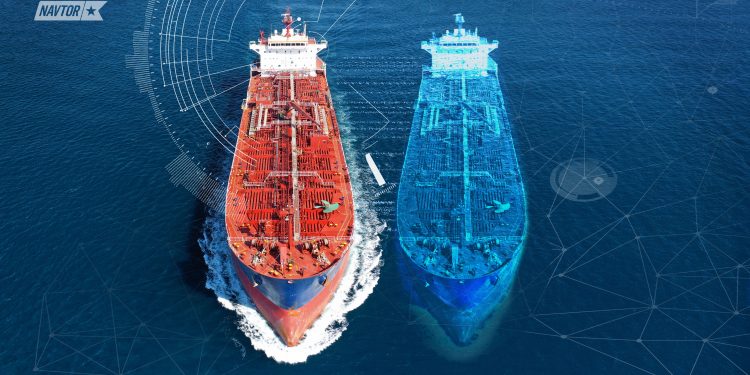
When asked, artificial intelligence defines itself as the capability of machines or software to perform tasks that normally require human intelligence, adding that it is designed to process data, identify patterns, and act on them—often improving over time without being explicitly reprogrammed. However, in the massive industry that is shipping, where the margin for error is minimal, can it be trusted?
In the recently published Maritime Cyber Trends Report 2026 from Cydome, Katerina Raptaki of Navios stated that shipping companies are deploying AI faster than they are defining cyber accountability and that, in 2026, the question after an incident won’t be ‘was the AI wrong?’ but ‘why was it trusted?’
So, if we want to look at this from an analytical standpoint, we need numbers. And they show that the maritime industry’s accelerating adoption of artificial intelligence is sharply compressing the cybersecurity response window, with new data showing that up to 60% of newly disclosed software vulnerabilities are weaponised within 48 hours.
The real opportunity is to rethink and simplify the underlying processes first and then apply AI
That same Cydome report also found that the average time from vulnerability disclosure to active exploitation has fallen from 63 days in 2018 to five days in 2024. Today, AI-driven tools are targeting some systems within 15 minutes of a flaw being detected. The report also notes a 1,600% surge in voice phishing attacks and an 800% rise in assaults on edge network devices in 2025.
A new white paper from maritime cyber specialist CYTUR warns that shipping’s digital revolution has outpaced its defences and that the industry is facing systemic cyber risk. The white paper claimed that maritime cyber incidents in 2025 surged by 103% compared to 2024, emerging as a critical threat to maritime safety.
The Institute of Marine Engineering, Science and Technology (IMarEST), in its survey of 130 maritime professionals and in-depth interviews, found that around 80% of respondents believe AI can improve efficiency. However, it also found that 37% have personally witnessed AI failures. The report added that only 11% have any formal AI policies.
Even though the numbers do look very problematic, IMO and BIMCO claim that AI-based threat detection reduces incident response times by up to 70%. Maritime organisations integrating AI-driven analytics also benefit from predictive maintenance and early warning of emerging cyber risks.
But the point Raptaki was making was somewhat supported by Bob Doncom, chair of the IMarEST AI special interest group. He said that just because AI may arrive at an answer faster than a human, that answer is not necessarily correct.
“The machine might be wrong, but if you don’t do anything in, for example, a rapidly evolving collision situation you’re wrong as well,” Doncom stated.
However, he points out that people can cope with one, two, or three variables, whereas AI can handle seven, eight, or more, and all sorts of variables can be thrown in, with different scenarios run to see the likely outcomes.
“Human in the loop is absolutely brilliant, unless you can’t afford the time. In rapidly evolving situations, such as collision avoidance, the volume of information and speed of events can overwhelm human operators,” Doncom said.
Seafarers, like any human being, can only take so much input at once, and Doncom believes that as the situation gets more complex and the threat gets closer, humans may be just too slow.
“We’ve got to find out where the benefit of relying on autonomy or AI overcomes the risk, when not relying on it is more of a hazard than relying on it,” Doncom said.
The argument for human supervision of AI, or AI supporting humans in decision-making – whichever way you prefer to look at it – is also supported by Marcus Warrelmann, CEO of SEA.AI.
He believes that there is some truth to the idea that AI adoption is outpacing governance in parts of the maritime industry, but says that’s not unusual for emerging technologies, especially those that deliver immediate value.
According to him, in many cases, AI-powered machine vision systems are being adopted precisely because radar and AIS systems have known limitations, including susceptibility to deliberate manipulation, so machine vision is added as an independent layer of perception to help close these gaps.
“Today, most AI-powered safety systems don’t make autonomous decisions; they support human operators with additional situational awareness. In that context, the question is less about ‘trusting AI’ outright and more about how crews are trained to interpret and act on AI-assisted insights,” Warrelmann explains to Splash Extra.
From SEA.AI’s perspective, accountability remains with the operator because the company’s systems augment human decision-making. They do not replace it. They provide detections, classifications, and alerts, but the final judgment always sits with the crew.
Denis Morais, CEO of Canadian shipbuilding software specialist SSI, is for an approach that involves much more scrutiny of AI.
In a talk with Splash Extra, he explains how security is too often treated as an afterthought in a race between shipping firms to adopt the latest in AI tech, as has been the case with every major technological shift.
“That short-term mindset creates the illusion of rapid progress, but the moment an AI-enabled system is compromised, the consequences can be catastrophic,” Morais says. “Unlike other sectors where failures are contained, shipping is the circulatory system of the global economy; a single breach can ripple across markets, supply chains, and national security.”
He adds that the pressure to move fast is great, but in shipping, the stakes are too high to bolt on security later, and that a security-first approach is necessary when dealing with AI.
“[That is] not because it slows innovation, but because it’s the only way to ensure that innovation doesn’t become the source of the next global disruption,” Morais warns.
SEA.AI’s Warrelmann understands that the industry is right to consider human factors, including over-reliance on automation and the need for safety, but believes that AI in maritime is progressing at the pace it should.
“That’s why we believe AI systems should be designed to keep operators engaged and informed, not to remove them from the loop. Overall, we see that AI in maritime is progressing along the same path as in aviation and automotive: it starts with decision support, and best practices and standards evolve alongside it,” he tells Splash Extra.
When asked about the topic, Michael Kei, vice president of technology for the Americas at ABS, says that, for ABS, the central challenge is not AI itself, but its integration into established safety, cybersecurity, and risk management frameworks.
This is supported by Chakib Abi Saab, chief technology and innovation officer at Lloyd’s Register, who tells Splash Extra that the challenge is not the technology itself, but “how it is being integrated into operational environments that were not originally designed for this level of autonomy and data dependency”.
He adds that the broader narrative around AI and a tendency to overestimate what can be delivered in the short term create inflated expectations.
“[This] ultimately increases risk when those expectations are not matched by robust implementation. AI is powerful but not infallible, and it should not be treated as such,” Abi Saab points out.
And the issue of ‘why was AI trusted?’ is a question that should be formulated differently, according to ABS’ Kei.
“Expectations for AI-enabled systems must be unambiguous: how risk is managed, how system performance is validated and monitored, and how AI outputs are governed in daily operations. After any incident, the key question should include ‘how did the AI behave based on its design and limitations?’,” he says.
Ali Saab also made a very good point about which processes AI is applied to and what kinds of results it will yield.
“AI will only amplify the quality of the processes it is applied to. If we automate poor or outdated processes, we simply get poor outcomes faster. The real opportunity is to rethink and simplify the underlying processes first and then apply AI in a way that genuinely improves outcomes,” he explains.
He also makes it abundantly clear that he fully endorses the development of AI and emerging technologies. As long as the scale is balanced by equal focus on clear accountability, strong governance, and a deep understanding of where human oversight remains critical.
“The organisations that will lead are not simply those moving fastest, but those moving with clarity, discipline, and a strong foundation of trust in how these systems are deployed and managed,” Abi Saab notes.
Now, as the first paragraph suggested, one of the commercially available AIs was asked to define itself. But, to push the exercise a bit further, it was also asked, ‘Should AI systems integrated into maritime systems be trusted, and is AI at fault if an incident occurs due to systems it oversees?’.
It answered that AI in maritime systems “can be trusted—but only within a rigorously engineered, supervised, and regulated framework”. As for the fault, it gave a rather shrewd answer, stating that an AI is not “legally at fault in the current regime” and that “liability sits with human and corporate actors”.
So, just to be clear, if anything bad were ever to happen, artificial intelligence has a court defence ready.
But this is not only an AI’s point of view, so to speak. Anil Kumar Korupoju, a senior surveyor at the Indian Register of Shipping, wrote something similar in a story published on our sister title Splash last week.
“For owners, the implications extend beyond technical reliability. If an AI system contributes to a navigational or maintenance decision, accountability does not sit with the algorithm. It sits with the operator. In the event of an incident, questions will focus on data integrity, validation boundaries, and update control,” he said.
From everything experts have told us to a somewhat consensus regarding AI in shipping, it is still something that requires human supervision and improved governance within the industry. AI is improving by leaps and bounds in every direction, and for now, it appears that development is outpacing governance.
source : splash247
Featured Post
 বড় জাহাজ মেরামতে মাতারবাড়ীতে ১ বিলিয়ন ডলারের প্রকল্প
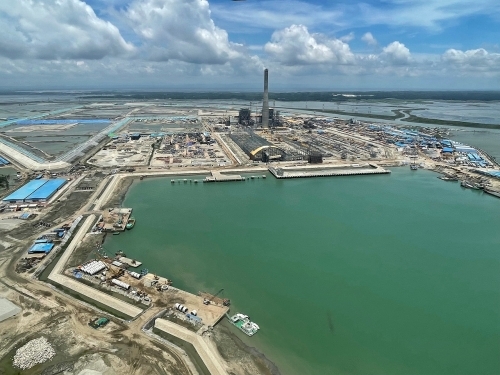
 মাতারবাড়ীতে প্রায় ১ বিলিয়ন মার্কিন ডলার ব্যয়ে পরিবেশবান্ধব ডকইয়ার্ড ও জাহাজ নির্মাণ কেন্দ্র স্থাপনের উদ্যোগে নীতিগত অনুমোদন দিয়েছে নৌপরিবহন মন্ত্রণালয়। এখন প্রকল্পটির কারিগরি ও আর্থিক মূল্যায়নের জন্য প্রস্তাবটি সরকারি-বেসরকারি অংশীদারত্ব (পিপিপি) কর্তৃপক্ষের কাছে পাঠানো হয়েছে। সম্পূর্ণ বেসরকারি অর্থায়নে সরকারি জমির মালিকানা অক্ষুণ্ন রেখে প্রকল্পটি বাস্তবায়নের পরিকল্পনা রয়েছে। বন্দর কর্তৃপক্ষ জানায়, […]
 Industry on alert over scam messages offering ships “safe passage” on Hormuz
 Credit: Shutterstock Fraudulent messages offering safe passage through the Strait of Hormuz in exchange for cryptocurrency have been circulated to shipping companies with vessels stranded west of the waterway, according to MARISKS. In an alert issued on 20 April, MARISKS cautioned that unknown actors posing as Iranian authorities had contacted […]



JOB SITES
CONTENTS
LINKS
Happy New Year

Découvrez les avantages de MadCasino
Dans le monde des casinos en ligne, MadCasino se distingue par ses offres attrayantes et ses services de qualité. Que vous soyez un joueur débutant ou un parieur aguerri, vous trouverez ici une variété de jeux qui sauront satisfaire toutes vos envies. Les machines à sous, les jeux de table et les options de paris en direct sont tous disponibles pour vous offrir une expérience de jeu inégalée. De plus, le casino propose régulièrement des bonus qui permettent d'augmenter vos chances de gagner, vous offrant ainsi une excellente opportunité de maximiser vos gains.
En matière de sécurité, MadCasino est un nom de confiance. Il est entièrement licencié et régulé, ce qui garantit un environnement de jeu sûr et équitable. Les joueurs peuvent se concentrer sur leur expérience de jeu sans se soucier des problèmes de sécurité. Les transactions financières sont également sécurisées grâce à des technologies de pointe.
Les jeux proposés par MadCasino sont issus des développeurs les plus réputés de l'industrie, vous assurant des graphismes époustouflants et des mécaniques de jeu innovantes. Les joueurs peuvent également profiter d'une expérience de jeu en direct qui simule l'atmosphère d'un casino terrestre, tout en restant dans le confort de leur maison.
Enfin, la plateforme de MadCasino est optimisée pour les appareils mobiles, permettant aux joueurs de parier à tout moment et de n'importe où. Que vous soyez sur votre smartphone ou votre tablette, l'accès à vos jeux préférés n'a jamais été aussi simple. Ne manquez pas l'opportunité de découvrir ce casino exceptionnel.
Les offres de Cresus Casino
Cresus Casino est un autre acteur majeur dans le domaine des jeux en ligne, offrant des promotions généreuses et une vaste sélection de jeux. Les joueurs peuvent profiter d'une expérience de jeu enrichissante grâce aux nombreux bonus disponibles, qui sont conçus pour attirer tant les nouveaux utilisateurs que les joueurs réguliers. Ces avantages permettent non seulement de prolonger votre temps de jeu, mais aussi d'augmenter vos chances de gains conséquents.
Le casino se distingue également par sa ludothèque impressionnante, comprenant une sélection variée de machines à sous, de jeux de table et de jeux en direct. Les clients peuvent choisir parmi des titres populaires et appréciés, ainsi que des nouveautés qui enrichissent constamment l'offre. L'interface utilisateur est conviviale, rendant la navigation sur la plateforme fluide et agréable.
En termes de sécurité, Cresus Casino assure à ses joueurs un environnement de jeu fiable. La plateforme utilise des protocoles de sécurité avancés pour protéger les données personnelles et financières des utilisateurs. Cela permet aux joueurs de se sentir en sécurité tout en jouant à leurs jeux préférés.
Avec un service client réactif et professionnel, Cresus Casino s'assure que toutes vos questions et préoccupations sont traitées rapidement. Que ce soit pour des questions concernant les bonus, les retraits ou les jeux, vous bénéficierez d'une assistance rapide et efficace.
Explorez Nine Casino et ses avantages
Dans l'univers des casinos en ligne, Nine Casino a su se faire une place de choix grâce à son approche innovante et à ses nombreux avantages pour les joueurs. Les utilisateurs peuvent s'attendre à une expérience de jeu enrichissante, avec des bonus attractifs qui sont régulièrement mis à jour. Ces offres sont une excellente façon de découvrir de nouveaux jeux tout en maximisant votre potentiel de gain.
La plateforme de Nine Casino est riche en options de jeux, allant des machines à sous aux jeux de table, en passant par le live casino. Chaque jeu est conçu pour offrir une expérience immersive grâce à des graphismes de haute qualité et des fonctionnalités innovantes. Les parieurs peuvent profiter de sessions de jeu captivantes, comme s'ils étaient dans un véritable casino.
La sécurité est une priorité pour Nine Casino, qui utilise des technologies de cryptage avancées pour protéger les informations de ses joueurs. Cela garantit un environnement de jeu sûr et fiable, permettant aux utilisateurs de se concentrer sur ce qu'ils aiment le plus : jouer.
Enfin, le service clientèle fourni par Nine Casino est exceptionnel, avec des agents disponibles pour répondre à toutes vos questions et résoudre vos problèmes. Vous pourrez ainsi jouer en toute tranquillité, sachant que votre satisfaction est au cœur de leurs préoccupations.
Profitez de l'expérience Lucky31
Lucky31 est un casino en ligne qui se distingue par son approche orientée vers le joueur, offrant une multitude d'options de jeux et des bonus généreux. Que vous soyez amateur de machines à sous ou passionné de jeux de table, vous trouverez une large sélection pour satisfaire toutes vos envies de jeu. Les promotions fréquentes permettent aux joueurs de prolonger leur expérience tout en augmentant leurs chances de gains.
La convivialité de la plateforme de Lucky31 est l'un de ses plus grands atouts. Les joueurs peuvent naviguer facilement entre les différents jeux, et l'interface est conçue pour être intuitive, quel que soit le niveau d'expérience de l'utilisateur. De plus, le casino est entièrement optimisé pour les appareils mobiles, ce qui permet de parier où que vous soyez.
En matière de sécurité, Lucky31 prend les préoccupations des joueurs très au sérieux. Le casino est agréé et régulé, garantissant un environnement de jeu équitable et sécurisé. Les joueurs peuvent ainsi se concentrer sur leur expérience de jeu sans se soucier des risques liés à la sécurité.
Pour ceux qui recherchent un support client efficace, Lucky31 offre un service réactif et professionnel. Que ce soit pour des questions sur les bonus, les jeux ou les paiements, vous aurez accès à une assistance de qualité, vous garantissant une expérience de jeu fluide et agréable.