search the site


Giant shipping containers fall into the sea every year, disappear without a trace, become a hidden risk for ships, a source of pollution, a silent legal dispute, and an uncomfortable reminder of the true cost of global trade.
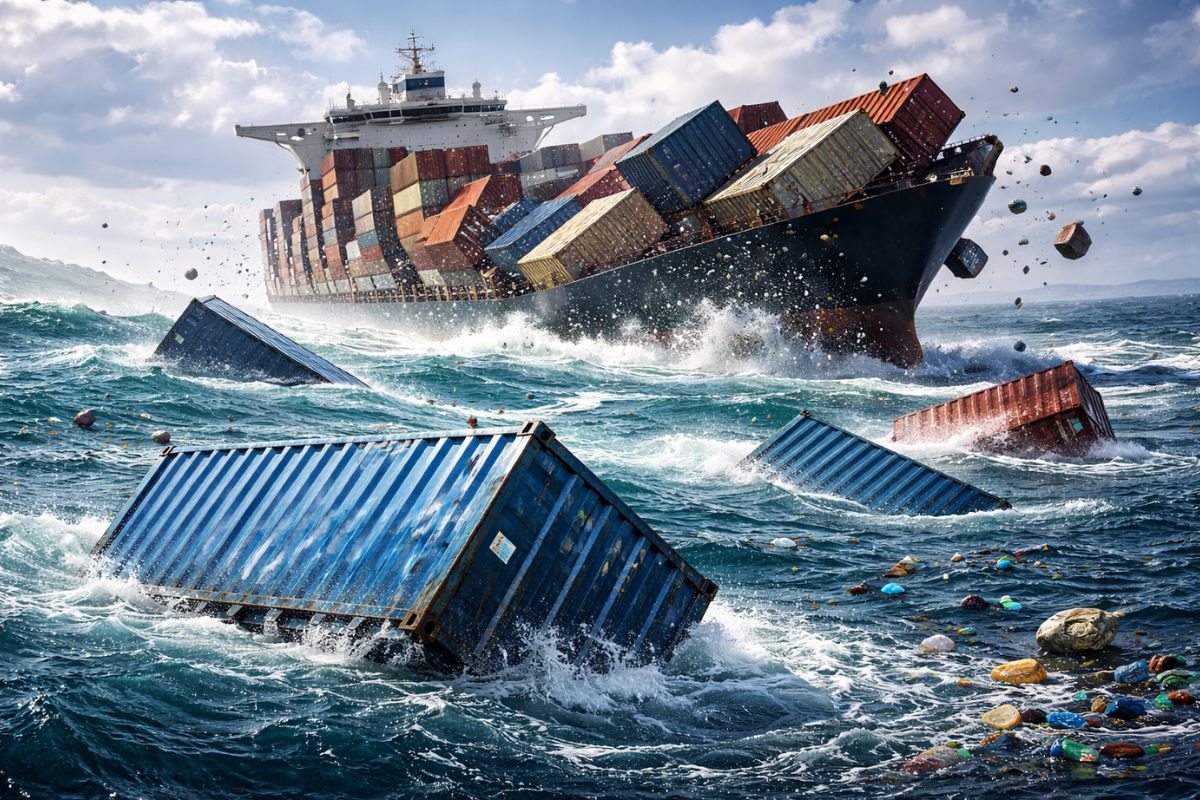
Every year, thousands of steel crates fall from ships, posing a hidden risk to other vessels, the environment, and the economic and legal chain itself, almost always far from any spotlight.
Every year, Thousands of shipping containers fall into the sea without attracting attention.…as a direct consequence of modern global trade. Ever-larger ships, longer routes, more violent storms, and cargo piles at heights unthinkable just a few decades ago create a scenario where a single failure is enough for these steel boxes to simply disappear from sight. but don’t disappear from the problemBecause that’s exactly where they see hidden risk.
Most of the time there’s no explosion, no viral video, no global alarm. A container falls overboard, the ship continues its route, and the system runs as if nothing happened. Except, the instant the container touches the water, It ceases to be just cargo and becomes an object out of control., without a defined course, capable of floating for days, sinking slowly, reappearing on distant beaches or becoming a threat to other ships, the environment and anyone who tries to approach it

The first question that arises is simple and disturbing at the same time: Will a shipping container that falls into the sea always sink, or can it float for extended periods? The answer is not obvious.
And it is precisely this lack of certainty that makes these objects… become a hidden risk on any major shipping route..
There is no exact global number of how many containers are lost in the oceans right now, but Estimates suggest more than a thousand per year under normal conditions.That’s without considering specific accidents or major storms where that number can multiply in a few hours. And not all of these containers behave the same way.
An empty container already weighs more than two tons. Loaded, it can easily exceed thirty. Some carry clothes or appliances.
Others carry chemicals, food, or goods that should never come into contact with salt waterIn extreme cases, live animals are transported. All of this can end up in the sea.
When one of these boxes falls, It becomes a hidden risk for two reasons at the same time.Because it can become a physical obstacle for other vessels and because it may carry cargo with a high potential for environmental, economic, and legal damage.
The unsettling physics of containers that float, sink, and reappear.
The intuitive idea seems simple. Containers are made of steel. Steel weighs something. Therefore, it sinks. But this logic ignores a crucial factor: the internal volume filled with air.
A shipping container is not a solid block, but rather a hollow structure designed to transport cargo, and as long as air remains inside, The assembly displaces more water than its own weight.which ensures buoyancy, at least for a while.
Here we see the first counterintuitive piece of information: A container can float even when fully loaded.The problem is that it was never designed for that.
It lacks a watertight seal, it wasn’t built to withstand continuous pressure, and it wasn’t designed to remain submerged for extended periods.
The moment it hits the sea, water begins to enter through the vents, the door joints, and through small deformations caused by the fall.
As water enters, air exits. This exchange creates an extremely dangerous intermediate statein which the container is partially submerged, neither fully sunk nor clearly floating. From a distance, it blends in with the sea itself.especially in areas with poor visibility.Play Video
The radar isn’t always able to detect it clearly. It’s at this stage that… It becomes the ultimate hidden risk for fishing boats, sailboats, and smaller vessels., which have already collided with floating containers in real accidents.
The fate of each tank depends on several factors: the type of load, the angle of impact with the water, the structural condition after years of use, as well as waves, currents, temperature, and salinity.
Two identical containers can have completely different destinations.Even when falling in virtually the same spot, some float for weeks. Others disappear in minutes.
Sooner or later, The fragile balance between air and water breaks down.The weight overcomes the buoyancy, and the container sinks.
Sometimes slowly, sometimes abruptly, sometimes just when someone believes they’ve located it. But even deep down, it doesn’t cease to exist. It becomes a rigid structure supported on the seabed, an out-of-place industrial object that begins to silently deteriorate.
The legal and economic side of the shipping container that nobody sees, but still has an owner.
From the outside, it might seem tempting. A ship passes by with a container floating adrift, which has clearly become a hidden risk on the routeApparently ownerless, in the open sea, with no one claiming it, and no visible sign of ownership. The question immediately arises: Is it possible to collect, secure, and transport this container to a port?
The answer, both physically and legally, is far less simple. From a legal standpoint, a lost container… It is not automatically an abandoned object..
It still has an owner, it’s still covered by insurance, and remains embedded in a chain of contracts, documents and responsibilities. that do not disappear when the box touches water.
When a container is lost, the cargo is declared damaged, the insurance is activated, and a clear economic process is triggered.
From there, that box becomes part of an active legal processTouching it without permission could make a captain, a fisherman, or anyone else responsible for an international crime.
Even so, The combination of potential value and lack of direct oversight fuels the temptation.A single container can store goods valued at hundreds of thousands of euros. New clothes, household appliances, industrial components, packaged goods.
In some cases, there are records of containers being collected and taken to ports without official communication, with the cargo divided, sold, and quickly dissolved into the informal economy.
Meanwhile, Goods that never reach the port enter a physical and legal limbo.It is not a delivered product, it is not clearly discarded waste, it is not formally registered scrap.
It’s a suspended load. which becomes a hidden legal, economic, and moral risk all at once., highlighting the conflict between opportunity and responsibility on the high seas.
Containers as a silent source of pollution and environmental damage.
If the issue were only the value of the cargo or the risk of collision, the problem would already be significant. But there is another troubling question: Do these containers pollute the ocean? The short answer is yes. The long answer is much worse.
From an environmental point of view, a container is an object completely foreign to the marine ecosystemSteel oxidizes slowly, coatings peel off, internal plastics crumble, and if the cargo includes chemicals, batteries, or industrial compounds, The ocean begins to receive a mix of substances that it was not prepared to dilute safely..
Construction project management tools
In some cases, the box opens gradually. Over days or weeks, the contents are released in small portions.
Sneakers, toys, packaging, pieces of foam, and microplastics begin appearing on distant beaches without apparent explanation, until their origin is discovered in a lost container.
Each object found on the coast holds the invisible signature of a ship, a route, and a failure somewhere in the system.
There are even more serious situations, involving biological load or invasive organisms, which should never have reached certain ecosystems.
On routes transporting live animals, lost refrigerated containers had predictable and unpleasant outcomes.
In other cases, plants, insects, and biological material end up being released in regions where they can profoundly alter the natural balance.
Paradoxically, Many shipping containers are unintentionally turning into artificial reefs. Upon reaching the bottom, they are colonized by marine organisms, creating new structures in places where nothing previously existed.
At first glance, this may seem positive, but these surfaces introduce toxic materials, alter the local dynamics, and introduce an industrial factor into environments that were never designed for it.
At the end, The ocean becomes an unwitting repository for part of the global logistics system., an unplanned, disorganized, and mostly invisible warehouse.
This is another point where these boxes They saw a hidden risk, now as a source of slow and accumulated pollution.which doesn’t generate spectacular images, but grows year after year.
source : en.clickpetroleoegas
Featured Post
 বড় জাহাজ মেরামতে মাতারবাড়ীতে ১ বিলিয়ন ডলারের প্রকল্প
 মাতারবাড়ীতে প্রায় ১ বিলিয়ন মার্কিন ডলার ব্যয়ে পরিবেশবান্ধব ডকইয়ার্ড ও জাহাজ নির্মাণ কেন্দ্র স্থাপনের উদ্যোগে নীতিগত অনুমোদন দিয়েছে নৌপরিবহন মন্ত্রণালয়। এখন প্রকল্পটির কারিগরি ও আর্থিক মূল্যায়নের জন্য প্রস্তাবটি সরকারি-বেসরকারি অংশীদারত্ব (পিপিপি) কর্তৃপক্ষের কাছে পাঠানো হয়েছে। সম্পূর্ণ বেসরকারি অর্থায়নে সরকারি জমির মালিকানা অক্ষুণ্ন রেখে প্রকল্পটি বাস্তবায়নের পরিকল্পনা রয়েছে। বন্দর কর্তৃপক্ষ জানায়, […]
 Industry on alert over scam messages offering ships “safe passage” on Hormuz
 Credit: Shutterstock Fraudulent messages offering safe passage through the Strait of Hormuz in exchange for cryptocurrency have been circulated to shipping companies with vessels stranded west of the waterway, according to MARISKS. In an alert issued on 20 April, MARISKS cautioned that unknown actors posing as Iranian authorities had contacted […]



JOB SITES
CONTENTS
LINKS
Happy New Year

Découvrez les avantages de MadCasino
Dans le monde des casinos en ligne, MadCasino se distingue par ses offres attrayantes et ses services de qualité. Que vous soyez un joueur débutant ou un parieur aguerri, vous trouverez ici une variété de jeux qui sauront satisfaire toutes vos envies. Les machines à sous, les jeux de table et les options de paris en direct sont tous disponibles pour vous offrir une expérience de jeu inégalée. De plus, le casino propose régulièrement des bonus qui permettent d'augmenter vos chances de gagner, vous offrant ainsi une excellente opportunité de maximiser vos gains.
En matière de sécurité, MadCasino est un nom de confiance. Il est entièrement licencié et régulé, ce qui garantit un environnement de jeu sûr et équitable. Les joueurs peuvent se concentrer sur leur expérience de jeu sans se soucier des problèmes de sécurité. Les transactions financières sont également sécurisées grâce à des technologies de pointe.
Les jeux proposés par MadCasino sont issus des développeurs les plus réputés de l'industrie, vous assurant des graphismes époustouflants et des mécaniques de jeu innovantes. Les joueurs peuvent également profiter d'une expérience de jeu en direct qui simule l'atmosphère d'un casino terrestre, tout en restant dans le confort de leur maison.
Enfin, la plateforme de MadCasino est optimisée pour les appareils mobiles, permettant aux joueurs de parier à tout moment et de n'importe où. Que vous soyez sur votre smartphone ou votre tablette, l'accès à vos jeux préférés n'a jamais été aussi simple. Ne manquez pas l'opportunité de découvrir ce casino exceptionnel.
Les offres de Cresus Casino
Cresus Casino est un autre acteur majeur dans le domaine des jeux en ligne, offrant des promotions généreuses et une vaste sélection de jeux. Les joueurs peuvent profiter d'une expérience de jeu enrichissante grâce aux nombreux bonus disponibles, qui sont conçus pour attirer tant les nouveaux utilisateurs que les joueurs réguliers. Ces avantages permettent non seulement de prolonger votre temps de jeu, mais aussi d'augmenter vos chances de gains conséquents.
Le casino se distingue également par sa ludothèque impressionnante, comprenant une sélection variée de machines à sous, de jeux de table et de jeux en direct. Les clients peuvent choisir parmi des titres populaires et appréciés, ainsi que des nouveautés qui enrichissent constamment l'offre. L'interface utilisateur est conviviale, rendant la navigation sur la plateforme fluide et agréable.
En termes de sécurité, Cresus Casino assure à ses joueurs un environnement de jeu fiable. La plateforme utilise des protocoles de sécurité avancés pour protéger les données personnelles et financières des utilisateurs. Cela permet aux joueurs de se sentir en sécurité tout en jouant à leurs jeux préférés.
Avec un service client réactif et professionnel, Cresus Casino s'assure que toutes vos questions et préoccupations sont traitées rapidement. Que ce soit pour des questions concernant les bonus, les retraits ou les jeux, vous bénéficierez d'une assistance rapide et efficace.
Explorez Nine Casino et ses avantages
Dans l'univers des casinos en ligne, Nine Casino a su se faire une place de choix grâce à son approche innovante et à ses nombreux avantages pour les joueurs. Les utilisateurs peuvent s'attendre à une expérience de jeu enrichissante, avec des bonus attractifs qui sont régulièrement mis à jour. Ces offres sont une excellente façon de découvrir de nouveaux jeux tout en maximisant votre potentiel de gain.
La plateforme de Nine Casino est riche en options de jeux, allant des machines à sous aux jeux de table, en passant par le live casino. Chaque jeu est conçu pour offrir une expérience immersive grâce à des graphismes de haute qualité et des fonctionnalités innovantes. Les parieurs peuvent profiter de sessions de jeu captivantes, comme s'ils étaient dans un véritable casino.
La sécurité est une priorité pour Nine Casino, qui utilise des technologies de cryptage avancées pour protéger les informations de ses joueurs. Cela garantit un environnement de jeu sûr et fiable, permettant aux utilisateurs de se concentrer sur ce qu'ils aiment le plus : jouer.
Enfin, le service clientèle fourni par Nine Casino est exceptionnel, avec des agents disponibles pour répondre à toutes vos questions et résoudre vos problèmes. Vous pourrez ainsi jouer en toute tranquillité, sachant que votre satisfaction est au cœur de leurs préoccupations.
Profitez de l'expérience Lucky31
Lucky31 est un casino en ligne qui se distingue par son approche orientée vers le joueur, offrant une multitude d'options de jeux et des bonus généreux. Que vous soyez amateur de machines à sous ou passionné de jeux de table, vous trouverez une large sélection pour satisfaire toutes vos envies de jeu. Les promotions fréquentes permettent aux joueurs de prolonger leur expérience tout en augmentant leurs chances de gains.
La convivialité de la plateforme de Lucky31 est l'un de ses plus grands atouts. Les joueurs peuvent naviguer facilement entre les différents jeux, et l'interface est conçue pour être intuitive, quel que soit le niveau d'expérience de l'utilisateur. De plus, le casino est entièrement optimisé pour les appareils mobiles, ce qui permet de parier où que vous soyez.
En matière de sécurité, Lucky31 prend les préoccupations des joueurs très au sérieux. Le casino est agréé et régulé, garantissant un environnement de jeu équitable et sécurisé. Les joueurs peuvent ainsi se concentrer sur leur expérience de jeu sans se soucier des risques liés à la sécurité.
Pour ceux qui recherchent un support client efficace, Lucky31 offre un service réactif et professionnel. Que ce soit pour des questions sur les bonus, les jeux ou les paiements, vous aurez accès à une assistance de qualité, vous garantissant une expérience de jeu fluide et agréable.