search the site


RMI Investigation: Fatal fall of bosun from scaffolding
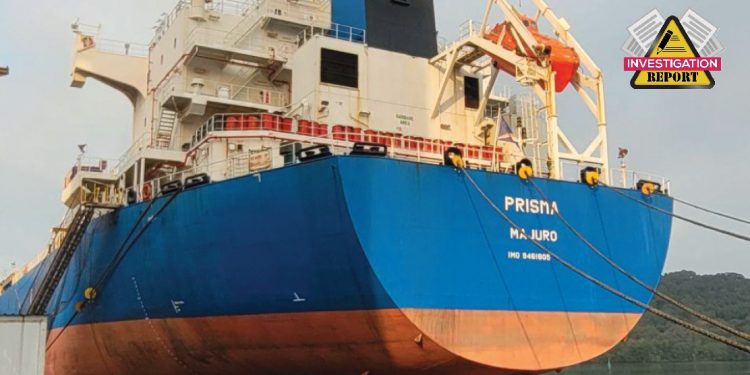
The Republic of the Marshall Islands (RMI) Maritime Administrator has issued an investigation report regarding an incident where the bosun on board the bulk carrier PRISMA fell from scaffolding while painting a cargo hold, losing his life.
The incident
On 29 January 2025, the Republic of the Marshall Islands-registered PRISMA, a geared five-hatch bulk carrier, managed by Maru LLC, was loitering in the Baltic Sea approximately 40–45 NM north of the Republic of Poland coast. Work being done on board included painting the cargo holds in preparation for loading cargo at the ship’s next load port. A few minutes before 2200, the Bosun, who was standing on scaffolding approximately 9.5 m above the tank top to paint the upper portions of frames located inside of CH No. 3, directed the ASD1 and ASD2 to move the scaffolding by 3 m.
The Bosun remained on the scaffolding when it was moved. The scaffolding, along with the Bosun, fell as the two ASDs were putting the stabilizer arms in place. The OS2, who was on deck, heard a loud noise from CH No. 3 and looked down into the cargo hold. He saw that the scaffolding had fallen and immediately reported by radio that the scaffolding being used in CH No. 3 had collapsed.
The ship’s C/O, who had just gone out on deck, heard the radio call from the OS2 and immediately entered the cargo hold. While climbing down the Australia ladder, he observed that the scaffolding had fallen and that ASD1 and ASD2 were assisting the Bosun, who was lying on the tank top. The Bosun was wearing a safety harness with a lifeline.
The clip on the lifeline was connected to the scaffolding. The C/O examined the Bosun and determined that he was unconscious, had labored breathing and a weak pulse, and that his eyes did not respond to light. The C/O informed the Master of the Bosun’s condition and requested medical equipment be brought to CH No. 3.
The C/O, with assistance from the 2/O and other crewmembers, began administering first aid to the Bosun. The Master informed the Company and requested medical advice from C.I.R.M. Rome. Based on advice from C.I.R.M. Rome, the Master directed the ship to proceed at full speed to the nearest port.
The Master also made a PAN-PAN broadcast on VHF Channel 16 requesting a MEDEVAC for the Bosun. MRCC Gdynia responded to the PAN-PAN broadcast and provided instructions for rendezvousing with a rescue helicopter and boat for MEDEVAC of the Bosun. At 2259, the C/O informed the Master that the Bosun was deceased.
The Master informed MRCC Gdynia, who then canceled the MEDEVAC. The marine safety investigation conducted by the Republic of the Marshall Islands Maritime Administrator ruled out either a material or structural failure of the scaffolding but was otherwise not able to determine why the scaffolding fell.

Conclusions
Causal factors that contributed to this very serious marine casualty included:
(a) that the Bosun remained on the scaffolding when it was moved;
(b) that the lifeline on the Bosun’s safety harness was connected to the scaffolding and not to the ship or to a fall arrestor;
(c) ineffective onboard implementation of stop-work authority; and
(d) ineffective oversight by the C/O of work being conducted in the cargo holds on 29 January 2025.
Additional causal factors that may have contributed to this very serious marine casualty included:
(a) ineffective onboard implementation of the Company’s permit to work procedures;
(b) that the Company’s procedures for working aloft did not address the safe use of scaffolding or other equipment, such as portable ladders, staging, bosun’s chairs, etc.;
(c) that the Company’s risk assessment for working aloft using a bosun’s chair, staging, or scaffolding did not identify equipment failures to include mechanical or structural defects of scaffolding, portable ladders, staging, bosun’s chair, etc.; and
(d) the removal of two of the scaffold’s four stabilizer arms before it was used in CH No. 3 on 29 January 2025.
Additional issues that were identified but did not contribute to this very serious marine casualty included:
(a) improper onboard implementation of the work and rest hour requirements in the STCW Code and MLC, 2006 in that
- the Master’s, C/O’s, and other crewmembers’ work and rest hour records for 29–30 January 2025 indicated they were resting and not that they were actively engaged in providing assistance to the Bosun after the scaffolding fell; and
- the C/O’s and other crewmembers’ hours of rest were divided into more than two periods while the ship’s cargo holds were being prepared for loading between 26–29 January 2025; and
(b) a dedicated Lookout was likely not on duty during hours of darkness or when the existing conditions might not have been appropriate for the OOW to serve as PRISMA’s only Lookout while the ship was loitering off the coast of Poland between 26–29 January 2025.
Lessons learned:
- Safe-work procedures are administrative controls that must be implemented consistently by all crewmembers to be an effective means of reducing exposure to hazards.
- Scaffolding, bosun’s chairs, staging, portable ladders, etc. must be set-up and used in accordance with the manufacturer’s instructions.
- Lifelines connected to a safety harness must be secured to a strong point on the ship or a fall arrester connected to the ship and not scaffolding, staging, portable ladders, etc. to provide protection from falls.
- The use of stop-work authority can prevent marine casualties. For stop-work authority to be effective, crewmembers must not only be aware that they have this authority, but they must also have confidence that the authority is nonnegotiable and can be exercised without fear of repercussion. Crewmembers must also be as familiar with how to issue and respond to a stop-work action or instruction as they are with their other shipboard duties.
- Work plans must prioritize watchstanding requirements (e.g., maintaining a proper lookout) and the rest-hour requirements in the STCW Code and MLC, 2006 over the course of the completion of routine ship-board tasks, such as preparing cargo holds for loading.
- source : safety4sea
Featured Post
 বড় জাহাজ মেরামতে মাতারবাড়ীতে ১ বিলিয়ন ডলারের প্রকল্প
 মাতারবাড়ীতে প্রায় ১ বিলিয়ন মার্কিন ডলার ব্যয়ে পরিবেশবান্ধব ডকইয়ার্ড ও জাহাজ নির্মাণ কেন্দ্র স্থাপনের উদ্যোগে নীতিগত অনুমোদন দিয়েছে নৌপরিবহন মন্ত্রণালয়। এখন প্রকল্পটির কারিগরি ও আর্থিক মূল্যায়নের জন্য প্রস্তাবটি সরকারি-বেসরকারি অংশীদারত্ব (পিপিপি) কর্তৃপক্ষের কাছে পাঠানো হয়েছে। সম্পূর্ণ বেসরকারি অর্থায়নে সরকারি জমির মালিকানা অক্ষুণ্ন রেখে প্রকল্পটি বাস্তবায়নের পরিকল্পনা রয়েছে। বন্দর কর্তৃপক্ষ জানায়, […]
 Industry on alert over scam messages offering ships “safe passage” on Hormuz
 Credit: Shutterstock Fraudulent messages offering safe passage through the Strait of Hormuz in exchange for cryptocurrency have been circulated to shipping companies with vessels stranded west of the waterway, according to MARISKS. In an alert issued on 20 April, MARISKS cautioned that unknown actors posing as Iranian authorities had contacted […]



JOB SITES
CONTENTS
LINKS
Happy New Year

Découvrez les avantages de MadCasino
Dans le monde des casinos en ligne, MadCasino se distingue par ses offres attrayantes et ses services de qualité. Que vous soyez un joueur débutant ou un parieur aguerri, vous trouverez ici une variété de jeux qui sauront satisfaire toutes vos envies. Les machines à sous, les jeux de table et les options de paris en direct sont tous disponibles pour vous offrir une expérience de jeu inégalée. De plus, le casino propose régulièrement des bonus qui permettent d'augmenter vos chances de gagner, vous offrant ainsi une excellente opportunité de maximiser vos gains.
En matière de sécurité, MadCasino est un nom de confiance. Il est entièrement licencié et régulé, ce qui garantit un environnement de jeu sûr et équitable. Les joueurs peuvent se concentrer sur leur expérience de jeu sans se soucier des problèmes de sécurité. Les transactions financières sont également sécurisées grâce à des technologies de pointe.
Les jeux proposés par MadCasino sont issus des développeurs les plus réputés de l'industrie, vous assurant des graphismes époustouflants et des mécaniques de jeu innovantes. Les joueurs peuvent également profiter d'une expérience de jeu en direct qui simule l'atmosphère d'un casino terrestre, tout en restant dans le confort de leur maison.
Enfin, la plateforme de MadCasino est optimisée pour les appareils mobiles, permettant aux joueurs de parier à tout moment et de n'importe où. Que vous soyez sur votre smartphone ou votre tablette, l'accès à vos jeux préférés n'a jamais été aussi simple. Ne manquez pas l'opportunité de découvrir ce casino exceptionnel.
Les offres de Cresus Casino
Cresus Casino est un autre acteur majeur dans le domaine des jeux en ligne, offrant des promotions généreuses et une vaste sélection de jeux. Les joueurs peuvent profiter d'une expérience de jeu enrichissante grâce aux nombreux bonus disponibles, qui sont conçus pour attirer tant les nouveaux utilisateurs que les joueurs réguliers. Ces avantages permettent non seulement de prolonger votre temps de jeu, mais aussi d'augmenter vos chances de gains conséquents.
Le casino se distingue également par sa ludothèque impressionnante, comprenant une sélection variée de machines à sous, de jeux de table et de jeux en direct. Les clients peuvent choisir parmi des titres populaires et appréciés, ainsi que des nouveautés qui enrichissent constamment l'offre. L'interface utilisateur est conviviale, rendant la navigation sur la plateforme fluide et agréable.
En termes de sécurité, Cresus Casino assure à ses joueurs un environnement de jeu fiable. La plateforme utilise des protocoles de sécurité avancés pour protéger les données personnelles et financières des utilisateurs. Cela permet aux joueurs de se sentir en sécurité tout en jouant à leurs jeux préférés.
Avec un service client réactif et professionnel, Cresus Casino s'assure que toutes vos questions et préoccupations sont traitées rapidement. Que ce soit pour des questions concernant les bonus, les retraits ou les jeux, vous bénéficierez d'une assistance rapide et efficace.
Explorez Nine Casino et ses avantages
Dans l'univers des casinos en ligne, Nine Casino a su se faire une place de choix grâce à son approche innovante et à ses nombreux avantages pour les joueurs. Les utilisateurs peuvent s'attendre à une expérience de jeu enrichissante, avec des bonus attractifs qui sont régulièrement mis à jour. Ces offres sont une excellente façon de découvrir de nouveaux jeux tout en maximisant votre potentiel de gain.
La plateforme de Nine Casino est riche en options de jeux, allant des machines à sous aux jeux de table, en passant par le live casino. Chaque jeu est conçu pour offrir une expérience immersive grâce à des graphismes de haute qualité et des fonctionnalités innovantes. Les parieurs peuvent profiter de sessions de jeu captivantes, comme s'ils étaient dans un véritable casino.
La sécurité est une priorité pour Nine Casino, qui utilise des technologies de cryptage avancées pour protéger les informations de ses joueurs. Cela garantit un environnement de jeu sûr et fiable, permettant aux utilisateurs de se concentrer sur ce qu'ils aiment le plus : jouer.
Enfin, le service clientèle fourni par Nine Casino est exceptionnel, avec des agents disponibles pour répondre à toutes vos questions et résoudre vos problèmes. Vous pourrez ainsi jouer en toute tranquillité, sachant que votre satisfaction est au cœur de leurs préoccupations.
Profitez de l'expérience Lucky31
Lucky31 est un casino en ligne qui se distingue par son approche orientée vers le joueur, offrant une multitude d'options de jeux et des bonus généreux. Que vous soyez amateur de machines à sous ou passionné de jeux de table, vous trouverez une large sélection pour satisfaire toutes vos envies de jeu. Les promotions fréquentes permettent aux joueurs de prolonger leur expérience tout en augmentant leurs chances de gains.
La convivialité de la plateforme de Lucky31 est l'un de ses plus grands atouts. Les joueurs peuvent naviguer facilement entre les différents jeux, et l'interface est conçue pour être intuitive, quel que soit le niveau d'expérience de l'utilisateur. De plus, le casino est entièrement optimisé pour les appareils mobiles, ce qui permet de parier où que vous soyez.
En matière de sécurité, Lucky31 prend les préoccupations des joueurs très au sérieux. Le casino est agréé et régulé, garantissant un environnement de jeu équitable et sécurisé. Les joueurs peuvent ainsi se concentrer sur leur expérience de jeu sans se soucier des risques liés à la sécurité.
Pour ceux qui recherchent un support client efficace, Lucky31 offre un service réactif et professionnel. Que ce soit pour des questions sur les bonus, les jeux ou les paiements, vous aurez accès à une assistance de qualité, vous garantissant une expérience de jeu fluide et agréable.