search the site


Moses parts the Red Sea: Israel’s strategic challenges as new routes emerge
By Amit Yarom
A new $4 billion bridge across the Strait of Tiran could upend plans to physically integrate Israel into the Middle East.
In a big step reshaping Red Sea connectivity, Saudi Arabia and Egypt have recently announced finalized plans for the Moses Bridge, a thirty two-kilometer causeway linking the Saudi coast of Ras Hamid with Egypt’s Sinai Peninsula at Sharm el-Sheikh. Named after the biblical tale of Moses parting the Red Sea, this ambitious megaproject aims to physically connect Asia and Africa, bolstering trade, tourism and pilgrimage routes between the Gulf and North Africa. Fully financed by Riyadh, the initiative reflects Crown Prince Mohammed bin Salman’s broader infrastructure diplomacy under Vision 2030, and it marks a shift from decades of discussion toward implementation.
The project carries important geopolitical and economic implications for the region. While the bridge promises logistical gains and deeper Gulf–Africa integration, it also poses strategic challenges, particularly for Israel. The new land link bypasses Israel entirely, creating an alternative to the proposed India–Middle East–Europe Economic Corridor (IMEC), in which Israel was expected to serve as a key transit node. Together with emerging land corridors through rehabilitated Syria and Iraq, the Moses Bridge highlights a possible future in which Israel is excluded from regional integration if political tensions persist.
These alternative routes may challenge Israel, but they should also serve as a wake-up call about what is at stake and what is possible. Israel should resist viewing these new corridors as a zero-sum threat; rather, the multiple transit routes can coexist and even complement one another if approached with strategic foresight and pragmatism. Perhaps most important, the United States and Israel must treat these developments not as competition to outmaneuver, but as momentum to harness; through coordination, quiet diplomacy, and shared economic gains.
From vision to reality: The Moses Bridge
The Moses Bridge project reflects Saudi Arabia’s and Egypt’s intent to diversify connectivity on their own terms. Originally proposed decades ago, and agreed in principle by Saudi King Salman and Egyptian President Abdel Fattah el-Sisi in 2016, the plan gained momentum after Egypt transferred the strategic Tiran and Sanafir islands to Saudi Arabia in 2017—removing a major diplomatic hurdle.
In June 2025, nearly a decade later, with planning finalized and diplomatic sensitivities resolved, Egyptian Transport Minister Kamel al-Wazir confirmed that all planning for the Red Sea bridge is complete and that construction can begin “at any time,” pending final approval.
The project’s strategic location is critical. The Strait of Tiran is the gateway to Israel’s only Red Sea port, Eilat, and falls under international guarantees stemming from the Camp David Accords. However, with US-backed security assurances in place, Israel has not opposed the plan.
From a logistical standpoint, the Moses Bridge has the potential to significantly streamline regional trade and travel. Designed to support both road and potentially rail traffic, it is expected to connect with Saudi Arabia’s expanding rail network and Egypt’s developing infrastructure in Sinai. The bridge will also support Saudi’s NEOM megacity project, which lies near the Saudi endpoint. Officials estimate the bridge could serve over one million travelers annually, including pilgrims traveling directly from North Africa to Saudi Arabia’s holy cities. By offering an overland alternative, the bridge may ease pressure on maritime chokepoints and help reduce transit times and shipping costs, particularly important given the recent financial strain on the Suez Canal caused by Houthi disruptions in the Red Sea.
For Saudi Arabia, the project represents far more than a civil engineering ambition; it is a cornerstone of the kingdom’s broader geo-economic strategy. Vision 2030 prioritizes infrastructure development as a means to transform Saudi Arabia into a logistical powerhouse connecting Africa, Asia, and Europe—with the goal of ranking among the world’s top ten logistics hubs. In this context, the bridge is not merely a connector of land masses, but a strategic tool of influence, physically linking continents while reinforcing Saudi Arabia’s role as an indispensable regional nexus for connectivity and commerce.
The IMEC Context: Israel’s bypassed role
The Moses Bridge has emerged at a time when regional powers are racing to establish East–West connectivity. At the 2023 Group of Twenty (G20) summit, the United States, India, Saudi Arabia, the United Arab Emirates (UAE), and the European Union (EU) announced the IMEC initiative, a proposed trade corridor linking Indian ports to Europe via the Gulf and Israel. The plan included two legs: an Indian Ocean maritime link to the Arabian Peninsula, and a northern overland route through the UAE, Saudi Arabia, Jordan, and Israel to Mediterranean ports.
For Israel, IMEC was a strategic boon, offering both economic and diplomatic benefits by generating transit revenues and attracting foreign direct investment. Israeli Prime Minister Benjamin Netanyahu described the corridor as a “blessing of a new Middle East that will transform lands once ridden with conflict and chaos into fields of prosperity and peace.” It aligned with the momentum of the Abraham Accords and the vision of Israel as a vital partner in regional logistics and trade.
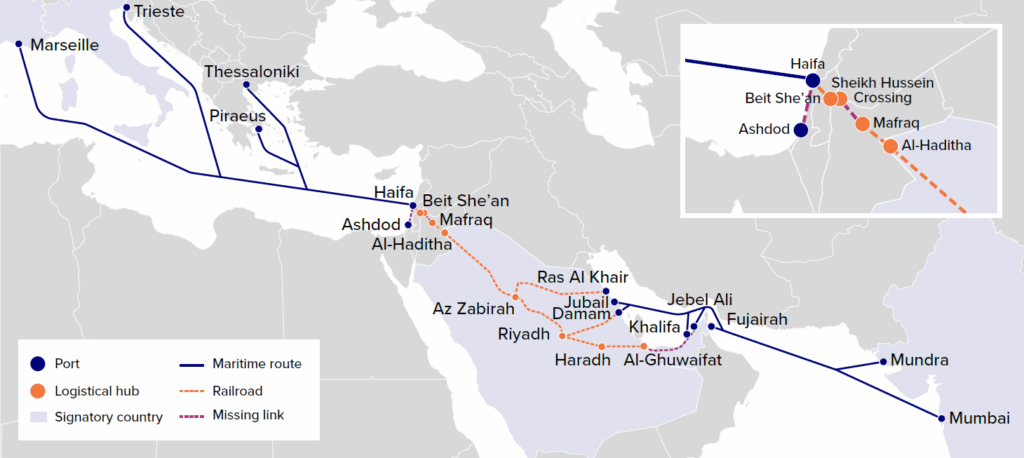
However, the IMEC project faces headwinds. The outbreak of war in Gaza in late 2023 dulled regional enthusiasm and put Saudi–Israeli normalization talks on hold, casting doubt over Israel’s political reliability as a partner. Meanwhile, regional actors started to diversify their options.
Saudi Arabia’s strategic hedging
The Moses Bridge reflects Saudi Arabia’s broader hedging strategy. Riyadh is investing in multiple corridors: east to India, west to Africa, and north through Iraq, and Syria to Turkey. All these routes sidestep Israel. While the IMEC plan placed Israel at the center, the Moses Bridge allows Saudi Arabia to connect to Europe independently, through Egypt’s Mediterranean gateway, offering a depoliticized alternative that avoids the risks of entanglement in the Israeli-Palestinian conflict.
Saudi officials have been clear on this front. In October 2024, Saudi Foreign Minister Prince Faisal bin Farhan reiterated that normalization with Israel is “off the table” until there is a “resolution to Palestinian statehood.” Moreover, recent polling indicates that 81 percent of Saudis oppose normalization with Israel, a figure that reflects deep public resistance to engagement with Israel absent meaningful progress on Palestinian rights. With tensions high and public opinion hostile, the kingdom is unlikely to embrace infrastructure projects tied to Israel in the near term.
Egypt’s expanding role
Egypt, for its part, sees this as a way to reinforce its own logistics ecosystem, ensuring that freight coming over the Moses Bridge can move efficiently to ports such as Port Said or Damietta. The bridge integrates with Egypt’s national transportation and logistics strategy, which includes investments in new east–west rail lines, port upgrades on the Mediterranean, and logistics zones in the Sinai Peninsula. It could also help boost tourism in Sharm el-Sheikh, a hub in the Sinai Peninsula.
Cairo is also eager to reduce its reliance on the Suez Canal, whose revenues have dropped by nearly 50 percent amid Red Sea tensions, by expanding overland trade routes. If successful, this infrastructure could help Egypt reposition itself as a land bridge between Africa, the Gulf, and Europe; again, bypassing Israel.
Beyond the Moses Bridge, two additional overland routes have been discussed: the gradual reopening of Syria, which could reconnect Gulf states to Turkey via Saudi Arabia or Jordan, and Iraq’s proposed “Development Road,” linking the al Faw Grand Port to Turkey. Both offer theoretical alternatives, though each faces significant financial, political, and security hurdles.
Geopolitical implications for Israel
Taken together, these developments suggest several overland alternatives that could reduce the strategic necessity of Israel as a transit center. The Moses Bridge is more than a physical connection, it is a strategic message. Saudi Arabia and Egypt are building the infrastructure of a post-conflict Middle East that might no longer depend on Israel. For the United States, this shift can erode one of its potential key channels of influence in the region. As other regional actors, including: Syria, Iraq, and Turkey rejoin the economic conversation, and Arab partners appear indifferent to explore other routes, Israel must act to reinstate its geopolitical advantage.
Recent diplomatic signals reinforce this shift. During his May 2025 Gulf tour, US President Donald Trump visited Riyadh, Doha, and Abu Dhabi, but conspicuously skipped Israel. In remarks delivered in Riyadh, he proposed new economic incentives to Saudi Arabia without linking them to normalization with Israel, a striking departure from past US policy that underscores shifting regional priorities. The message was clear: The Middle East’s road to Washington no longer necessarily runs through Jerusalem.
Strategic pathways forward
How should Washington respond to these developments? To begin with, the United States should assume a more proactive leadership role in advancing IMEC and coordinating with parallel initiatives. This includes fostering multilateral working groups among Israel, Egypt, India, Jordan, and Gulf states; encouraging interoperability between infrastructure projects; and providing political cover and technical support to accelerate implementation. A consistent US presence is essential to prevent fragmentation and ensure that economic corridors deliver on their strategic promise.
In parallel, the United States should elevate IMEC as a strategic priority. The corridor anchors Washington’s influence in the infrastructure domain, counterbalancing the influence of rival powers while reinforcing ties between its allies in the region. To achieve this, it could embed IMEC into national economic and foreign policy frameworks through interagency coordination, perhaps by appointing a dedicated envoy or task force. It could also take steps to integrate corridor diplomacy into the operational workflows of the State Department, National Security Council, and Department of Commerce. Such measures could help ensure continuity across administrations, demonstrate long-term US commitment to regional partners, and allow Washington to better align connectivity infrastructure with its broader geopolitical interests.
More broadly, both the United States and Israel should advocate for a depoliticized framing of IMEC—one that emphasizes mutual economic and logistic benefits rather than symbolic normalization. Quiet diplomacy that underscores shared interests in connectivity, climate adaptation, food security, and digital infrastructure may create space for engagement with Arab and Muslim states still cautious about ties with Israel.
Israel, for its part, must respond not with alarm, but with action. Rebuilding trust with Saudi Arabia should be a top priority. The cease-fire agreement in Gaza offers a window to re-engage regional partners: sustained de-escalation, paired with meaningful steps toward a sustainable and hopeful future for Palestinians, could help revitalize stalled dialogue and restore confidence among Arab states.
Finally, Israel should invest in its own logistical infrastructure, especially in digitization and artificial intelligence–powered logistics. Doing so will enhance its attractiveness and make participation in IMEC and future corridors more compelling.
If approached pragmatically and in close coordination with Washington, Israel can still position itself as a valuable partner; not just within IMEC, but in an emerging web of regional corridors. The window is open, but not forever.
Amit Yarom is a graduate student at the Elliott School of International Affairs at George Washington University. He is a foreign policy researcher, specializing in the Arabian Gulf.
source : atlanticcouncil
Featured Post
 বড় জাহাজ মেরামতে মাতারবাড়ীতে ১ বিলিয়ন ডলারের প্রকল্প
 মাতারবাড়ীতে প্রায় ১ বিলিয়ন মার্কিন ডলার ব্যয়ে পরিবেশবান্ধব ডকইয়ার্ড ও জাহাজ নির্মাণ কেন্দ্র স্থাপনের উদ্যোগে নীতিগত অনুমোদন দিয়েছে নৌপরিবহন মন্ত্রণালয়। এখন প্রকল্পটির কারিগরি ও আর্থিক মূল্যায়নের জন্য প্রস্তাবটি সরকারি-বেসরকারি অংশীদারত্ব (পিপিপি) কর্তৃপক্ষের কাছে পাঠানো হয়েছে। সম্পূর্ণ বেসরকারি অর্থায়নে সরকারি জমির মালিকানা অক্ষুণ্ন রেখে প্রকল্পটি বাস্তবায়নের পরিকল্পনা রয়েছে। বন্দর কর্তৃপক্ষ জানায়, […]
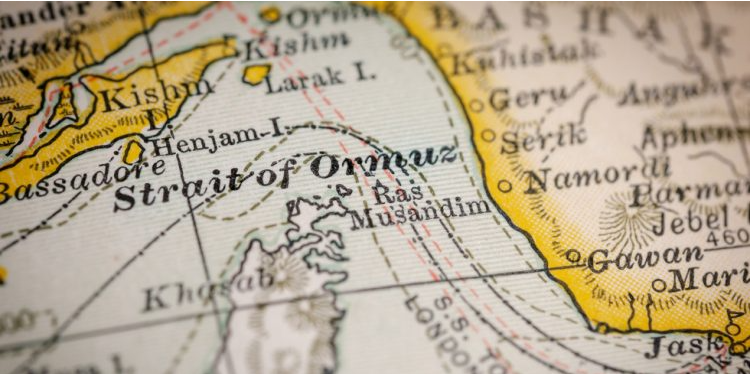 Industry on alert over scam messages offering ships “safe passage” on Hormuz
 Credit: Shutterstock Fraudulent messages offering safe passage through the Strait of Hormuz in exchange for cryptocurrency have been circulated to shipping companies with vessels stranded west of the waterway, according to MARISKS. In an alert issued on 20 April, MARISKS cautioned that unknown actors posing as Iranian authorities had contacted […]



JOB SITES
CONTENTS
LINKS
Happy New Year

Découvrez les avantages de MadCasino
Dans le monde des casinos en ligne, MadCasino se distingue par ses offres attrayantes et ses services de qualité. Que vous soyez un joueur débutant ou un parieur aguerri, vous trouverez ici une variété de jeux qui sauront satisfaire toutes vos envies. Les machines à sous, les jeux de table et les options de paris en direct sont tous disponibles pour vous offrir une expérience de jeu inégalée. De plus, le casino propose régulièrement des bonus qui permettent d'augmenter vos chances de gagner, vous offrant ainsi une excellente opportunité de maximiser vos gains.
En matière de sécurité, MadCasino est un nom de confiance. Il est entièrement licencié et régulé, ce qui garantit un environnement de jeu sûr et équitable. Les joueurs peuvent se concentrer sur leur expérience de jeu sans se soucier des problèmes de sécurité. Les transactions financières sont également sécurisées grâce à des technologies de pointe.
Les jeux proposés par MadCasino sont issus des développeurs les plus réputés de l'industrie, vous assurant des graphismes époustouflants et des mécaniques de jeu innovantes. Les joueurs peuvent également profiter d'une expérience de jeu en direct qui simule l'atmosphère d'un casino terrestre, tout en restant dans le confort de leur maison.
Enfin, la plateforme de MadCasino est optimisée pour les appareils mobiles, permettant aux joueurs de parier à tout moment et de n'importe où. Que vous soyez sur votre smartphone ou votre tablette, l'accès à vos jeux préférés n'a jamais été aussi simple. Ne manquez pas l'opportunité de découvrir ce casino exceptionnel.
Les offres de Cresus Casino
Cresus Casino est un autre acteur majeur dans le domaine des jeux en ligne, offrant des promotions généreuses et une vaste sélection de jeux. Les joueurs peuvent profiter d'une expérience de jeu enrichissante grâce aux nombreux bonus disponibles, qui sont conçus pour attirer tant les nouveaux utilisateurs que les joueurs réguliers. Ces avantages permettent non seulement de prolonger votre temps de jeu, mais aussi d'augmenter vos chances de gains conséquents.
Le casino se distingue également par sa ludothèque impressionnante, comprenant une sélection variée de machines à sous, de jeux de table et de jeux en direct. Les clients peuvent choisir parmi des titres populaires et appréciés, ainsi que des nouveautés qui enrichissent constamment l'offre. L'interface utilisateur est conviviale, rendant la navigation sur la plateforme fluide et agréable.
En termes de sécurité, Cresus Casino assure à ses joueurs un environnement de jeu fiable. La plateforme utilise des protocoles de sécurité avancés pour protéger les données personnelles et financières des utilisateurs. Cela permet aux joueurs de se sentir en sécurité tout en jouant à leurs jeux préférés.
Avec un service client réactif et professionnel, Cresus Casino s'assure que toutes vos questions et préoccupations sont traitées rapidement. Que ce soit pour des questions concernant les bonus, les retraits ou les jeux, vous bénéficierez d'une assistance rapide et efficace.
Explorez Nine Casino et ses avantages
Dans l'univers des casinos en ligne, Nine Casino a su se faire une place de choix grâce à son approche innovante et à ses nombreux avantages pour les joueurs. Les utilisateurs peuvent s'attendre à une expérience de jeu enrichissante, avec des bonus attractifs qui sont régulièrement mis à jour. Ces offres sont une excellente façon de découvrir de nouveaux jeux tout en maximisant votre potentiel de gain.
La plateforme de Nine Casino est riche en options de jeux, allant des machines à sous aux jeux de table, en passant par le live casino. Chaque jeu est conçu pour offrir une expérience immersive grâce à des graphismes de haute qualité et des fonctionnalités innovantes. Les parieurs peuvent profiter de sessions de jeu captivantes, comme s'ils étaient dans un véritable casino.
La sécurité est une priorité pour Nine Casino, qui utilise des technologies de cryptage avancées pour protéger les informations de ses joueurs. Cela garantit un environnement de jeu sûr et fiable, permettant aux utilisateurs de se concentrer sur ce qu'ils aiment le plus : jouer.
Enfin, le service clientèle fourni par Nine Casino est exceptionnel, avec des agents disponibles pour répondre à toutes vos questions et résoudre vos problèmes. Vous pourrez ainsi jouer en toute tranquillité, sachant que votre satisfaction est au cœur de leurs préoccupations.
Profitez de l'expérience Lucky31
Lucky31 est un casino en ligne qui se distingue par son approche orientée vers le joueur, offrant une multitude d'options de jeux et des bonus généreux. Que vous soyez amateur de machines à sous ou passionné de jeux de table, vous trouverez une large sélection pour satisfaire toutes vos envies de jeu. Les promotions fréquentes permettent aux joueurs de prolonger leur expérience tout en augmentant leurs chances de gains.
La convivialité de la plateforme de Lucky31 est l'un de ses plus grands atouts. Les joueurs peuvent naviguer facilement entre les différents jeux, et l'interface est conçue pour être intuitive, quel que soit le niveau d'expérience de l'utilisateur. De plus, le casino est entièrement optimisé pour les appareils mobiles, ce qui permet de parier où que vous soyez.
En matière de sécurité, Lucky31 prend les préoccupations des joueurs très au sérieux. Le casino est agréé et régulé, garantissant un environnement de jeu équitable et sécurisé. Les joueurs peuvent ainsi se concentrer sur leur expérience de jeu sans se soucier des risques liés à la sécurité.
Pour ceux qui recherchent un support client efficace, Lucky31 offre un service réactif et professionnel. Que ce soit pour des questions sur les bonus, les jeux ou les paiements, vous aurez accès à une assistance de qualité, vous garantissant une expérience de jeu fluide et agréable.