
search the site


The Ship-Breakers
By Peter Gwin
In Bangladesh men desperate for work perform one of the world’s most dangerous jobs.
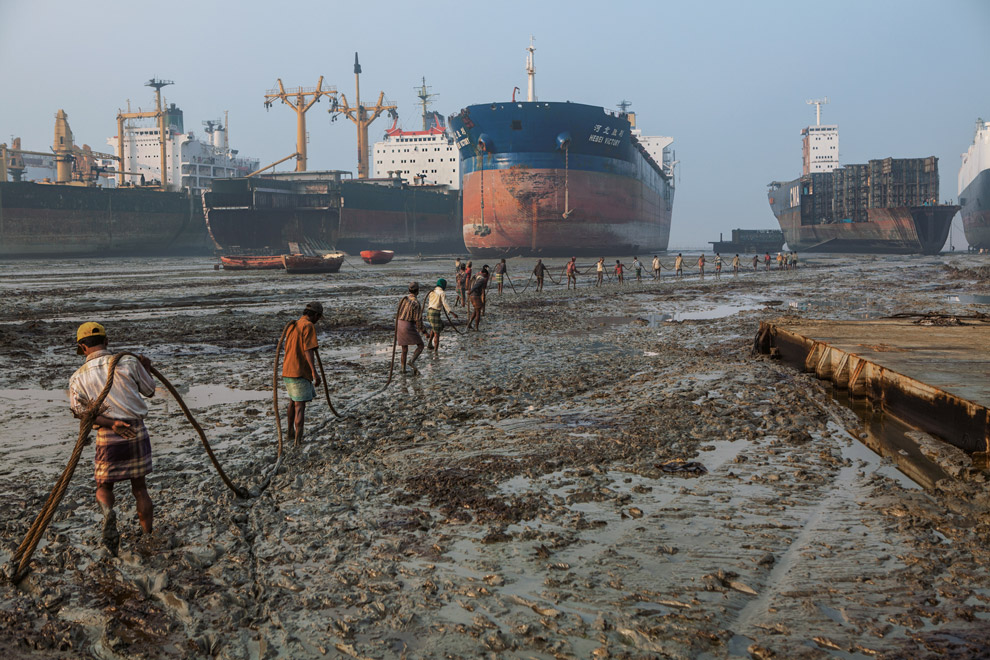
Photograph by Mike Hettwer
I had been warned that it would be difficult to get into Bangladesh’s shipbreaking yards. “It used to be a tourist attraction,” a local man told me. “People would come watch men tear apart ships with their bare hands. But they don’t let in outsiders anymore.” I walked a few miles along the road that parallels the Bay of Bengal, just north of the city of Chittagong, where 80 active shipbreaking yards line an eight-mile stretch of the coast. Each yard was secured behind high fences topped with razor wire. Guards were posted, and signs warned against photography. Outsiders had become especially unwelcome in recent years after an explosion killed several workers, prompting critics to say the owners put profits above safety. “But they can’t block the sea,” the local said.
So late one afternoon I hired a fisherman to take me on a water tour of the yards. At high tide the sea engulfed the rows of beached oil tankers and containerships, and we slipped in and out of the deep shadows cast by their towering smokestacks and superstructures. Some vessels remained intact, as if they had just arrived. Others had been reduced to skeletons, the steel skin cut away to reveal their cavernous black holds.
We drifted alongside barnacle-encrusted hulls and beneath the blades of massive propellers. I read off names and flags painted on the sterns: Front Breaker (Comoros), V Europe (Marshall Islands), Glory B (Panama). I wondered about cargoes they had carried, ports where they had called, and crews that had sailed them.
The life span of such ships is roughly 25 to 30 years, so most of these likely had been launched during the 1980s. But the rising cost to insure and maintain aging vessels makes them unprofitable to operate. Now their value was contained mostly in their steel bodies.
Nearly all the demolition crews had left work for the day, and the ships stood silent, except for the gurgling in their bowels and the occasional echo of metal clanking. The air hung heavy with the odor of brine and diesel fuel. Making our way around one hull, we heard laughter and came upon a group of naked boys who had swum out to a half-submerged piece of wreckage and were using it as a diving platform. Just beyond the line of ships, fishermen were casting their nets for schools of tiny ricefish, a local delicacy.
Suddenly a shower of sparks rained down from the stern several stories above us. A head appeared over the side, then arms waving vigorously. “Move away! We’re cutting this section,” a man yelled down at us. “Do you want to die?”
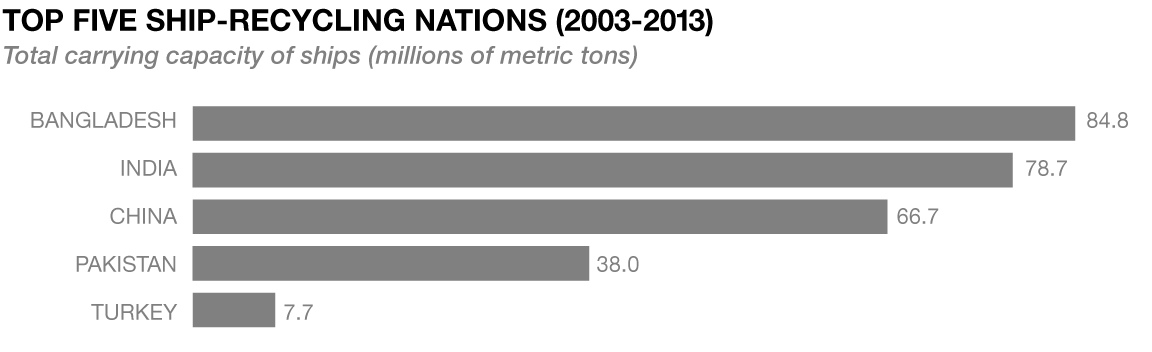
Over the past decade India recycled more ships, but Bangladesh led in deadweight tonnage, meaning the biggest vessels generally ended up on its beaches. China and Turkey enforce more safety measures than the others and take steps to reduce the environmental impact.
Oceangoing vessels are not meant to be taken apart. They’re designed to withstand extreme forces in some of the planet’s most difficult environments, and they’re often constructed with toxic materials, such as asbestos and lead. When ships are scrapped in the developed world, the process is more strictly regulated and expensive, so the bulk of the world’s shipbreaking is done in Bangladesh, India, and Pakistan, where labor is cheap and oversight is minimal.
Industry reforms have come in fits and starts. India now requires more protections for workers and the environment. But in Bangladesh, where 194 ships were dismantled in 2013, the industry remains extremely dirty and dangerous.
It also remains highly lucrative. Activists in Chittagong told me that in three to four months the average ship in Bangladeshi yards returns roughly a one-million-dollar profit on an investment of five million, compared with less than $200,000 profit in Pakistan. I called Jafar Alam, former head of the Bangladesh Ship Breakers Association. He denied that profit margins were that high. “It varies by ship and depends on many factors, such as the current price of steel,” he said.
Whatever the actual profits, they are realized by doggedly recycling more than 90 percent of each ship. The process begins after a ship-breaker acquires a vessel from an international broker who deals in outdated ships. A captain who specializes in beaching large craft is hired to deliver it to the breaker’s yard, generally a sliver of beach barely a hundred yards wide.
Once the ship is mired in the mud, its liquids are siphoned out, including any remaining diesel fuel, engine oil, and firefighting chemicals, which are resold. Then the machinery and fittings are stripped. Everything is removed and sold to salvage dealers—from enormous engines, batteries, generators, and miles of copper wiring to the crew bunks, portholes, lifeboats, and electronic dials on the bridge.
After the ship has been reduced to a steel hulk, swarms of laborers from the poorest parts of Bangladesh use acetylene torches to slice the carcass into pieces. These are hauled off the beach by teams of loaders, then melted down and rolled into rebar for use in construction.
“It sounds like a good business until you consider the poison that is soaking into our land,” says Muhammed Ali Shahin, an activist with the NGO Shipbreaking Platform. “Until you’ve met the widows of young men who were crushed by falling pieces of steel or suffocated inside a ship.” At 37 Shahin has been working for more than 11 years to raise awareness about the plight of the men who toil in these yards. The industry, he says, is controlled by a few powerful Chittagong families who also hold stakes in the ancillary businesses, including the steel rerolling mills.
Shahin insists he’s not blind to his country’s desperate need for the jobs shipbreaking creates. “I do not say shipbreaking must stop entirely,” he says. “But it must be done cleaner and safer with better treatment for the workers.”
His criticism isn’t reserved just for Bangladeshi ship-breakers. “In the West you don’t let people pollute your countries by breaking up ships on your beaches. Why is it OK for poor workers to risk their lives to dispose of your unwanted ships here?”
In the sprawling shantytowns that have grown up around the yards, I met dozens of the workers about whom Shahin is most concerned: the men who cut the steel and haul it off the beaches. Many had deep, jagged scars. “Chittagong tattoos,” one man called them. Some men were missing fingers. A few were blind in one eye.
In one home I meet a family whose four sons worked in the yards. The oldest, Mahabub, 40, spent two weeks as a cutter’s helper before witnessing a man burn to death when his torch sparked a pocket of gas belowdecks. “I didn’t even collect my pay for fear they wouldn’t let me leave,” he says, explaining that bosses often intimidate workers to keep silent about accidents.
He points to a photo in a small glass cabinet. “This is Jahangir, my second oldest brother,” Mahabub says. Jahangir went to work at 15, after their father died. “He was a cutter in the Ziri Subedar yard and was fatally injured there in 2008.” He and his fellow workers had been cutting a large section for three days, but it wouldn’t fall. During a rainstorm they took shelter beneath the piece, and it suddenly gave way.
The third brother, Alamgir, 22, is not home. He had been assisting a cutter when he fell through a hatch on a tanker, plunging about 90 feet into the hold. Miraculously, enough water had seeped into the bottom to break his fall. One of his friends risked his own life to shinny down a rope and pull him out. Alamgir quit the next day. Now he serves tea to the managers in the yard’s office.
The youngest brother, Amir, 18, still works as a cutter’s helper. He is a wiry boy with smooth, unscarred skin and a nervous smile. I ask if he’s scared by his brothers’ experiences. “Yes,” he says, smiling shyly as if unsure what to say next. As we talk, a thunderclap shakes the tin roof. Another boom follows. I look outside, expecting to see the onset of one of Bangladesh’s famously violent monsoons, but the sun is shining. “It’s a large piece falling from a ship,” says the boy. “We hear this every day.”
http://www.dailymail.co.uk/news/article-2610478/The-wages-fear-The-harrowing-plight-ship-breakers-Bangladesh-one-dangerous-jobs-world.html
Source: Daily Mail
Featured Post
 Industry on alert over scam messages offering ships “safe passage” on Hormuz
 Credit: Shutterstock Fraudulent messages offering safe passage through the Strait of Hormuz in exchange for cryptocurrency have been circulated to shipping companies with vessels stranded west of the waterway, according to MARISKS. In an alert issued on 20 April, MARISKS cautioned that unknown actors posing as Iranian authorities had contacted […]
 The ‘Cadet Gridlock’ in Bangladesh’s Maritime Sector: A Sorrowful Story of Wasted Potential
 The ‘Cadet Gridlock’ in Bangladesh’s Maritime Sector: A Sorrowful Story of Wasted Potential By Minar Rashid 21E On 15 November, the BMCS Gala Night 2025 was held at Singapore’s Orchid Country Club. With the vibrant participation of hundreds of Bangladeshi mariners and their families, the event became a remarkable reunion […]



JOB SITES
CONTENTS
LINKS
Happy New Year

Découvrez les avantages de MadCasino
Dans le monde des casinos en ligne, MadCasino se distingue par ses offres attrayantes et ses services de qualité. Que vous soyez un joueur débutant ou un parieur aguerri, vous trouverez ici une variété de jeux qui sauront satisfaire toutes vos envies. Les machines à sous, les jeux de table et les options de paris en direct sont tous disponibles pour vous offrir une expérience de jeu inégalée. De plus, le casino propose régulièrement des bonus qui permettent d'augmenter vos chances de gagner, vous offrant ainsi une excellente opportunité de maximiser vos gains.
En matière de sécurité, MadCasino est un nom de confiance. Il est entièrement licencié et régulé, ce qui garantit un environnement de jeu sûr et équitable. Les joueurs peuvent se concentrer sur leur expérience de jeu sans se soucier des problèmes de sécurité. Les transactions financières sont également sécurisées grâce à des technologies de pointe.
Les jeux proposés par MadCasino sont issus des développeurs les plus réputés de l'industrie, vous assurant des graphismes époustouflants et des mécaniques de jeu innovantes. Les joueurs peuvent également profiter d'une expérience de jeu en direct qui simule l'atmosphère d'un casino terrestre, tout en restant dans le confort de leur maison.
Enfin, la plateforme de MadCasino est optimisée pour les appareils mobiles, permettant aux joueurs de parier à tout moment et de n'importe où. Que vous soyez sur votre smartphone ou votre tablette, l'accès à vos jeux préférés n'a jamais été aussi simple. Ne manquez pas l'opportunité de découvrir ce casino exceptionnel.
Les offres de Cresus Casino
Cresus Casino est un autre acteur majeur dans le domaine des jeux en ligne, offrant des promotions généreuses et une vaste sélection de jeux. Les joueurs peuvent profiter d'une expérience de jeu enrichissante grâce aux nombreux bonus disponibles, qui sont conçus pour attirer tant les nouveaux utilisateurs que les joueurs réguliers. Ces avantages permettent non seulement de prolonger votre temps de jeu, mais aussi d'augmenter vos chances de gains conséquents.
Le casino se distingue également par sa ludothèque impressionnante, comprenant une sélection variée de machines à sous, de jeux de table et de jeux en direct. Les clients peuvent choisir parmi des titres populaires et appréciés, ainsi que des nouveautés qui enrichissent constamment l'offre. L'interface utilisateur est conviviale, rendant la navigation sur la plateforme fluide et agréable.
En termes de sécurité, Cresus Casino assure à ses joueurs un environnement de jeu fiable. La plateforme utilise des protocoles de sécurité avancés pour protéger les données personnelles et financières des utilisateurs. Cela permet aux joueurs de se sentir en sécurité tout en jouant à leurs jeux préférés.
Avec un service client réactif et professionnel, Cresus Casino s'assure que toutes vos questions et préoccupations sont traitées rapidement. Que ce soit pour des questions concernant les bonus, les retraits ou les jeux, vous bénéficierez d'une assistance rapide et efficace.
Explorez Nine Casino et ses avantages
Dans l'univers des casinos en ligne, Nine Casino a su se faire une place de choix grâce à son approche innovante et à ses nombreux avantages pour les joueurs. Les utilisateurs peuvent s'attendre à une expérience de jeu enrichissante, avec des bonus attractifs qui sont régulièrement mis à jour. Ces offres sont une excellente façon de découvrir de nouveaux jeux tout en maximisant votre potentiel de gain.
La plateforme de Nine Casino est riche en options de jeux, allant des machines à sous aux jeux de table, en passant par le live casino. Chaque jeu est conçu pour offrir une expérience immersive grâce à des graphismes de haute qualité et des fonctionnalités innovantes. Les parieurs peuvent profiter de sessions de jeu captivantes, comme s'ils étaient dans un véritable casino.
La sécurité est une priorité pour Nine Casino, qui utilise des technologies de cryptage avancées pour protéger les informations de ses joueurs. Cela garantit un environnement de jeu sûr et fiable, permettant aux utilisateurs de se concentrer sur ce qu'ils aiment le plus : jouer.
Enfin, le service clientèle fourni par Nine Casino est exceptionnel, avec des agents disponibles pour répondre à toutes vos questions et résoudre vos problèmes. Vous pourrez ainsi jouer en toute tranquillité, sachant que votre satisfaction est au cœur de leurs préoccupations.
Profitez de l'expérience Lucky31
Lucky31 est un casino en ligne qui se distingue par son approche orientée vers le joueur, offrant une multitude d'options de jeux et des bonus généreux. Que vous soyez amateur de machines à sous ou passionné de jeux de table, vous trouverez une large sélection pour satisfaire toutes vos envies de jeu. Les promotions fréquentes permettent aux joueurs de prolonger leur expérience tout en augmentant leurs chances de gains.
La convivialité de la plateforme de Lucky31 est l'un de ses plus grands atouts. Les joueurs peuvent naviguer facilement entre les différents jeux, et l'interface est conçue pour être intuitive, quel que soit le niveau d'expérience de l'utilisateur. De plus, le casino est entièrement optimisé pour les appareils mobiles, ce qui permet de parier où que vous soyez.
En matière de sécurité, Lucky31 prend les préoccupations des joueurs très au sérieux. Le casino est agréé et régulé, garantissant un environnement de jeu équitable et sécurisé. Les joueurs peuvent ainsi se concentrer sur leur expérience de jeu sans se soucier des risques liés à la sécurité.
Pour ceux qui recherchent un support client efficace, Lucky31 offre un service réactif et professionnel. Que ce soit pour des questions sur les bonus, les jeux ou les paiements, vous aurez accès à une assistance de qualité, vous garantissant une expérience de jeu fluide et agréable.