search the site


102 Years Ago: The Mystery Surrounding the Titanic
By Nikeel Idnani
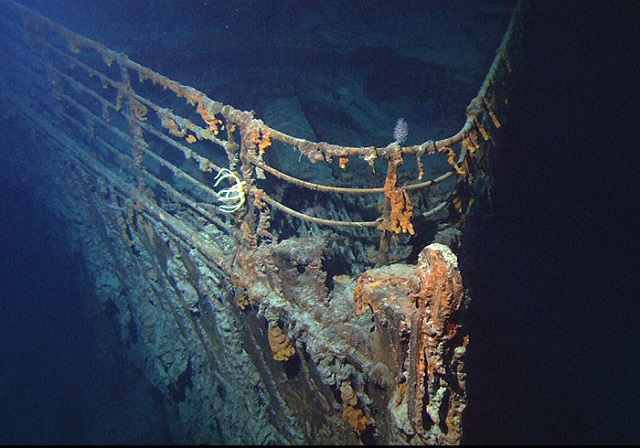
The bow of the wrecked RMS Titanic, photographed in June 2004
Perhaps the greatest maritime disaster ever occurred on April 14/15, 1912, when 1,513 people met their watery grave aboard the White Star Line’s pride, the RMS Titanic, about 95 miles south of the Grand Banks of Newfoundland after it struck an iceberg.
Questions remain even to this day:
How could an iceberg cause such catastrophic damage to an “unsinkable” steel ship?
How did this fiasco occur in calm seas and clear weather?
Why was there uninhibited flooding despite all watertight doors being closed remotely from the bridge?
Why was there no response to any of the distress signals being transmitted for almost two hours?
Was safety of life at sea not a prime consideration of the shipbuilders/naval architects?
How It Happened
Aesthetically, the $7.5 million RMS Titanic was the epitome of self-indulgence. The passenger list included a “who’s who” of the era, and the famous four-funneled, 46,328 GRT, “Millionaire’s Special” – at that time the largest and most luxurious vessel afloat – had a double-bottom hull. To guarantee safety, 15 transverse bulkheads divided her from bow to stern into 16 “almost” watertight compartments. Since four of these could be flooded without endangering the liner’s buoyancy, she was considered unsinkable.
Titanic leaving Belfast for her sea trials on 2 April 1912

Shortly before midnight on April 14, while steaming at 21.5 knots, adjudged at the time to be too fast for existing conditions, the ship collided with an iceberg that apparently ripped a 300-foot gash along the vessel’s starboard bow. While some passengers and crew recounted an understated “faint grinding jar,” six watertight compartments were in fact breached, which caused the ship to founder at 0220 hours, April 15. The ship was designed to allow for four forward compartments to be flooded without the risk of sinking. When six forward compartments flooded, the ship trimmed excessively, causing water to overflow into the abaft compartments as the separating bulkheads were not watertight up to the uppermost continuous deck.
The greatest problem in navigating the Grand Banks region, which is on the Great Circle route from Europe to North America, is limited visibility due to low-lying fog. This is most persistent during the worst ice-threat period of April, May and June. As the number of ships plying the route increased, the recurrence of pack ice and iceberg collisions became less of a menace than the peril of collision between ships bound in opposite directions at night or during poor visibility.
After an accident involving a French and an American ship on Sept 27, 1854, which claimed 300 lives, separate eastbound & westbound lanes across the North Atlantic Ocean were designated. Furthermore, modifications of advisable shipping routes were established in 1898 due to the continued occurrence of pack ice and iceberg collisions. Unfortunately, icebergs wandered astray of anticipated limits and, although navigation passages were well-instituted and conformed to by major shipping companies, collisions still occurred.
After perhaps 3,000 years of snow accumulation and creep across the Greenland terrain, an iceberg broke off the west Greenland coast and drifted for perhaps two years, until April 1912, in the Labrador Current, carried at one to two knots towards the North Atlantic maritime routes. This iceberg had a ram (underwater projection), as most bergs do by the time they enter the warmer waters near the Gulf Stream. Due to the force of wind and current, this drift ice was driven into the path of the Titanic on April 14, 1912, and they collided at latitude 41°46’N and longitude 50°14’W.
The ship’s owners had apparently urged Capt. Edward John Smith to make a speedy Trans-Atlantic voyage so as to arrive in New York City before the expected date, thus gaining publicity and admiration from the passengers. While other vessels on similar routes altered course and reduced speed, the Titanic’s triple expansion engines continued to run the three propellers at full service speed despite receiving six iceberg warnings.
Few on board gave much heed to iceberg warnings as they were under the misconception that the ship was unsinkable. Everyone was oblivious to the impending doom.
Two hours before impact, the wireless operator received a warning of heavy pack ice from the ship Mesaba. Rather than report it to the Second Officer on bridge, the “sparky” negligently placed the message on his spike that fateful night. This ice field was lying directly in Titanic’s path.
The sea was smooth as glass with the stars being clearly reflected in the water under a moonless sky. Had the sea been rougher, the waves breaking against the iceberg would have made it more noticeable. Even the lookouts, 29 meters above sea level in the crow’s nest, were unable to spot floating objects in the exceptionally calm water in the dark night.
The iceberg was sighted about a quarter mile from the ship by probably not very vigilant lookouts, who might have been battling to keep themselves warm in the near-freezing ambient temperature. This was insufficient distance for the 883-foot vessel to take precautionary maneuvers. A mere 37 seconds elapsed from the time of warning to the moment of impact, inadequate for the steam-powered steering gear to effect rudder “hard over” with the ship running ahead at maximum service speed. While it is inconclusive when exactly the engines had been reversed, the rudder effectiveness would have been hampered by the interruption in the flow of water passing the rudder and by the reduction in the force of water coming off the center propeller.
The iceberg thought to have been hit by Titanic, photographed on the morning of 15 April 1912.

Edward Wilding, a naval architect, studied sonar reports taken through the sand sea bed and concluded that, contrary to the popular perception of a massive 300-foot gash, the iceberg actually caused a series of small holes, approximately 12 square feet in total surface area. The unequal flooding of the compartments was primarily responsible for the catastrophe. Within 20 minutes of the crash some 8,000 tons of sea water entered the ship. This increased to 25,000 tons 40 minutes later.
The “Achilles Heel”
Gibbs & Cox, a naval architecture firm based in Arlington, Virginia, was intrigued as to why the ship broke in two. They developed a computer model that illustrated stress distribution in various conditions. In a simulated flood case, stress concentrations of up to 35,000 psi were estimated in strategic locations, about 1.5 times the maximum force the hull could endure. These magnified stresses buckled plates and popped rivets, eventually overwhelming the liner.
Due to access difficulties while using a pneumatic riveting machine to construct the curved sections of the hull, the steel plates were sealed using wrought iron rivets rather than the stronger steel rivets. The iron rivets were easier to hammer into place. However, this proved to be Titanic’s “Achilles heel” as the iron rivets succumbed with a mere five millimeters of relative movement between the steel plates, which the rivets were meant to secure.
A riveted joint is not as strong as an equivalent welded joint, leading to a weaker ship. Titanic’s hull was comprised of about 2,000 plates, each one-inch thick, secured by some three million rivets. If cracks occurred due to the inherent weakness of the vessel, i.e., if the bending moment created unduly high stresses, the crack would spread through the plates whether they were riveted, welded or a combination of each.
Inquires held in the U.S. and Great Britain alleged that the Leyland Line steamship Californian, which was less than 20 nautical miles away, could have aided the stricken vessel had the radio operator been on duty. The rocket parachute flares fired reportedly paled against the dazzling starlight.
Lessons Learned
The tragedy resulted in the establishment of the International Ice Patrol in 1913 to patrol and guard by ship, plane or other feasible means the eastern, southern and western limits of drifting Arctic ice during the most dangerous part of the year. Ships are warned twice daily by detailed messages broadcast to all North Atlantic shipping concerning the boundaries of ice and positions of threatening icebergs. The U.S. Coast Guard has operated the ice patrol since its inception.
Safety philosophy changed forever. Present-day regulations demand sufficient lifeboat accommodation on a passenger liner for the total number of persons the vessel is certified to carry. In ships likely to encounter icebergs, the shell plating in the region of the waterline forward is increased in thickness for ice navigation strengthening. While the exact reasons for what happened continue to perplex us, it must be borne in mind that despite prevalent state-of-the-art technology, an unsinkable ship is a mere hypothesis.
It beggars belief that in January 2012, a century after Titanic, an ultra-modern seven-year-old luxury cruise ship, outfitted with the latest technology including double-redundancy navigation safety equipment, ran aground near the coast of Tuscany and capsized with the loss of some 32 lives. In that case, human error, which is said to account for 80 percent of all marine accidents, was the probable cause of the mishap.
Likewise, last year an 8,110-TEU containership suffered a fracture amidships. The fore and aft sections broke asunder and subsequently plunged into the abyss of the Indian Ocean. While the investigation is still underway, it is likely that, as with the Titanic, a combination of reasons, viz., structural weakness, unusual weather load and heavier container weight distribution, might be plausible causes that contributed toward the dramatic loss of the five-year-old hull. This 302-meter ship was the first in a six-ship series that was built at a leading shipyard to new lightweight design using 47kgf/mm2, high-tensile steel.
In the building of ships, technical innovation runs headlong into commercial pressures to deliver ships within budget and on time to be subsequently contracted on tight schedules. A ship, after all generates revenue only when sailing.
The sinking of the Titanic led directly to the introduction two years later of the International Convention for the Safety of Life at Sea. Shipping is one of the safest means of passenger transport there is. Statistics illustrate that travel by sea has far lower death rates than those for cars, motorcycles or bicycles, and even for pedestrians in Europe.
As we up the ante of technology, what with the rumored 24,000-TEU container ship expected to be put into service around 2018, we must be reminded of the parable about the vanity of human striving, divine punishment for overweening confidence in our technological achievement, and the futility of human effort in a world governed by indifferent nature.
Nonetheless, the number of ships over 100 GT lost in 2013 was 94, a 20 percent reduction from 2012, which contributed to a 45 percent decline in ship losses from 2003 to 2013. Experience has indeed been a very good educator, albeit a costly one. – MarEx
Nikeel Idnani is based in Dubai. He is the Business Development Manager for a major classification society and was formerly Chief Engineer onboard merchant ships plying the North Atlantic.
Source: Maritime-Executive
Featured Post
 বড় জাহাজ মেরামতে মাতারবাড়ীতে ১ বিলিয়ন ডলারের প্রকল্প
 মাতারবাড়ীতে প্রায় ১ বিলিয়ন মার্কিন ডলার ব্যয়ে পরিবেশবান্ধব ডকইয়ার্ড ও জাহাজ নির্মাণ কেন্দ্র স্থাপনের উদ্যোগে নীতিগত অনুমোদন দিয়েছে নৌপরিবহন মন্ত্রণালয়। এখন প্রকল্পটির কারিগরি ও আর্থিক মূল্যায়নের জন্য প্রস্তাবটি সরকারি-বেসরকারি অংশীদারত্ব (পিপিপি) কর্তৃপক্ষের কাছে পাঠানো হয়েছে। সম্পূর্ণ বেসরকারি অর্থায়নে সরকারি জমির মালিকানা অক্ষুণ্ন রেখে প্রকল্পটি বাস্তবায়নের পরিকল্পনা রয়েছে। বন্দর কর্তৃপক্ষ জানায়, […]
 Industry on alert over scam messages offering ships “safe passage” on Hormuz
 Credit: Shutterstock Fraudulent messages offering safe passage through the Strait of Hormuz in exchange for cryptocurrency have been circulated to shipping companies with vessels stranded west of the waterway, according to MARISKS. In an alert issued on 20 April, MARISKS cautioned that unknown actors posing as Iranian authorities had contacted […]



JOB SITES
CONTENTS
LINKS
Happy New Year

Découvrez les avantages de MadCasino
Dans le monde des casinos en ligne, MadCasino se distingue par ses offres attrayantes et ses services de qualité. Que vous soyez un joueur débutant ou un parieur aguerri, vous trouverez ici une variété de jeux qui sauront satisfaire toutes vos envies. Les machines à sous, les jeux de table et les options de paris en direct sont tous disponibles pour vous offrir une expérience de jeu inégalée. De plus, le casino propose régulièrement des bonus qui permettent d'augmenter vos chances de gagner, vous offrant ainsi une excellente opportunité de maximiser vos gains.
En matière de sécurité, MadCasino est un nom de confiance. Il est entièrement licencié et régulé, ce qui garantit un environnement de jeu sûr et équitable. Les joueurs peuvent se concentrer sur leur expérience de jeu sans se soucier des problèmes de sécurité. Les transactions financières sont également sécurisées grâce à des technologies de pointe.
Les jeux proposés par MadCasino sont issus des développeurs les plus réputés de l'industrie, vous assurant des graphismes époustouflants et des mécaniques de jeu innovantes. Les joueurs peuvent également profiter d'une expérience de jeu en direct qui simule l'atmosphère d'un casino terrestre, tout en restant dans le confort de leur maison.
Enfin, la plateforme de MadCasino est optimisée pour les appareils mobiles, permettant aux joueurs de parier à tout moment et de n'importe où. Que vous soyez sur votre smartphone ou votre tablette, l'accès à vos jeux préférés n'a jamais été aussi simple. Ne manquez pas l'opportunité de découvrir ce casino exceptionnel.
Les offres de Cresus Casino
Cresus Casino est un autre acteur majeur dans le domaine des jeux en ligne, offrant des promotions généreuses et une vaste sélection de jeux. Les joueurs peuvent profiter d'une expérience de jeu enrichissante grâce aux nombreux bonus disponibles, qui sont conçus pour attirer tant les nouveaux utilisateurs que les joueurs réguliers. Ces avantages permettent non seulement de prolonger votre temps de jeu, mais aussi d'augmenter vos chances de gains conséquents.
Le casino se distingue également par sa ludothèque impressionnante, comprenant une sélection variée de machines à sous, de jeux de table et de jeux en direct. Les clients peuvent choisir parmi des titres populaires et appréciés, ainsi que des nouveautés qui enrichissent constamment l'offre. L'interface utilisateur est conviviale, rendant la navigation sur la plateforme fluide et agréable.
En termes de sécurité, Cresus Casino assure à ses joueurs un environnement de jeu fiable. La plateforme utilise des protocoles de sécurité avancés pour protéger les données personnelles et financières des utilisateurs. Cela permet aux joueurs de se sentir en sécurité tout en jouant à leurs jeux préférés.
Avec un service client réactif et professionnel, Cresus Casino s'assure que toutes vos questions et préoccupations sont traitées rapidement. Que ce soit pour des questions concernant les bonus, les retraits ou les jeux, vous bénéficierez d'une assistance rapide et efficace.
Explorez Nine Casino et ses avantages
Dans l'univers des casinos en ligne, Nine Casino a su se faire une place de choix grâce à son approche innovante et à ses nombreux avantages pour les joueurs. Les utilisateurs peuvent s'attendre à une expérience de jeu enrichissante, avec des bonus attractifs qui sont régulièrement mis à jour. Ces offres sont une excellente façon de découvrir de nouveaux jeux tout en maximisant votre potentiel de gain.
La plateforme de Nine Casino est riche en options de jeux, allant des machines à sous aux jeux de table, en passant par le live casino. Chaque jeu est conçu pour offrir une expérience immersive grâce à des graphismes de haute qualité et des fonctionnalités innovantes. Les parieurs peuvent profiter de sessions de jeu captivantes, comme s'ils étaient dans un véritable casino.
La sécurité est une priorité pour Nine Casino, qui utilise des technologies de cryptage avancées pour protéger les informations de ses joueurs. Cela garantit un environnement de jeu sûr et fiable, permettant aux utilisateurs de se concentrer sur ce qu'ils aiment le plus : jouer.
Enfin, le service clientèle fourni par Nine Casino est exceptionnel, avec des agents disponibles pour répondre à toutes vos questions et résoudre vos problèmes. Vous pourrez ainsi jouer en toute tranquillité, sachant que votre satisfaction est au cœur de leurs préoccupations.
Profitez de l'expérience Lucky31
Lucky31 est un casino en ligne qui se distingue par son approche orientée vers le joueur, offrant une multitude d'options de jeux et des bonus généreux. Que vous soyez amateur de machines à sous ou passionné de jeux de table, vous trouverez une large sélection pour satisfaire toutes vos envies de jeu. Les promotions fréquentes permettent aux joueurs de prolonger leur expérience tout en augmentant leurs chances de gains.
La convivialité de la plateforme de Lucky31 est l'un de ses plus grands atouts. Les joueurs peuvent naviguer facilement entre les différents jeux, et l'interface est conçue pour être intuitive, quel que soit le niveau d'expérience de l'utilisateur. De plus, le casino est entièrement optimisé pour les appareils mobiles, ce qui permet de parier où que vous soyez.
En matière de sécurité, Lucky31 prend les préoccupations des joueurs très au sérieux. Le casino est agréé et régulé, garantissant un environnement de jeu équitable et sécurisé. Les joueurs peuvent ainsi se concentrer sur leur expérience de jeu sans se soucier des risques liés à la sécurité.
Pour ceux qui recherchent un support client efficace, Lucky31 offre un service réactif et professionnel. Que ce soit pour des questions sur les bonus, les jeux ou les paiements, vous aurez accès à une assistance de qualité, vous garantissant une expérience de jeu fluide et agréable.